


In 1912, the United States Mint created a Proof finish unlike any it had used before.
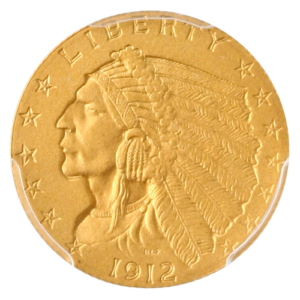
This is one of its finest surviving examples.
The Mint had been experimenting with Proof gold for several years, and traditional mirrored fields didn’t work well with Bela Lyon Pratt’s innovative incuse design, which has the coin’s principal design features recessed below the surface.
So after striking, Mint workers applied a pressurized stream of fine abrasive particles to each Indian Head Quarter Eagle. This created countless microscopic facets across the surface, producing a finely textured, softly reflective finish instead of the mirrored fields of a traditional Proof.
The 1912 issue, however, was even more special. A finer grain was used, which created an especially delicate texture. The result is a proof that displays its design not with a bold reflective boast, but with a shimmer. As you tilt this proof under the light, each beautiful detail is quietly revealed. It’s a finish that rewards a
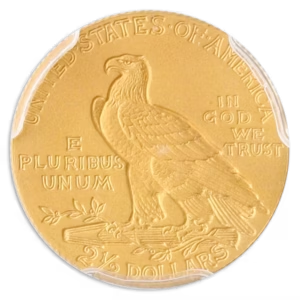
second look, and if you’re one of the few to own this coin, you’ll definitely want to take one.
An Indian Head proof’s preservation matters because its surfaces are unforgiving. Even minor contact or improper handling can disturb its delicate texture and leave an immediately visible mark.
The Philadelphia Mint issued only 197 Proof Indian Head Quarter Eagles in 1912. PCGS estimates that approximately 103 survive in all grades.
This example is PCGS-certified PR67 and CAC-approved. PCGS currently reports only seven grading events at PR67. That places this coin among the finest 1912 Proof Quarter Eagles PCGS has ever certified.
This coin has preserved the Mint’s distinctive 1912 finish at an extraordinary level for more than 110 years. Now, it can become the centerpiece of one exceptional collection.
View this extraordinary 1912 Indian Head Quarter Eagle PCGS PR67 CAC here, or call Blanchard directly at 1-888-782-6405 before another collector claims it.
1912 Historical Events
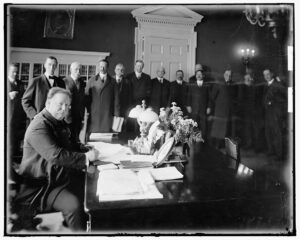
January – New Mexico Joined the U.S.
Spanish explorers came through New Mexico starting in the early 1500s, the region became part of Mexico in 1821, part of America 27 years later, and finally gained statehood in 1912.
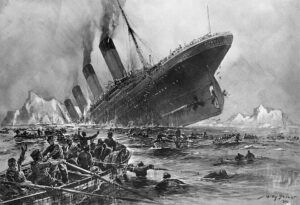
April – The Titanic Sunk
On its maiden voyage, The Titanic sank in “Iceberg Alley,” a notoriously dangerous part of the Atlantic Ocean. One of the highest-profile tragedies of the 20th century, the sinking caused the deaths of about 1,500 people. The wreck wasn’t found until decades later, in 1985.
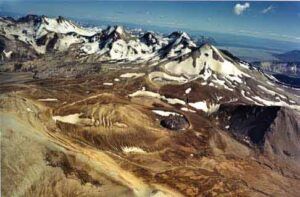
June – The Novarupta Eruption Began
The largest volcanic eruption of the 20th century began when the Novarupta volcano exploded in Alaska. The eruption was so large that 100 miles away, the darkness was so all-consuming that you could barely see a lantern held at arm’s length. 11 days later, the ash cloud reached Algeria. The volume of ash released into the air lowered the temperature in the Northern Hemisphere by 2°F for over a year.
About The Author
