- Gold price kicks off the new week on a softer note as bulls turn cautious amid trade optimism.
- US fiscal concerns and Fed rate cut bets undermine the USD, lending support to the commodity.
- Any further slide could be seen as a buying opportunity amid a bullish fundamental backdrop.
Gold price (XAU/USD) kicks off the new week on a weaker note and erodes a part of Friday’s strong gains to over a two-week high, though the downtick lacks bearish conviction. US President Donald Trump’s decision to delay the implementation of tariffs on the European Union (EU) adds to the recent optimism and undermines demand for the safe-haven precious metal. However, a combination of factors holds back traders from placing aggressive bearish bets around the commodity.
Investors remain on edge in the wake of worries over the worsening US fiscal health and persistent geopolitical risks stemming from the protracted Russia-Ukraine war and conflicts in the Middle East. This is seen as acting as a tailwind for the Gold price. Meanwhile, the growing market acceptance that the Federal Reserve (Fed) will lower borrowing costs further drags the US Dollar (USD) to a fresh monthly low and further contributes to limiting losses for the non-yielding yellow metal.
Daily Digest Market Movers: Gold price bulls remain on the defensive amid US-EU trade optimism
- In a mega U-turn, US President Donald Trump delayed the implementation of a 50% tariff on the European Union from June 1 until July 9. Earlier on Sunday Ursula von der Leyen, president of the European Commission, said that the EU was ready to move quickly in trade talks with the U.S. but needed more time to strike a deal.
- Trump’s sweeping tax cuts and spending bill, which would add an estimated $4 trillion to the federal primary deficit over the next decade, was passed in the lower house last week and will be voted on in the Senate this week. This adds to worries that the US budget deficit could worsen at a faster pace than previously expected.
- Softer-than-expected US Consumer Price Index (CPI) and the Producer Price Index (PPI) released earlier this week, along with a sluggish growth outlook, lifted bets that the Federal Reserve will eventually step in to support the economy. Traders are now pricing in at least two 25 basis points interest rate cuts by the Fed this year.
- Minneapolis Fed President Neel Kashkari said early this Monday that extended tariffs raise the risk of stagflation. The question now is a scale of stagflation, Kashkari added further. Meanwhile, the US Dollar prolongs a two-week-old downtrend and drops to a fresh monthly low, which, in turn, lends additional support to the Gold price.
- Meanwhile, Russian forces launched a massive drone and missile attack across Ukrainian cities, marking the war’s largest aerial attack to date. Trump called the attack unacceptable and said that he was considering new sanctions against Russia. Moreover, the continuous Israeli strikes on Gaza keep the geopolitical risk in play.
- The focus now shifts to FOMC minutes, due on Wednesday, which will look for cues about the rate-cut path. Traders will further confront the release of key US macro data – Durable Goods Order on Wednesday, the Prelim GDP, and the Personal Consumption Expenditure (PCE) Price Index on Thursday and Friday, respectively.
Gold price dips towards ascending trend-line, around $3,325 could be seen as buying opportunity
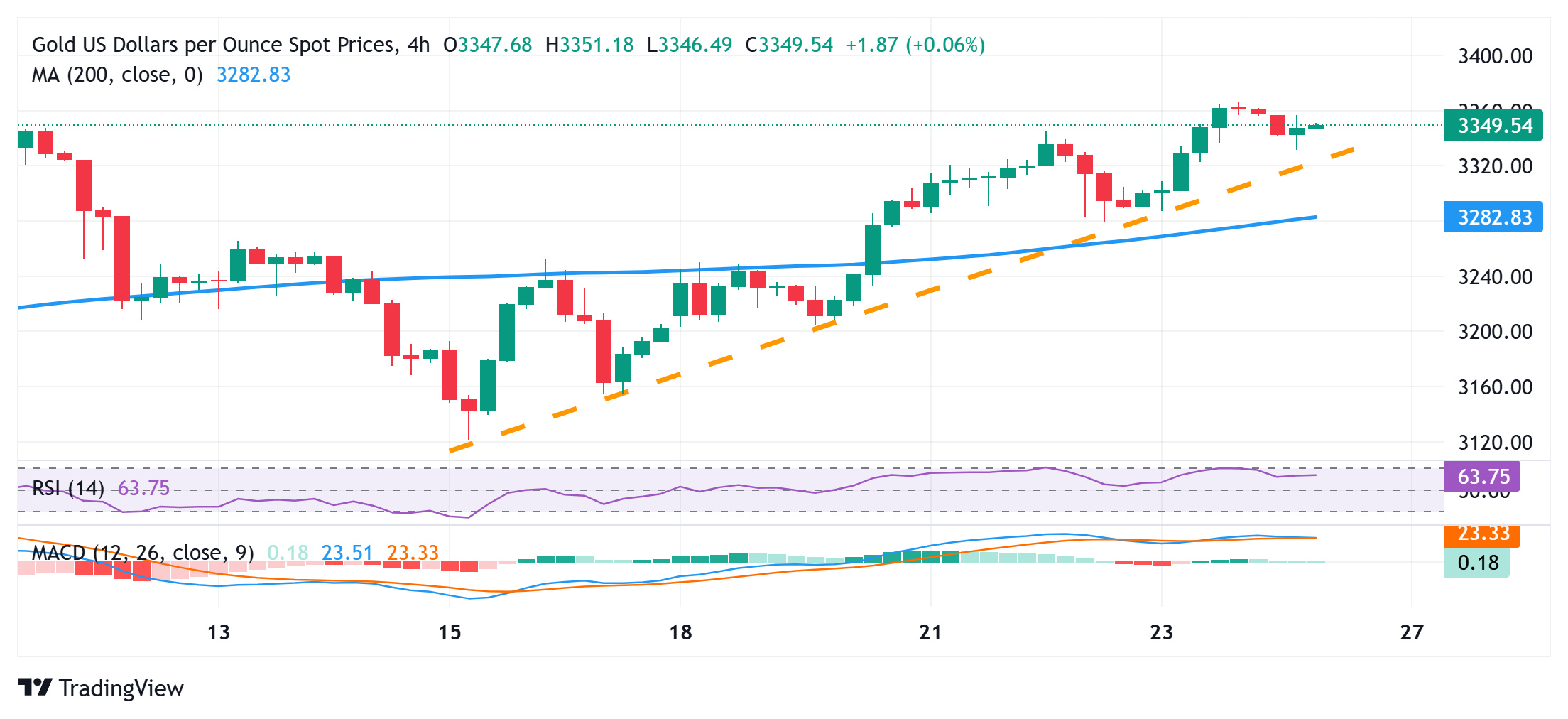
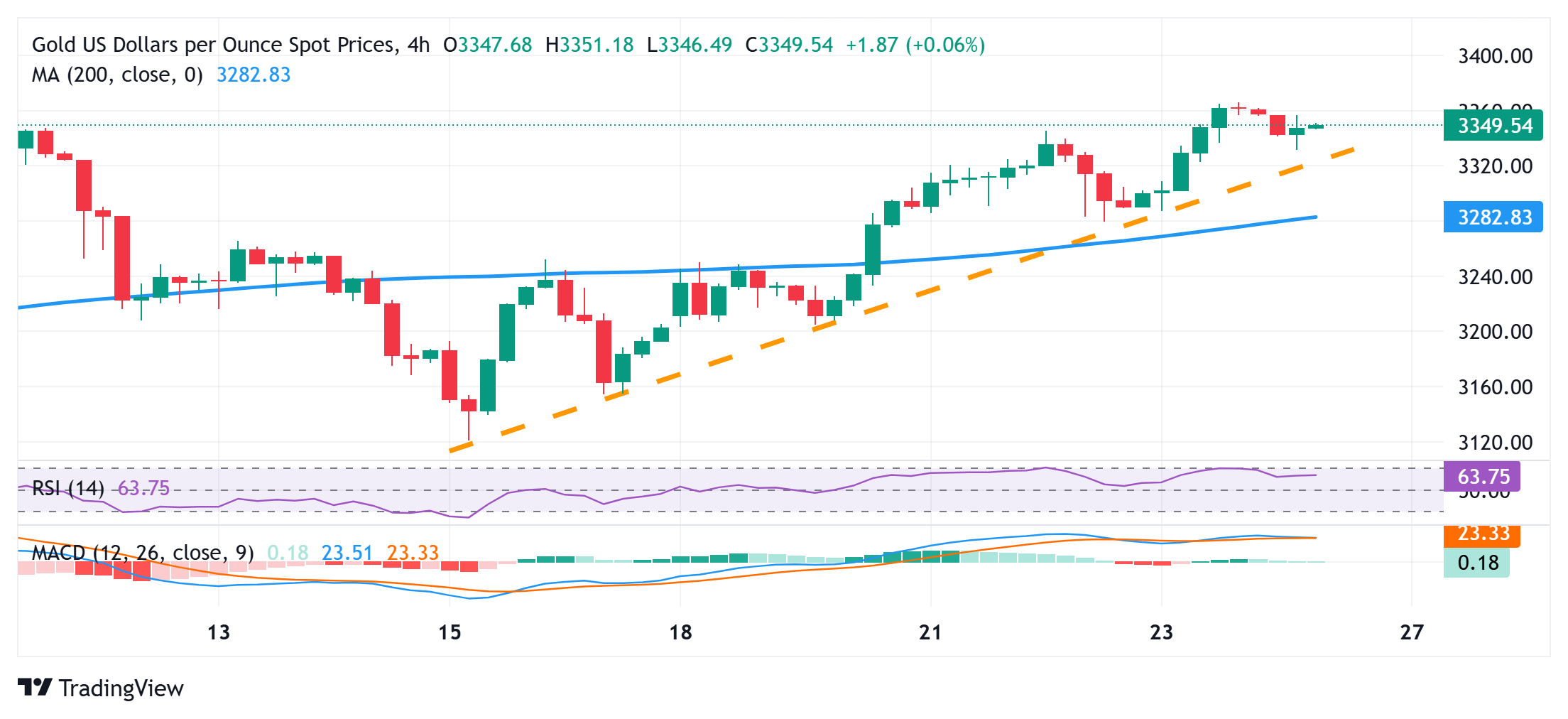
From a technical perspective, the recent move higher along an ascending trendline and positive oscillators on hourly/daily charts validates the near-term positive outlook for the Gold price. Hence, any subsequent slide is more likely to find decent support near the said trendline, currently pegged near the $3,325-3,324 region. A convincing break below, however, might prompt some technical selling and drag the XAU/USD to the $3,300 round figure en route to the $3,283 area, or the 200-period Simple Moving Average (SMA) on the 4-hour chart. The latter should act as a key pivotal point, which if broken decisively should pave the way for deeper losses.
On the flip side, momentum beyond Friday’s swing high, around the $3,366 area, will be seen as a fresh trigger for bullish traders and allow the Gold price to reclaim the $3,400 round figure. The next relevant resistance is seen near the $3,430 region, above which the XAU/USD could aim to challenge the all-time peak, around the $3,500 psychological mark touched in April, with some intermediate hurdle around the $3,465-3,470 zone.
Tariffs FAQs
Tariffs are customs duties levied on certain merchandise imports or a category of products. Tariffs are designed to help local producers and manufacturers be more competitive in the market by providing a price advantage over similar goods that can be imported. Tariffs are widely used as tools of protectionism, along with trade barriers and import quotas.
Although tariffs and taxes both generate government revenue to fund public goods and services, they have several distinctions. Tariffs are prepaid at the port of entry, while taxes are paid at the time of purchase. Taxes are imposed on individual taxpayers and businesses, while tariffs are paid by importers.
There are two schools of thought among economists regarding the usage of tariffs. While some argue that tariffs are necessary to protect domestic industries and address trade imbalances, others see them as a harmful tool that could potentially drive prices higher over the long term and lead to a damaging trade war by encouraging tit-for-tat tariffs.
During the run-up to the presidential election in November 2024, Donald Trump made it clear that he intends to use tariffs to support the US economy and American producers. In 2024, Mexico, China and Canada accounted for 42% of total US imports. In this period, Mexico stood out as the top exporter with $466.6 billion, according to the US Census Bureau. Hence, Trump wants to focus on these three nations when imposing tariffs. He also plans to use the revenue generated through tariffs to lower personal income taxes.
About The Author