Leading scientists have launched an international campaign to stop the creation of synthetic bacteria that could threaten life on earth.
Eminent researchers at a landmark gathering in Paris urged international action to prevent the emergence of so-called mirror life — manufactured microbes that they fear could overwhelm the immune defences of humans, other animals and plants.
The scale of the danger was still hard to predict but could affect “the preponderance of life as we know it today on this planet”, David Relman, a microbiologist and immunologist at Stanford University, told the Financial Times on the sidelines of the event.
“There is a scenario in which a future mirror organism becomes a widely pervasive invasive species and displaces and disrupts many critical ecosystems across the planet — including our own,” he said. “We have to be concerned about the possibility of an extreme, potentially existential, threat.”
The warning highlights how the modification of natural biological systems using techniques such as gene editing has transformed healthcare but opened a path to new dangers. Scientists and governments are grappling with how to regulate these emerging technologies, including “gain of function” work that enhances pathogens.
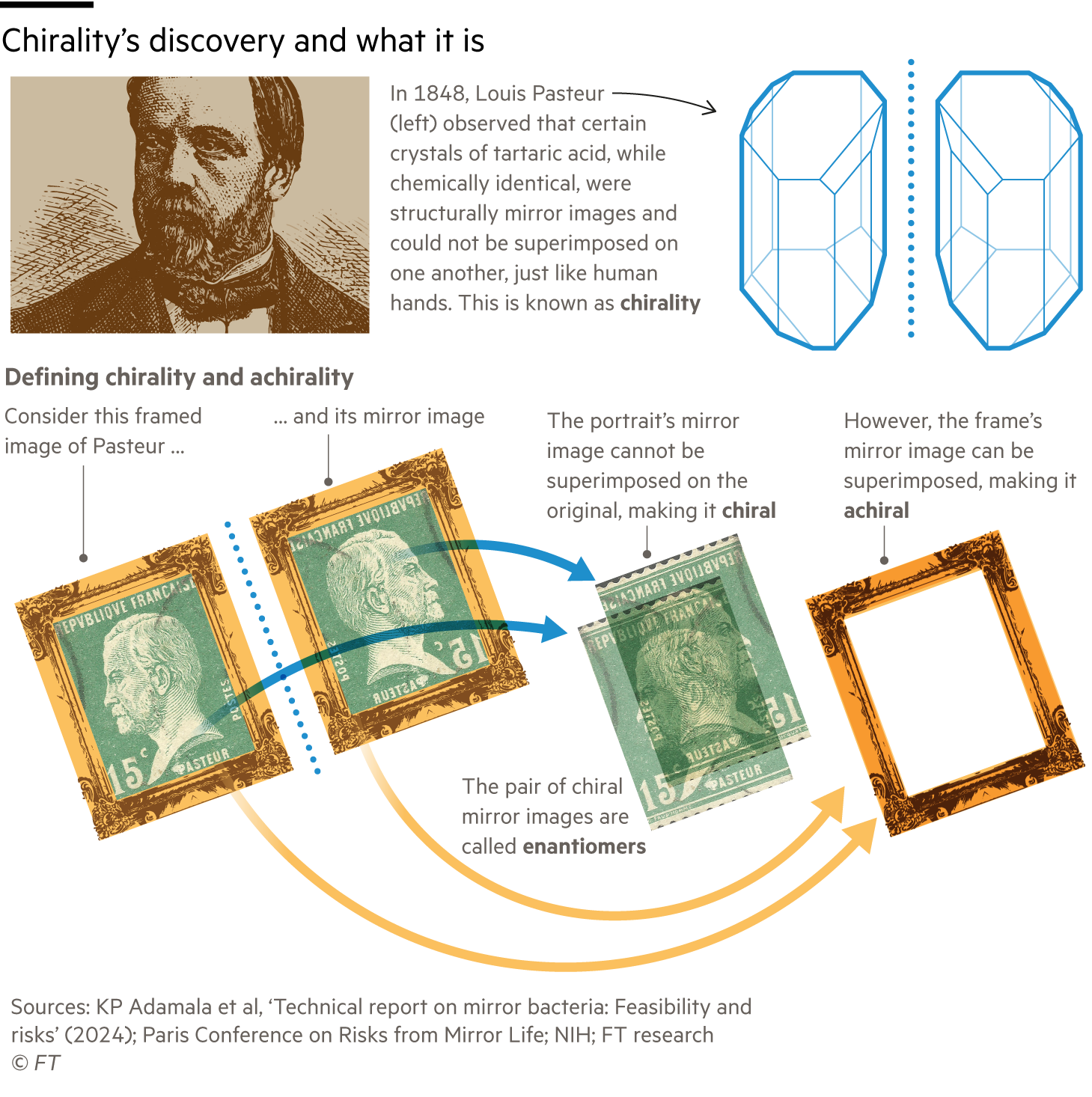
Mirror life is a possibility because of a natural phenomenon known as chirality, derived from the Greek word for “hand”. It was discovered by 19th century vaccine pioneer Louis Pasteur’s observations of crystals formed on wine corks. Thursday’s event was held at the Pasteur Institute he founded.
Chiral molecules have a single chemical composition but exist in two structural forms that are mirror images of one another — just like human hands.

A pair of chiral structures can be thought of as differently shaped locks. Each interacts in a distinctive way with the biological keys used by organisms’ immune systems to deal with particles and pathogens that enter them.
If a naturally occurring bacterium were to be replaced by its mirror twin, it would in effect change those locks and render the immune response keys impotent. This means a mirror microbe could spread unchecked, fatally clogging the life support systems of organisms it infiltrates and unaffected by many existing drugs.
The scandal of the drug thalidomide in the 1950s and 1960s is a horrifying example of the impact a change in chirality can have on the human body.
One chiral form of thalidomide had the intended effect of easing morning sickness in pregnant women. The other caused severe birth defects such as brain damage and limb deformities.
More than 10,000 thalidomide victims are thought to have been born worldwide, with many dying very young and others being stillborn.

Mirror microbes have emerged as a more serious prospect as researchers create chirally changed forms of naturally occurring biological molecules such as proteins. These could be used as the basis of longer-lasting drugs, because the body’s immune system would find them harder to break them down.
Experts also think mirror organisms may be equipped to feed on a wider range of food sources than previously thought, making them better able to sustain themselves.
Almost 40 scientists, including two Nobel Prize winners, warned in December that mirror organisms’ dangers meant they should never be created. They argued that their potential gains, such as more efficient delivery of drugs, were far outweighed by the risks.
With big investments and technical advances, experts now think it could be possible to make mirror microbes within a generation.
Manufactured bacteria might be feasible within 10-30 years, said John Glass, a synthetic biology specialist based in California for the J Craig Venter Institute. It would require the convergence of multiple frontier experimental fields, such as the production of complex mirror biomolecules and the manufacture of synthetic living cells from nonliving components.
But he warned that the ability to contain mirror organisms, if made, in laboratories was a “myth”, adding: “Biocontainment units are vulnerable to human error or deliberate misuse. A single failure would be unacceptable because of the unprecedented risk posed by these organisms.”

Politicians have highlighted synthetic biology’s hazards even as governments embrace the technology’s benefits. The UK’s strategic defence review published last week highlighted “avenues for enormous harm in the shape of new pathogens and other weapons of mass destruction”.
In the US, so-called gain of function research, which investigates the threat of pathogens by enhancing their potency, has become increasingly contentious. Last month President Donald Trump issued an executive order to restrict such work, alluding to a theory — disputed among scientists — that Covid-19 emerged from laboratory research in China.
Scientists working on mirror life say they are discussing the field with the UN, other international organisations and national governments. One model is the Tianjin Biosecurity Guidelines drawn up in 2021. The Paris event is expected to yield recommendations and is due to be followed by similar gatherings in the UK and Singapore this year and next.
The “unprecedented capacity” to engineer plants, animals and microbes must be dealt with at a global level, said Filippa Lentzos, an associate professor in science and international security at King’s College London.
“It’s clear it’s becoming ever more pressing to address the security dimension of biology and the life sciences,” Lentzos said, citing past examples of action, such as the 1975 Biological Weapons Convention. “Responsible science is more important — but also more challenging — than ever.”
Mirror microbes might not turn out to be apocalyptic even if they were created, said David Bikard, the Pasteur Institute’s head of synthetic biology. Mirror life may have existed long ago but been surpassed in evolutionary terms by today’s dominant organisms, and would be again if it re-emerges.
“There’s one argument that at very early beginning of life . . . both sides of the mirror existed,” Bikard said. “One side won, and the other never came back from it.”
But this was “not a reason for reassurance”, Bikard warned. “The unknowns are large. And I agree that there’s also a scenario where this is a catastrophic event.”
Graphic illustrations by Ian Bott
About The Author