Unlock the White House Watch newsletter for free
Your guide to what Trump’s second term means for Washington, business and the world
Spain is threatening to derail a Nato summit intended to appease Donald Trump by refusing to commit to the US president’s request for allies to increase their defence spending to 5 per cent of GDP.
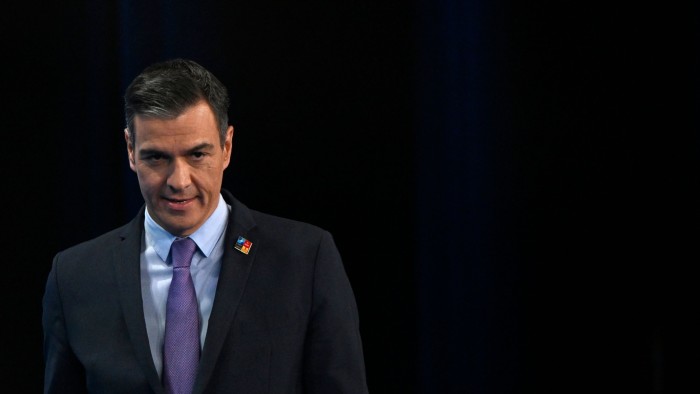
In a forthright letter on Thursday, Spanish Prime Minister Pedro Sánchez warned that the new goal was “unreasonable” and could have damaging consequences for the economy and social welfare by diverting public spending.
Leaders of the transatlantic military alliance will meet in The Hague next Wednesday amid uncertainty over Washington’s continued support for Europe’s defence, after Trump threatened to stop protecting allies that don’t commit to spend 5 per cent of their GDP on defence.
Nato secretary-general Mark Rutte has received broad support for his proposal to increase core military spending to 3.5 per cent of GDP by 2030, accompanied by 1.5 per cent in investment in security-adjacent areas such as roads, bridges and cyber security.
But Spain and a few other members were still holding out on this pledge, officials said. Sánchez’s stark letter is a setback for Rutte, which will probably roil the debate further.
The Spanish premier said a “rushed” effort to meet 5 per cent would slow Spain’s economic growth “through debt increase, inflationary pressures and the diversion of investment from crucial activities with a higher multiplier effect than the defence industry”, such as education, healthcare and technology.
He wrote: “The empirical reality is that, for Spain, as for other Nato countries, reaching 5 per cent defence spending will be impossible unless it comes at the cost of increasing taxes on the middle class, cutting public services and social benefits for their citizens.”
Sánchez, the most prominent leftwing leader in Nato, said countries would also have to scale back their commitment to the green transition and international development. Many right-of-centre governments are already cutting back their efforts in those areas.
The Spanish prime minister also raised practical concerns about how money could be spent. A dash to meet 5 per cent would force Nato members “into off-the-shelf purchases that could further exacerbate equipment interoperability challenges, and send a substantial portion of their resources to non-European suppliers, thus preventing them from developing their own industrial base”, he wrote.
Setting out two possible solutions to Rutte, Sánchez asked that Spain be excluded from the application of any new spending target agreed next week, or requested a more flexible formula that “makes the spending target optional”.
Madrid is one of few Nato capitals that have failed to meet even the alliance’s current goal of 2 per cent of GDP for defence.
Nato has cut back the upcoming leaders’ summit to just one working session to avoid Trump walking out early as he did recently at a G7 meeting. Originally supposed to take place over three days, the summit will be limited to just a two-and-a-half hour working session among the 32 leaders, dedicated to that spending pledge.
The decision was taken to ensure Trump did not get bored and leave early, three officials briefed on the preparations told the Financial Times.
An informal leaders’ dinner hosted by the King and Queen of the Netherlands will also take place on Tuesday evening.
“The entire point is to make it as small, and as focused as possible,” said one of the officials. “With as little scope for disruption.”
“It has gone from two days to one two-hour session . . . so it should be feasible, and my hope is that it will work,” Claudia Major, senior vice-president at the German Marshall Fund, told an FT Live event in Berlin on Thursday. “But I gave up trying to predict Trump.”
Trump walked out of a G7 summit in Canada on Monday evening, skipping the event’s second day, which included talks with Ukrainian President Volodymyr Zelenskyy.
He argued that he was needed back in Washington to deal with the conflict between Israel and Iran. But people familiar with the discussions said that his decision to leave was partly due to irritation at French President Emmanuel Macron who had stopped in Greenland and opposed Trump’s plans to take control of the island, as well as the US president’s lack of interest in meeting the Ukrainian leader.
Zelenskyy has been invited to The Hague and is set to take part in the Tuesday evening dinner.
About The Author