- President Trump said that he needs two weeks to decide whether to strike Iran, and the markets sigh with relief.
- An ebbing risk aversion is providing some support to the Euro as safe-haven demand eases.
- EUR/USD remains on a bearish correction from 1.1630 highs.
The EUR/USD pair is trading higher for the third consecutive day on Friday and has returned above the 1.1500 level, trading at 1.1520 at the moment of writing. US President Donald Trump’s comments saying that he needs two weeks to decide on entering the Middle East conflict have eased investors’ fears of an imminent attack and provided some support to the Euro.
The pair, however, remains on track to a moderate weekly loss, as investors’ concerns that the war between Iran and Israel might turn into a wider regional conflict have kept risk appetite subdued, boosting demand for the US Dollar and other traditional safe havens.
Beyond that, the sharp increase in Oil prices poses another challenge for a soft Eurozone Economy while the trade relationship with the US remains highly uncertain. The negotiations between the US and European authorities remain stalled just two weeks before Trump’s July 9 deadline to cut a deal or face high tariffs.
Earlier this week, the Federal Reserve (Fed) left interest rates unchanged and maintained its projection of two cuts in 2025, but Chairman Jerome Powell struck a hawkish note, downplaying the dot plot and warning about higher inflationary pressures stemming from Trump’s tariffs. Powell’s press release turned the decision into a “hawkish hold,” which gave additional support to the US Dollar.
Euro PRICE Today
The table below shows the percentage change of Euro (EUR) against listed major currencies today. Euro was the strongest against the US Dollar.
| USD | EUR | GBP | JPY | CAD | AUD | NZD | CHF | |
|---|---|---|---|---|---|---|---|---|
| USD | -0.19% | -0.09% | -0.10% | -0.11% | -0.22% | -0.06% | -0.04% | |
| EUR | 0.19% | 0.07% | 0.07% | 0.09% | 0.14% | 0.15% | 0.15% | |
| GBP | 0.09% | -0.07% | 0.10% | 0.02% | 0.07% | 0.08% | 0.08% | |
| JPY | 0.10% | -0.07% | -0.10% | 0.05% | -0.13% | -0.10% | -0.00% | |
| CAD | 0.11% | -0.09% | -0.02% | -0.05% | -0.08% | -0.18% | 0.06% | |
| AUD | 0.22% | -0.14% | -0.07% | 0.13% | 0.08% | 0.29% | 0.02% | |
| NZD | 0.06% | -0.15% | -0.08% | 0.10% | 0.18% | -0.29% | 0.00% | |
| CHF | 0.04% | -0.15% | -0.08% | 0.00% | -0.06% | -0.02% | -0.00% |
The heat map shows percentage changes of major currencies against each other. The base currency is picked from the left column, while the quote currency is picked from the top row. For example, if you pick the Euro from the left column and move along the horizontal line to the US Dollar, the percentage change displayed in the box will represent EUR (base)/USD (quote).
Daily digest market movers: The Euro extends its recovery as risk aversion eases
- Market sentiment improved somewhat on Friday after Trump eased fears of an imminent attack on Iran, and news reports suggest that US and Iranian officials are keeping diverse lines of direct and indirect negotiations. There is also news that Iranian diplomats will meet Eurozone officials to hold nuclear talks on Friday, which opens a possibility of a peace agreement.
- Meanwhile, the Middle East conflict enters its eighth day with Tehran and Tel Aviv exchanging missiles and threats. Israel attacked several military and nuclear targets overnight in an attempt to cripple the Islamic Republic’s aim to obtain a nuclear weapon and topple its Government.
- Oil prices remain steady at high levels, about 12% above May’s range, which poses a further challenge to the Eurozone economy, and acts as a headwind to the Euro recovery
- Data from France revealed that the Business Climate remained fairly steady at the 96.1 level in June, inching up from 96.0, but the sentiment among manufacturers has deteriorated to 96.0 from 97.0 in May, against expectations of an improvement to 97.8.
- Earlier this week, The Federal Reserve kept interest rates on hold at the 4.25%-4.50% range as expected, as well as the projections of two interest rate cuts by year end, but the economic growth expectations for 2025 were downgraded to 1.4% from the previous 1.7%, and inflation expectations hiked to 3% from the previous 2.7%. A context of softer growth and higher inflation poses a dilemma for the central bank.
- On Thursday, European Central Bank (ECB) President Christine Lagarde pitched for greater regional trade between the European Union and neighboring economies to offset losses from global fragmentation during an event in Kyiv.
- The macroeconomic calendar is thin on Friday. In the US, the highlight will be the Philadelphia Fed Manufacturing Survey, which is expected to show some minor improvement, yet with the index remaining in negative territory for the third consecutive month.
- Somewhat later, the preliminary Consumer Confidence Index released by the European Commission is expected to have improved to -14.5 in June from -15.2 in the previous month, still at levels consistent with a soft economic growth.
EUR/USD remains on a bearish correction from 1.1630
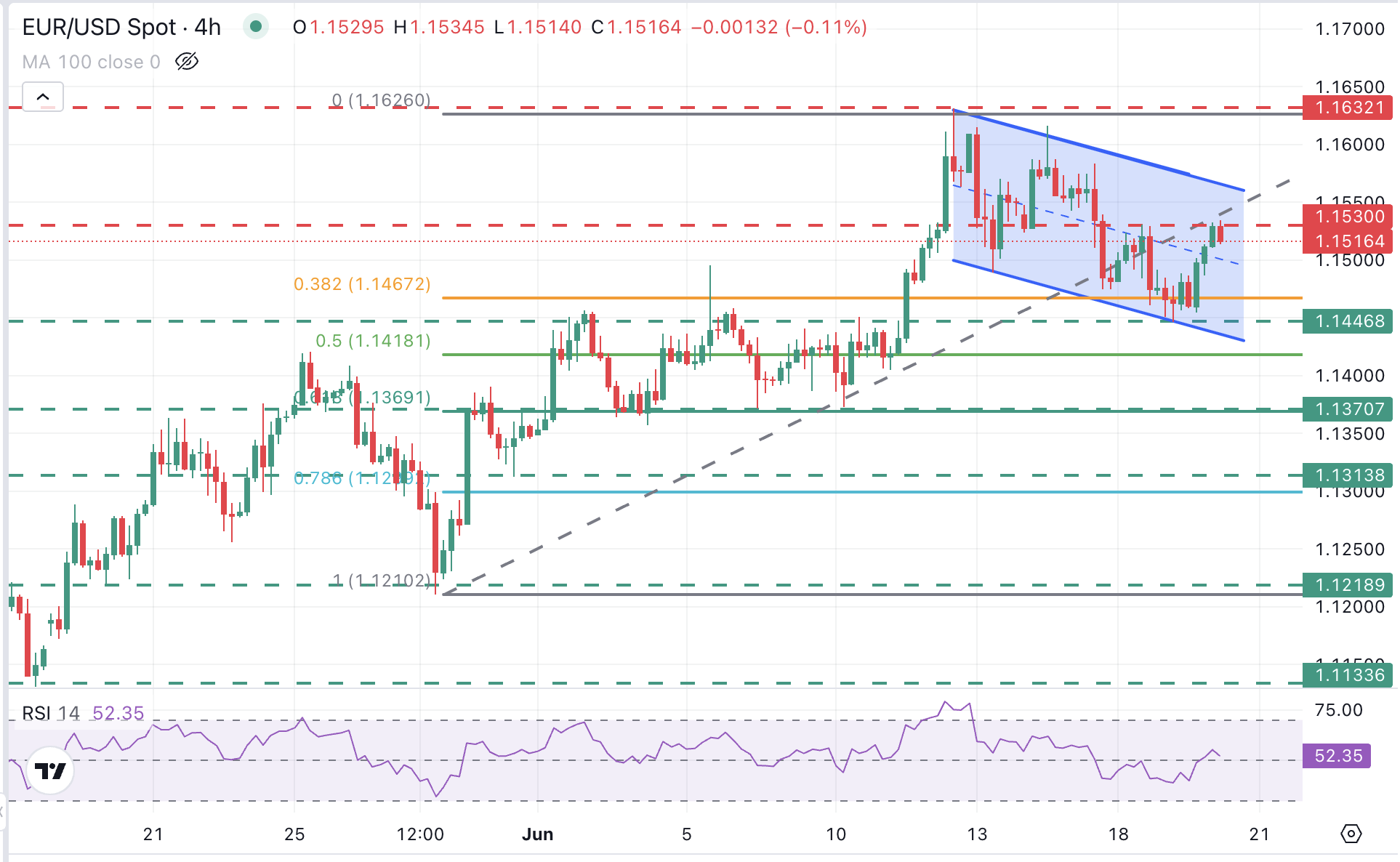
EUR/USDis trading within a descending channel since peaking at 1.1630 on June 12. The pair has pared some losses over the last three days, but it remains on track for a moderate weekly loss. From a technical perspective, the bearish correction from last week’s highs remains in play.
Upside attempts are being capped around the June 18 high at 1.530 on Friday. The pair should confirm above that level and breach the top of the descending channel, now at 1.1570, to break the immediate bearish structure and shift the focus back to the mentioned 1.1630 high.
On the downside, immediate support is at 1.1445 (June 19 low) and the descending channel trendline support, at 1.1440. A bearish reaction below that level would increase pressure towards 1.1370, the June 6 and 10 lows, and the 61.8% Fibonacci retracement level drawn from the May 29 low of 1.1210 to the June 12 high of 1.1630.
Fed FAQs
Monetary policy in the US is shaped by the Federal Reserve (Fed). The Fed has two mandates: to achieve price stability and foster full employment. Its primary tool to achieve these goals is by adjusting interest rates.
When prices are rising too quickly and inflation is above the Fed’s 2% target, it raises interest rates, increasing borrowing costs throughout the economy. This results in a stronger US Dollar (USD) as it makes the US a more attractive place for international investors to park their money.
When inflation falls below 2% or the Unemployment Rate is too high, the Fed may lower interest rates to encourage borrowing, which weighs on the Greenback.
The Federal Reserve (Fed) holds eight policy meetings a year, where the Federal Open Market Committee (FOMC) assesses economic conditions and makes monetary policy decisions.
The FOMC is attended by twelve Fed officials – the seven members of the Board of Governors, the president of the Federal Reserve Bank of New York, and four of the remaining eleven regional Reserve Bank presidents, who serve one-year terms on a rotating basis.
In extreme situations, the Federal Reserve may resort to a policy named Quantitative Easing (QE). QE is the process by which the Fed substantially increases the flow of credit in a stuck financial system.
It is a non-standard policy measure used during crises or when inflation is extremely low. It was the Fed’s weapon of choice during the Great Financial Crisis in 2008. It involves the Fed printing more Dollars and using them to buy high grade bonds from financial institutions. QE usually weakens the US Dollar.
Quantitative tightening (QT) is the reverse process of QE, whereby the Federal Reserve stops buying bonds from financial institutions and does not reinvest the principal from the bonds it holds maturing, to purchase new bonds. It is usually positive for the value of the US Dollar.
About The Author