- Gold price extends the previous day’s slide amid the Israel-Iran ceasefire announcement.
- July Fed rate cut bets weigh heavily on the USD, supporting the non-yielding commodity.
- The XAU/USD bears also seem reluctant to commit ahead of speeches from influential FOMC members.
Gold price (XAU/USD) maintains its offered tone through the Asian session and currently trades just above a nearly two-week low touched earlier this Tuesday. The latest optimism led by US President Donald Trump’s announcement that a ceasefire had been brokered between Iran and Israel turns out to be a key factor undermining demand for the safe-haven precious metal. That said, the prevalent US Dollar (USD) selling bias could offer some support to the commodity and help limit further losses.
The mixed US PMI data and dovish remarks from Federal Reserve (Fed) officials fueled speculations about the possibility of a rate cut in July. This, along with US fiscal concerns and the uncertainty surrounding Trump’s trade policies, drags the USD away from over a one-week high touched on Monday and acts as a tailwind for the Gold price. This might hold back the XAU/USD bears from placing aggressive bets ahead of the US data and Fed Chair Jerome Powell’s congressional testimony.
Daily Digest Market Movers: Gold price remains depressed on Israel-Iran ceasefire
- US President Donald Trump announced that Israel and Iran have agreed to a complete and total ceasefire, providing a goodish lift to the global risk sentiment. However, reports suggest that Israel has launched some attacks against Iran.
- Moreover, Iran’s Foreign Minister, Abbas Araqchi, said that if Israel stopped its illegal aggression against the Iranian people no later than 00.30 GMT on Tuesday, Iran had no intention of continuing its response afterward, per Reuters.
- This, along with persistent trade-related uncertainties, keeps a lid on the market optimism. Apart from this, some follow-through US Dollar selling for the second straight day assists the Gold price to stall its slide to a nearly two-week low.
- Meanwhile, data released on Monday showed that S&P Global’s flash Manufacturing PMI held steady at 52 in June, while the gauge for the service sector cooled slightly to 53.1 from 53.7 and the composite index slipped to 52.8 from 53.0 in May.
- Adding to this, Federal Reserve Governor Michelle Bowman said that the time to cut rates may be fast approaching as she has grown more worried about risks to the job market and less concerned that tariffs will cause an inflation problem.
- This backs Fed Governor Christopher Waller’s view that the US central bank should consider cutting interest rates at its next policy meeting on July 29-30, which keeps the USD depressed and further supports the non-yielding yellow metal.
- Traders now look to the US economic docket – featuring the release of the Conference Board’s Consumer Confidence Index and the Richmond Manufacturing Index. This, along with speeches by influential FOMC members, will drive the USD.
- The focus, however, will remain glued to Fed Chair Jerome Powell’s testimony before the House Financial Services Committee, which could offer cues about the future rate-cut path and determine the near-term trajectory for the XAU/USD pair.
Gold price seems vulnerable; break below 100-period SMA and trend-channel in play
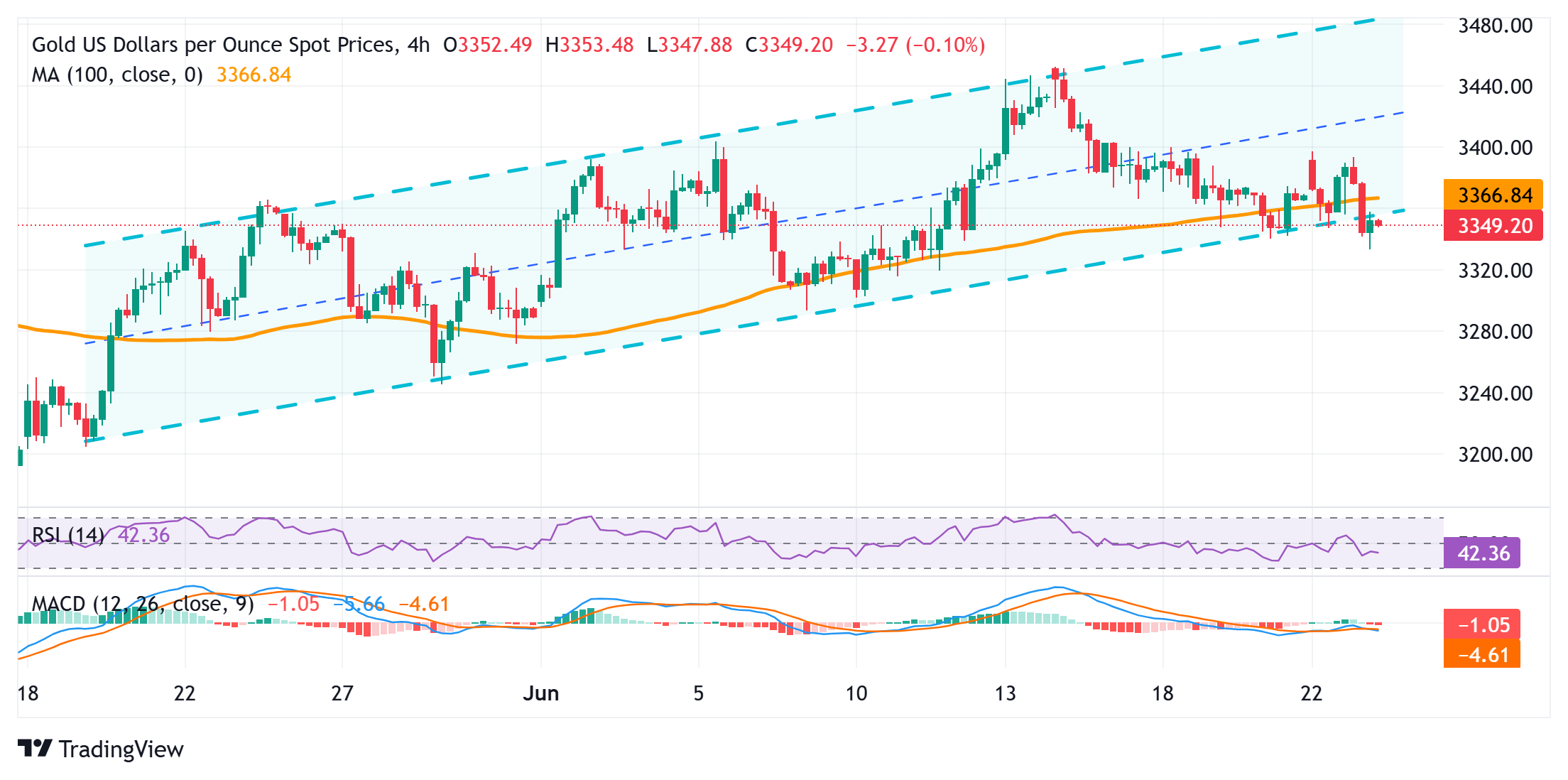
From a technical perspective, the commodity now seems to have found acceptance below the 100-period Simple Moving Average (SMA) on the 4-hour chart and is looking to extend the fall below a short-term ascending channel support. Moreover, oscillators on the said chart have been gaining negative traction and back the case for a further intraday depreciating move. Some follow-through selling below the $3,323-3,322 intermediate support will reaffirm the outlook and drag the Gold price to sub-$3,300 levels.
On the flip side, any meaningful recovery beyond the $3,368-3,370 immediate hurdle is more likely to attract fresh sellers and remain capped near the $3,400 round figure. The latter should act as a key pivotal point, which if cleared decisively could lift the Gold price to the $3,434-3,435 area en route to the $3,451-3,452 zone, or a nearly two-month top touched last Monday. The subsequent move up could extend further towards challenging the all-time peak, around the $3,500 psychological mark.
Risk sentiment FAQs
In the world of financial jargon the two widely used terms “risk-on” and “risk off” refer to the level of risk that investors are willing to stomach during the period referenced. In a “risk-on” market, investors are optimistic about the future and more willing to buy risky assets. In a “risk-off” market investors start to ‘play it safe’ because they are worried about the future, and therefore buy less risky assets that are more certain of bringing a return, even if it is relatively modest.
Typically, during periods of “risk-on”, stock markets will rise, most commodities – except Gold – will also gain in value, since they benefit from a positive growth outlook. The currencies of nations that are heavy commodity exporters strengthen because of increased demand, and Cryptocurrencies rise. In a “risk-off” market, Bonds go up – especially major government Bonds – Gold shines, and safe-haven currencies such as the Japanese Yen, Swiss Franc and US Dollar all benefit.
The Australian Dollar (AUD), the Canadian Dollar (CAD), the New Zealand Dollar (NZD) and minor FX like the Ruble (RUB) and the South African Rand (ZAR), all tend to rise in markets that are “risk-on”. This is because the economies of these currencies are heavily reliant on commodity exports for growth, and commodities tend to rise in price during risk-on periods. This is because investors foresee greater demand for raw materials in the future due to heightened economic activity.
The major currencies that tend to rise during periods of “risk-off” are the US Dollar (USD), the Japanese Yen (JPY) and the Swiss Franc (CHF). The US Dollar, because it is the world’s reserve currency, and because in times of crisis investors buy US government debt, which is seen as safe because the largest economy in the world is unlikely to default. The Yen, from increased demand for Japanese government bonds, because a high proportion are held by domestic investors who are unlikely to dump them – even in a crisis. The Swiss Franc, because strict Swiss banking laws offer investors enhanced capital protection.
About The Author