- Gold price remains conflicted as the US Dollar recovers and yields rise.
- Tariff warnings from Trump and rising trade tensions could provide downside protection for Gold.
- XAU/USD tests moving average resistance near $3,320, recovering from the intraday low near $3,296.
Gold (XAU/USD) is currently under pressure as markets await more news of trade deals ahead of Wednesday’s tariff deadline, with prices nearing $3,320 at the time of writing.
Liquidity and trade volumes are increasing on Monday as the US returns to financial markets following Friday’s Independence Day holiday.
US yields have also firmed after Thursday’s Nonfarm Payrolls (NFP) report revealed a resilient labour market. This reduced the prospects that the Federal Reserve (Fed) would lower interest rates in July. The positive economic data has eased fears of a slowing economy, lifting the US Dollar.
Expectations that interest rates will remain at higher levels for longer do not bode well for non-yielding assets such as bullion.
Daily digest market movers: Gold awaits details on trade deals, FOMC Minutes
- Reporters spoke to US President Donald Trump at the Morristown Airport on Sunday about the trade negotiations. “I think we will have most countries done by July 9, either a letter or a deal,” he said.
- Letters outlining the tariffs that will be charged to 12-15 countries are expected to be sent by noon on Monday. The remaining notifications are to be dispatched before Wednesday. Reciprocal tariffs are set to take effect starting August 1.
- Trump has written a post on Truth Social stating that “Any country aligning themselves with the Anti‑American policies of BRICS, will be charged an ADDITIONAL 10 % tariff. There will be no exceptions to this policy.”
- The BRICS summit in Rio de Janeiro is currently underway, and the emerging market nations that established the bloc are beginning to reduce their reliance on the United States. This initiative includes moving away from using the US Dollar as a receiving currency, a concept known as de-dollarization.
- BRICS is an acronym that stands for an association of five major emerging economies: Brazil, Russia, India, China, and South Africa. This group was formed to enhance economic cooperation and promote development in these countries.BRICS nations collaborate on various issues, including trade, investment, finance, and sustainable development. They aim to increase their influence in global economic and political affairs. The bloc also holds annual summits to discuss and coordinate strategies for mutual support and growth.
- The World Gold Survey in June showed that demand for bullion has been on the rise, especially with tensions between the US and China escalating in recent years.
- The Federal Open Market Committee will release the Minutes from its June Meeting on Wednesday. This report outlines the reasons for maintaining interest rates at the current range of 4.25% to 4.50% in June.It also provides insight into the perspective of the Board of Governors members regarding the prospects of the US economy. This influences expectations of when the Fed may cut interest rates.
Gold technical analysis: XAU/USD tests moving average resistance near $3,320
The current daily chart of Gold shows price action consolidating within a symmetrical triangle, suggesting that a breakout is likely as the range narrows. This tightening formation reflects growing pressure, which often precedes a significant directional move.
XAU/USD is currently threatening a retest of the 50-day Simple Moving Average (SMA) at $3,321 but remains below the 20-day SMA, which is near $3,350.
Psychological support remains at $3,300 with the 38.2% Fibonacci retracement level of the April rally at $3,292, highlighting the significance of this critical support zone, which could help determine the near-term direction.
Downside targets below this range include the 50% and 61.8% Fibonacci retracement levels at $3,228 and $3,164, respectively.
Spot Gold (XAU/USD) daily chart
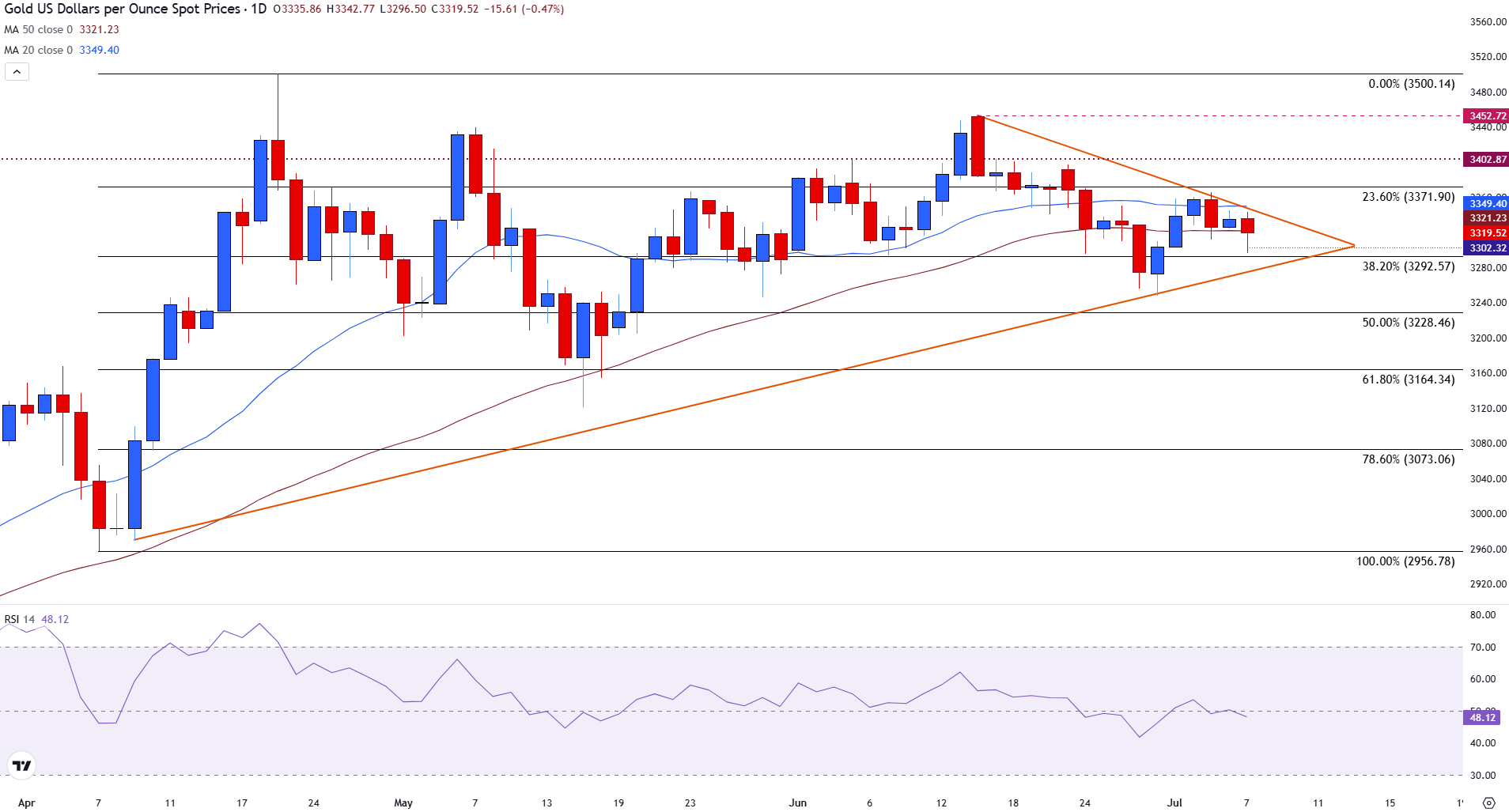
However, if the price manages to hold above $3,300 and rebound, a bullish reversal could occur. In that case, the first upside targets would be the 20-day SMA at $3,350. A confirmed breakout above the triangle resistance and the 23.6% Fibonacci level at $3,371 would open the door for further gains, with a potential move toward psychological resistance at $3,400.
The Relative Strength Index (RSI) is currently near 48, indicating mild bearish momentum, but with sufficient room before entering oversold territory.
Risk sentiment FAQs
In the world of financial jargon the two widely used terms “risk-on” and “risk off” refer to the level of risk that investors are willing to stomach during the period referenced. In a “risk-on” market, investors are optimistic about the future and more willing to buy risky assets. In a “risk-off” market investors start to ‘play it safe’ because they are worried about the future, and therefore buy less risky assets that are more certain of bringing a return, even if it is relatively modest.
Typically, during periods of “risk-on”, stock markets will rise, most commodities – except Gold – will also gain in value, since they benefit from a positive growth outlook. The currencies of nations that are heavy commodity exporters strengthen because of increased demand, and Cryptocurrencies rise. In a “risk-off” market, Bonds go up – especially major government Bonds – Gold shines, and safe-haven currencies such as the Japanese Yen, Swiss Franc and US Dollar all benefit.
The Australian Dollar (AUD), the Canadian Dollar (CAD), the New Zealand Dollar (NZD) and minor FX like the Ruble (RUB) and the South African Rand (ZAR), all tend to rise in markets that are “risk-on”. This is because the economies of these currencies are heavily reliant on commodity exports for growth, and commodities tend to rise in price during risk-on periods. This is because investors foresee greater demand for raw materials in the future due to heightened economic activity.
The major currencies that tend to rise during periods of “risk-off” are the US Dollar (USD), the Japanese Yen (JPY) and the Swiss Franc (CHF). The US Dollar, because it is the world’s reserve currency, and because in times of crisis investors buy US government debt, which is seen as safe because the largest economy in the world is unlikely to default. The Yen, from increased demand for Japanese government bonds, because a high proportion are held by domestic investors who are unlikely to dump them – even in a crisis. The Swiss Franc, because strict Swiss banking laws offer investors enhanced capital protection.
About The Author