- The Euro holds some gains on hopes of a trade deal between the EU and the US.
- The US Dollar remains steady at lower levels following dovish FOMC minutes.
- EUR/USD remains trapped within a bearish channel, below the 1.1750 trendline resistance.
The EUR/USD pair holds gains on Thursday, but the pair has pulled back from intra-day highs. Investors’ concerns about the uncertain outlook for international trade are weighing on risk appetite, although a somewhat softer US Dollar, following the minutes of the last Federal Reserve (Fed) meeting, keeps the pair supported.
The Euro (EUR) met buyers right below 1.1700 on Wednesday, paring some losses and returning to the mid-range of the 1.1700s, as the pair trades at 1.1740 at the time of writing. From a wider perspective, however, the bearish structure from the July 1 highs remains in play.
News reports about the trade negotiations between the European Union (EU) and the US are positive, and markets remain hopeful that the bloc might skip the 10% baseline tariff. US President Donald Trump noted the EU’s constructive attitude, and the European trade chief, Maros Sefcovic, affirmed that a trade deal might be announced in the coming days.
In the US, the minutes of the last Fed meeting revealed that most committee members see it appropriate to lower interest rates in the coming months. This, and a strong US 10-year bond auction on Wednesday, contributed to pulling treasury yields down, easing the US Dollar’s (USD) bullish momentum.
Earlier on Thursday, German Consumer Price Index (CPI) data confirmed that monthly inflation remained flat in June. In the US, the main attraction on Thursday will be the Weekly Jobless Claims release, which will provide further insight into the health of the US labour market.
Euro PRICE Today
The table below shows the percentage change of Euro (EUR) against listed major currencies today. Euro was the strongest against the Swiss Franc.
| USD | EUR | GBP | JPY | CAD | AUD | NZD | CHF | |
|---|---|---|---|---|---|---|---|---|
| USD | -0.09% | -0.19% | -0.01% | -0.12% | -0.44% | -0.31% | 0.05% | |
| EUR | 0.09% | -0.11% | 0.07% | -0.00% | -0.33% | -0.22% | 0.13% | |
| GBP | 0.19% | 0.11% | 0.14% | 0.10% | -0.22% | -0.10% | 0.24% | |
| JPY | 0.01% | -0.07% | -0.14% | -0.09% | -0.41% | -0.23% | -0.03% | |
| CAD | 0.12% | 0.00% | -0.10% | 0.09% | -0.29% | -0.22% | 0.14% | |
| AUD | 0.44% | 0.33% | 0.22% | 0.41% | 0.29% | 0.08% | 0.45% | |
| NZD | 0.31% | 0.22% | 0.10% | 0.23% | 0.22% | -0.08% | 0.35% | |
| CHF | -0.05% | -0.13% | -0.24% | 0.03% | -0.14% | -0.45% | -0.35% |
The heat map shows percentage changes of major currencies against each other. The base currency is picked from the left column, while the quote currency is picked from the top row. For example, if you pick the Euro from the left column and move along the horizontal line to the US Dollar, the percentage change displayed in the box will represent EUR (base)/USD (quote).
Daily digest market movers: The Euro advances as trade fears ease
- The Euro is drawing support from a more contained market reaction to Trump’s latest tariff salvo and higher hopes that a deal between the EU and the US is still possible. Comments from both sides have been upbeat, and the August 1 deadline is still weeks away. Investors’ optimism is likely to keep the common currency buoyed in the next sessions.
- On Wednesday, the FOMC minutes revealed diverging views among the committee, with most policymakers anticipating at least one rate cut this year, as they believe the tariffs’ impact on inflation will likely be temporary, while the labour market is showing signs of cooling.
- The Fed minutes heightened hopes of an interest rate cut in September. The CME Group’s Fed Watch Tool shows a 72% chance of at least 25 bps cuts after the summer, up from less than 65% before the minutes were released. Chances of a July cut remain practically unchanged at 6%.
- US Treasury yields pulled back on Wednesday, with the benchmark 10-year yield easing about 10 basis points from Tuesday’s highs following an auction for $39 billion worth of US bonds, which saw a stronger-than-expected demand.
- In the Eurozone, German CPI data confirmed that inflation stalled in June compared with the previous month and the yearly rate eased to the ECBs 2% target. The data had a slightly negative impact on the Euro.
EUR/USD remains trapped within a descending channel
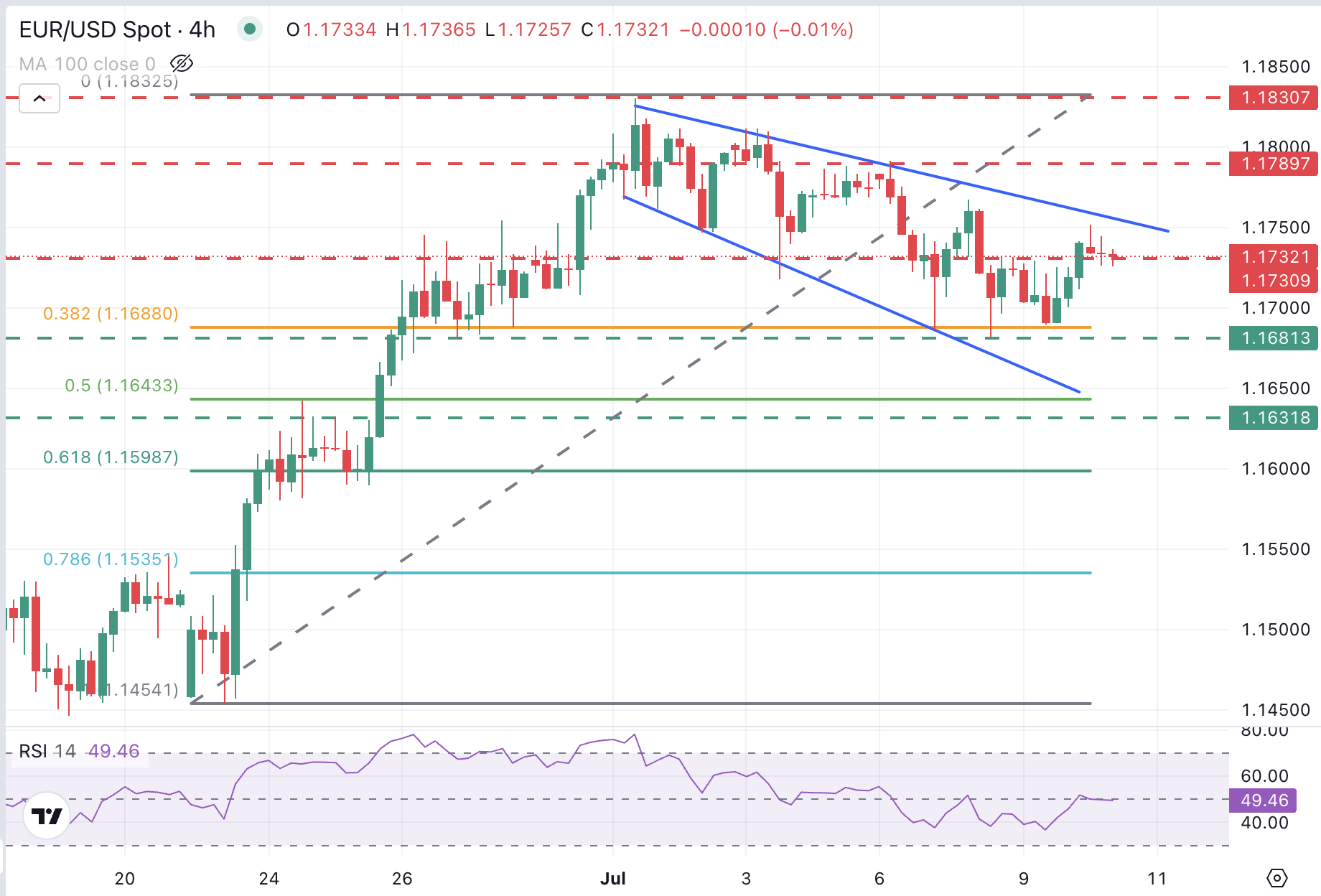
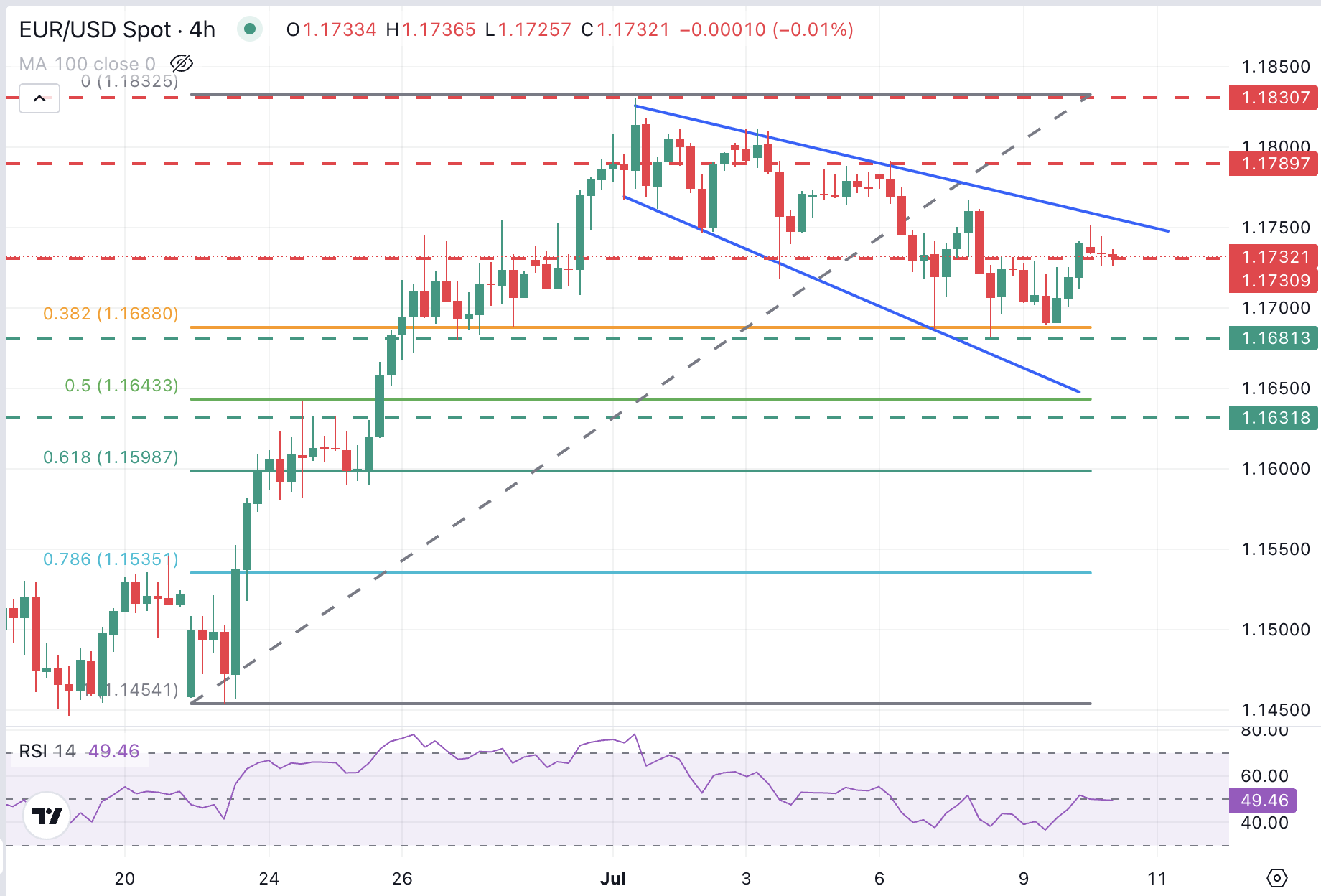
EUR/USD‘s upside attempts remain capped below the descending trendline resistance from July 1 highs, now at the 1.1760 area. This keeps the price action trapped within a broadening wedge pattern, a figure that reflects an emotional market and that often appears at major tops.
Above here, the high from July 4 and 7 at 1.1790 is likely to challenge bulls ahead of the multi-year high of 1.1830.
The Relative Strength Index (RSI) on the 4-hour chart is fluctuating around the 50 level, suggesting that the pair keeps looking for direction, while the 1.1680 area – where the 38.2% Fibonacci retracement level of the June 24 – July 1 rally meets the July 7 and 8 lows – provides significant support.
A bearish reaction below here would increase pressure towards the 1.1630-1.1645 area, where previous highs meet the 50% Fibonacci retracement level of the mentioned late June rally.
Euro FAQs
The Euro is the currency for the 19 European Union countries that belong to the Eurozone. It is the second most heavily traded currency in the world behind the US Dollar. In 2022, it accounted for 31% of all foreign exchange transactions, with an average daily turnover of over $2.2 trillion a day.
EUR/USD is the most heavily traded currency pair in the world, accounting for an estimated 30% off all transactions, followed by EUR/JPY (4%), EUR/GBP (3%) and EUR/AUD (2%).
The European Central Bank (ECB) in Frankfurt, Germany, is the reserve bank for the Eurozone. The ECB sets interest rates and manages monetary policy.
The ECB’s primary mandate is to maintain price stability, which means either controlling inflation or stimulating growth. Its primary tool is the raising or lowering of interest rates. Relatively high interest rates – or the expectation of higher rates – will usually benefit the Euro and vice versa.
The ECB Governing Council makes monetary policy decisions at meetings held eight times a year. Decisions are made by heads of the Eurozone national banks and six permanent members, including the President of the ECB, Christine Lagarde.
Eurozone inflation data, measured by the Harmonized Index of Consumer Prices (HICP), is an important econometric for the Euro. If inflation rises more than expected, especially if above the ECB’s 2% target, it obliges the ECB to raise interest rates to bring it back under control.
Relatively high interest rates compared to its counterparts will usually benefit the Euro, as it makes the region more attractive as a place for global investors to park their money.
Data releases gauge the health of the economy and can impact on the Euro. Indicators such as GDP, Manufacturing and Services PMIs, employment, and consumer sentiment surveys can all influence the direction of the single currency.
A strong economy is good for the Euro. Not only does it attract more foreign investment but it may encourage the ECB to put up interest rates, which will directly strengthen the Euro. Otherwise, if economic data is weak, the Euro is likely to fall.
Economic data for the four largest economies in the euro area (Germany, France, Italy and Spain) are especially significant, as they account for 75% of the Eurozone’s economy.
Another significant data release for the Euro is the Trade Balance. This indicator measures the difference between what a country earns from its exports and what it spends on imports over a given period.
If a country produces highly sought after exports then its currency will gain in value purely from the extra demand created from foreign buyers seeking to purchase these goods. Therefore, a positive net Trade Balance strengthens a currency and vice versa for a negative balance.
About The Author