The Australian Dollar (AUD) rises against the US Dollar (USD) on Wednesday, continuing its winning streak for the fourth successive session. The AUD/USD pair rises despite the easing of Australia’s inflation in November. Traders now await the full fourth-quarter inflation report, due later this month. Analysts warned that a 0.9% or higher rise in core inflation could prompt the Reserve Bank of Australia (RBA) to tighten at its February meeting.
The Australian Financial Review (AFR) suggested that the RBA may not be done tightening this cycle. The poll indicates that inflation is expected to remain stubbornly elevated over the coming year, fueling expectations of at least two additional rate hikes.
The Australian Bureau of Statistics (ABS) reported on Wednesday that Australia’s Consumer Price Index rose 3.4% year-over-year (YoY) in November, easing from 3.8% in October. The reading missed market expectations of 3.7% but remained above the RBA’s 2–3% target. It marked the lowest inflation since August, with housing costs increasing at the slowest pace in three months.
Australia’s CPI was unchanged at 0% month-on-month (MoM) in November, matching October’s reading. Meanwhile, the RBA’s Trimmed Mean CPI rose 0.3% MoM and 3.2% YoY. Separately, seasonally adjusted Building Permits surged 15.2% MoM to a near four-year high of 18,406 units in November 2025, rebounding from a downwardly revised 6.1% fall previously. Annual approvals jumped 20.2%, reversing a revised 1.1% decline in October.
US Dollar declines ahead of ISM Services PMI
- The US Dollar Index (DXY), which measures the value of the US Dollar against six major currencies, is edging lower after registering modest gains in the previous session and hovering around 98.50 at the time of writing.
- Traders await US economic data that could shape expectations for Federal Reserve (Fed) policy. ISM Services Purchasing Managers’ Index (PMI) and JOLTs job openings will be eyed later in the day. The US Nonfarm Payrolls (NFP) report due Friday is expected to show job gains of 55,000 in December, down from 64,000 in November.
- Fed Governor Stephen Miran said on Tuesday that the US central bank needs to cut interest rates aggressively this year to support economic momentum. Meanwhile, Minneapolis Fed President Neel Kashkari warned of a risk that the unemployment rate could “pop” higher.
- Richmond Fed President Tom Barkin, a non-voter on the Fed’s rate-setting committee this year, said Tuesday that interest rate adjustments will need to be “finely tuned” to incoming data, citing risks to both the Fed’s employment and inflation objectives, according to Reuters.
- According to the CME Group’s FedWatch tool, Fed funds futures continue to price in about an 82.8% probability that the US central bank will keep rates unchanged at its January 27–28 meeting.
- The US launched a large-scale military strike against Venezuela on Saturday. US President Donald Trump said Venezuelan President Nicolas Maduro and his wife were captured and flown out of the country.
- Venezuelan President Maduro, on Monday, pleaded not guilty to US charges in a narco-terrorism case, setting the stage for an unprecedented legal battle with major geopolitical implications, according to Bloomberg.
- Traders expect two additional Federal Reserve rate cuts in 2026. Markets are bracing for US President Donald Trump to nominate a new Fed chair to replace Jerome Powell when his term ends in May, a move that could tilt monetary policy toward lower interest rates.
- China’s RatingDog Services Purchasing Managers’ Index (PMI), released on Monday, declined to 52.0 in December from 52.1 in November. RatingDog reported last week that Manufacturing PMI climbed to 50.1 in December from 49.9 in November. It is important to note that any change in the Chinese economy could impact the AUD as China and Australia are close trading partners.
- The RBA December Meeting Minutes indicated that policymakers stand ready to tighten policy if inflation fails to ease as expected, placing increased focus on the Q4 CPI report due January 28. Analysts note that a stronger-than-expected Q4 core inflation reading could trigger a rate hike at the RBA’s February 3 meeting.
Australian Dollar records fresh 15-month highs above 0.6750
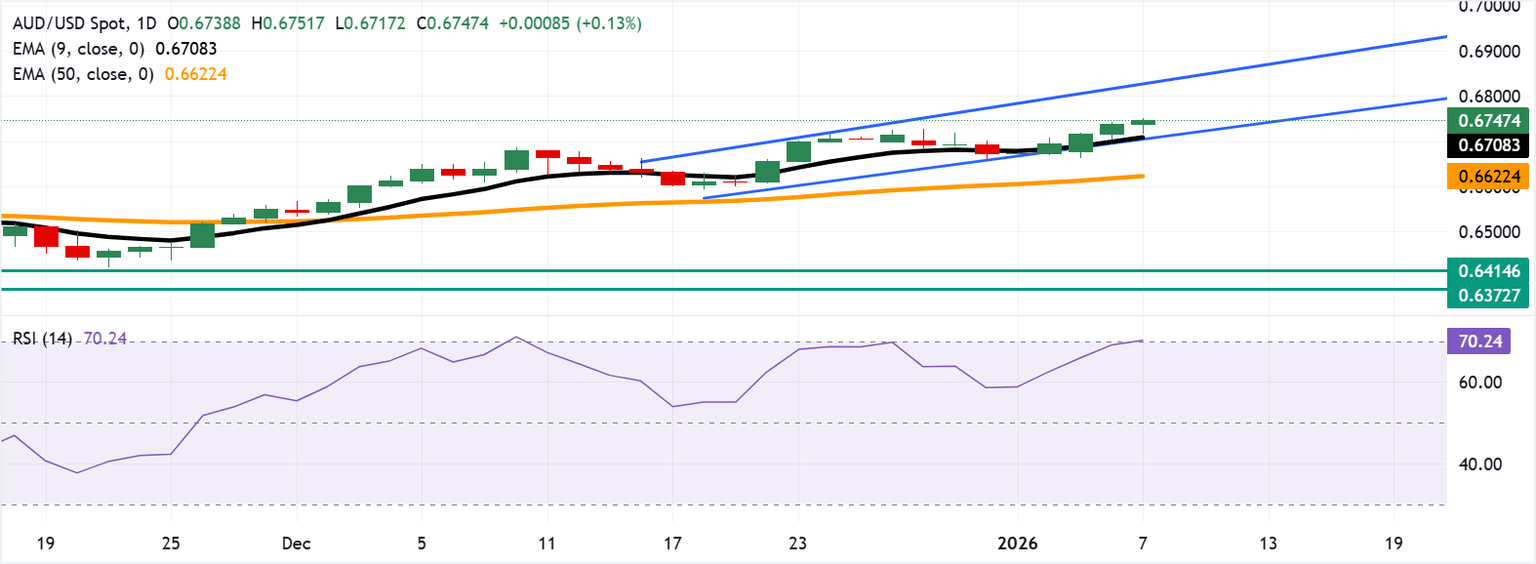
AUD/USD is trading around 0.6750 on Wednesday. The technical analysis of the daily chart indicates that the pair moves upwards within the ascending channel pattern, suggesting a persistent bullish bias. However, the 14-day Relative Strength Index (RSI) at 70 suggests overbought conditions.
The AUD/USD pair has reached fresh highs since October 2024 and targets the upper boundary of the ascending channel near 0.6830.
The initial support lies at the nine-day Exponential Moving Average (EMA) of 0.6708, followed by the lower ascending channel boundary around 0.6700. A break below the confluence support zone could expose the AUD/USD pair to the area around the 50-day EMA at 0.6625.
Australian Dollar Price Today
The table below shows the percentage change of Australian Dollar (AUD) against listed major currencies today. Australian Dollar was the strongest against the Canadian Dollar.
| USD | EUR | GBP | JPY | CAD | AUD | NZD | CHF | |
|---|---|---|---|---|---|---|---|---|
| USD | -0.05% | -0.06% | -0.09% | 0.02% | -0.31% | -0.02% | -0.08% | |
| EUR | 0.05% | -0.01% | -0.05% | 0.07% | -0.26% | 0.03% | -0.04% | |
| GBP | 0.06% | 0.01% | -0.04% | 0.08% | -0.23% | 0.04% | -0.02% | |
| JPY | 0.09% | 0.05% | 0.04% | 0.12% | -0.21% | 0.07% | 0.01% | |
| CAD | -0.02% | -0.07% | -0.08% | -0.12% | -0.33% | -0.04% | -0.10% | |
| AUD | 0.31% | 0.26% | 0.23% | 0.21% | 0.33% | 0.29% | 0.22% | |
| NZD | 0.02% | -0.03% | -0.04% | -0.07% | 0.04% | -0.29% | -0.06% | |
| CHF | 0.08% | 0.04% | 0.02% | -0.01% | 0.10% | -0.22% | 0.06% |
The heat map shows percentage changes of major currencies against each other. The base currency is picked from the left column, while the quote currency is picked from the top row. For example, if you pick the Australian Dollar from the left column and move along the horizontal line to the US Dollar, the percentage change displayed in the box will represent AUD (base)/USD (quote).
RBA FAQs
The Reserve Bank of Australia (RBA) sets interest rates and manages monetary policy for Australia. Decisions are made by a board of governors at 11 meetings a year and ad hoc emergency meetings as required. The RBA’s primary mandate is to maintain price stability, which means an inflation rate of 2-3%, but also “..to contribute to the stability of the currency, full employment, and the economic prosperity and welfare of the Australian people.” Its main tool for achieving this is by raising or lowering interest rates. Relatively high interest rates will strengthen the Australian Dollar (AUD) and vice versa. Other RBA tools include quantitative easing and tightening.
While inflation had always traditionally been thought of as a negative factor for currencies since it lowers the value of money in general, the opposite has actually been the case in modern times with the relaxation of cross-border capital controls. Moderately higher inflation now tends to lead central banks to put up their interest rates, which in turn has the effect of attracting more capital inflows from global investors seeking a lucrative place to keep their money. This increases demand for the local currency, which in the case of Australia is the Aussie Dollar.
Macroeconomic data gauges the health of an economy and can have an impact on the value of its currency. Investors prefer to invest their capital in economies that are safe and growing rather than precarious and shrinking. Greater capital inflows increase the aggregate demand and value of the domestic currency. Classic indicators, such as GDP, Manufacturing and Services PMIs, employment, and consumer sentiment surveys can influence AUD. A strong economy may encourage the Reserve Bank of Australia to put up interest rates, also supporting AUD.
Quantitative Easing (QE) is a tool used in extreme situations when lowering interest rates is not enough to restore the flow of credit in the economy. QE is the process by which the Reserve Bank of Australia (RBA) prints Australian Dollars (AUD) for the purpose of buying assets – usually government or corporate bonds – from financial institutions, thereby providing them with much-needed liquidity. QE usually results in a weaker AUD.
Quantitative tightening (QT) is the reverse of QE. It is undertaken after QE when an economic recovery is underway and inflation starts rising. Whilst in QE the Reserve Bank of Australia (RBA) purchases government and corporate bonds from financial institutions to provide them with liquidity, in QT the RBA stops buying more assets, and stops reinvesting the principal maturing on the bonds it already holds. It would be positive (or bullish) for the Australian Dollar.
(This story was corrected on January 7 at 04:15 GMT to say, in the title, that the AUD hits new 15-month highs instead of 14-month.)
About The Author