
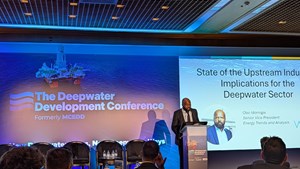
March 10, 2026

Fig. 1. Welligence’s Obo Idornigie presents a market overview to Deepwater Development attendees.
World Oil/Gulf Energy Information’s Deepwater Development Conference got off to a roaring start in Lisbon on Tuesday, featuring an operator’s panel, two solo speakers, and a case studies/lessons learned session. The participants represented a wide mix of operators, service companies and a market analyst.
Industry overview. Kicking off the afternoon sessions was Obo Idornigie, Senior V.P., Energy Trends & Analysis at Welligence, Fig. 1. Looking at the global oil and gas market overall, he noted that investment is expected to remain flat for the third year running. However, he added, “despite near-term wobbles, long-term demand remains robust.” Idornigie also stated that there is recognition that exploration needs to be stepped up the major operators.
Meanwhile, he declared that “deep water” is a core growth engine, and Brazil and Guyana will continue to underpin deepwater production growth.” Idornigie said that since 2020, roughly $200 billion has gone to deepwater projects, yet only three key deepwater projects progressed during 2025. While project execution is a top priority of operators, he acknowledged that consolidation has been a theme across key segments of the service sector.

Fig. 2. Participants in the Operators Panel gave the audience a variety of views on deepwater issues and potential solutions.
On the positive side of the ledger, said Idornigie, the deepwater emissions footprint continues to improve, including on FPSOs. He also pointed out that there is a $20 billion contract backlog among the top deepwater drilling contractors.
Operators panel. While deepwater development remains a critical component of global upstream strategy, operators are under increasing pressure to deliver projects faster and with greater capital discipline. That message was reinforced during the Operators’ Panel (“The State of Deepwater – New Ways for a New Era”), where industry leaders outlined how collaboration, digitalization and standardized development models are reshaping offshore project execution, Fig. 2.
Moderated by Chris Barton, CEO of Business Development Advisory, the panel featured Adriano Bastos, head of upstream at Galp; Elisabetta Boi, head of project control and portfolio at Eni; Pablo Gomes, R&D manager for subsea pipelines at Petrobras; and Grant McKenzie, vice president of developments at Woodside. The discussion focused on the role deepwater will play in the coming decades and how operators are adapting development strategies to manage complexity, cost and execution risk.
Panelists broadly agreed that deepwater remains one of the most attractive sources of long-term oil supply. Large discoveries in regions, such as Brazil, continue to deliver high-quality resources and strong production potential, supporting both corporate growth strategies and global energy demand. However, speakers emphasized that deepwater projects remain among the most complex developments in the upstream sector, requiring coordination across multiple companies, contractors and regulatory environments.
A central theme was the importance of engaging partners earlier in the development cycle. One operator noted that bringing contractors and key suppliers into projects during the earliest design stages helps reduce redesign later in the project, improve schedule certainty and increase competitiveness during execution. Early technical engagement allows operators to align project scope, identify risks sooner and accelerate development timelines.
Another operator emphasized that collaboration should be viewed as a driver of efficiency rather than simply a cost-control measure. In his view, projects benefit when operators rely on the expertise of specialized contractors and equipment providers, rather than attempting to control every element internally. Allowing experienced partners to contribute earlier in the process can significantly improve execution performance.
Digitalization is also playing a growing role in offshore project management. One panel member described how his firm applies real-time monitoring systems, predictive analytics and shared digital platforms to improve both operational performance and project execution. In some cases, data-driven tools have been used to anticipate equipment issues, extend the design life of flexible pipelines and improve coordination between project teams and contractors.
Standardization was another topic that drew strong support. Panelists said repeatable designs and lessons learned from previous developments can significantly reduce engineering effort and shorten project schedules, particularly in mature deepwater basins. At the same time, speakers cautioned that standardization must be balanced against the unique technical requirements of each reservoir and development concept.
One panelist noted that commercial considerations also remain central to deepwater investment decisions. In addition to technical complexity, projects must navigate geopolitical uncertainty, regulatory environments and long-term commodity price expectations. These factors, combined with long development timelines, make disciplined project planning and execution increasingly important.
Across the discussion, panelists identified three priorities for accelerating first oil from deepwater discoveries: earlier collaboration across the supply chain, greater use of digital tools to improve predictability and stronger organizational discipline in project decision-making.

Fig. 3. Gary Archer of SLB OneSubsea delivered the keynote talk to attendees at Deepwater Development Conference 2026.
While emerging technologies, such as autonomous operations, predictive maintenance and new materials, may further improve offshore performance, speakers suggested the industry’s biggest gains may come from improving how projects are planned and executed. In an environment where development timelines often span decades, companies that align partners early and simplify project delivery models are likely to be best positioned to bring new deepwater resources to market.
Building deepwater’s next chapter. After a mid-afternoon break, SLB OneSubsea’s Vice President of Operations, Gary Archer, delivered the keynote address, giving his views on what he thinks is needed to fulfill deepwater’s next chapter, Fig. 3. He said that when it comes to new frontiers, “the challenge is that the projects are becoming too complex. We still engineer too much.”
That’s why, he continued, “early collaboration matters. Predictability transforms everything.” He said one of the biggest problems in getting projects up and running is the overwhelming amount of documentation that engineers must deal with, much of it “one-off” pieces of paper that clog the process. “Imagine being able to standardize 75% of the project documents.”
Case studies/lessons learned. Finishing off the day was a session devoted to specific projects and lessons learned from them. Andrea Oliveri, Section Lead for SPS & Umbilical Work Packages at Azule Energy. He discussed in detail the Agogo Integrated West Hub Project’s subsea control system offshore Angola. Meanwhile, John Wharton, Lead Project Engineering Manager at TechnipFMC, discussed developing ultra-deepwater fields in harsh and remote environments. He assessed the merit of early collaborative engagement.
Last, but not least, was an excellent presentation from Mario Perrina, EniProgetti Deepwater and Subsea Engineering Department Manager at Eni. He explained a phased and flexible engineering approach case study on an Eni ultra-deepwater project.
The Deepwater Development Conference 2026 continues for a full day on Wednesday in Lisbon.
About The Author


