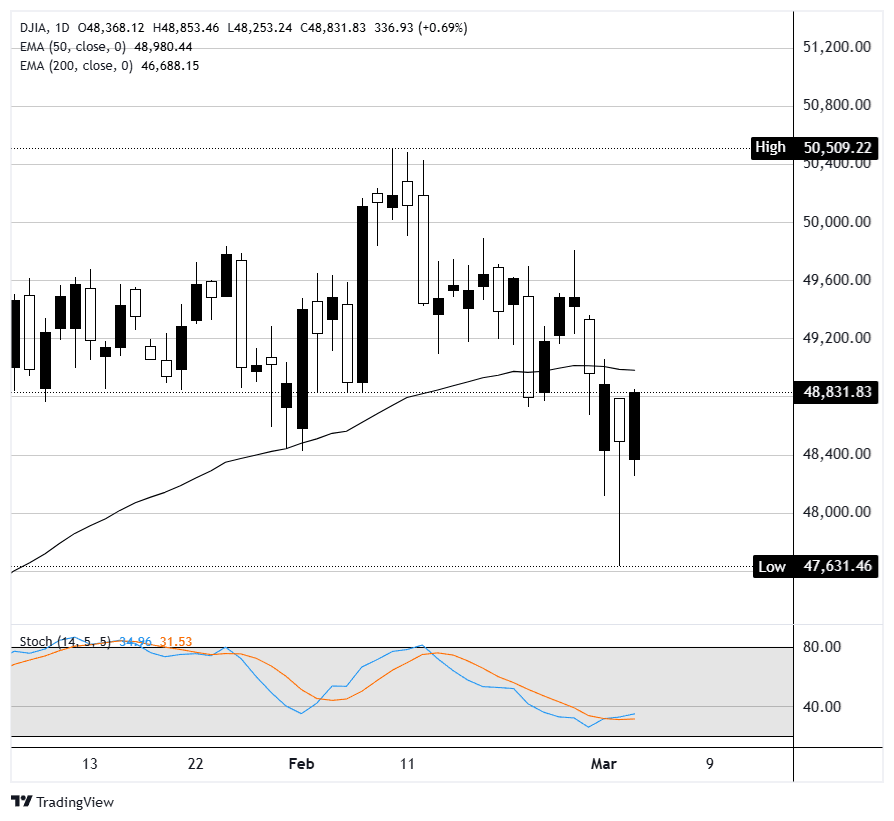
The Dow Jones Industrial Average traded 312 points higher, or 0.65%, at 48,807 at the time of writing on Wednesday, clawing back most of Tuesday’s losses after a session that saw the index drop as much as 1.2K points intraday before closing down 403 points. The index opened at 48,368 and reached an intraday high of 48,853, though it remained below the 50-day exponential moving average at 48,979. The S&P 500 rose 0.87% to 6,875, while the Nasdaq Composite led the way with a 1.47% gain to 22,847. A combination of better-than-expected economic data and easing Oil prices gave investors a reason to buy the dip, even as the US-Iran conflict continued to dominate headlines.
Strong jobs and services data bolster sentiment
ADP’s National Employment Report showed private sector employers added 63K jobs in February, comfortably beating the 50K consensus and marking a sharp acceleration from January’s revised 11K print. Separately, the Institute for Supply Management (ISM) Services Purchasing Managers Index (PMI) jumped to 56.1 from 53.8 in January, well above the 53.5 forecast and the highest reading since July 2022. The new orders component rose to 58.6, signaling robust demand across the services sector. The data pushed back against recession fears that had been building alongside the geopolitical turmoil, although the ISM prices paid component came in at 63, which may keep the Federal Reserve (Fed) cautious on rate cuts.
Nonfarm Payrolls on deck Friday
Attention now shifts to Friday’s Nonfarm Payrolls (NFP) report for February, where the consensus expects just 60K jobs added, down sharply from January’s 130K print. Average Hourly Earnings are forecast at 0.3% MoM and 3.7% YoY, while the unemployment rate is expected to hold at 4.3%. Before that, Thursday brings Initial Jobless Claims (consensus 215K) and preliminary fourth-quarter productivity and unit labor cost data. The Fed’s Beige Book, due later Wednesday, will also be closely watched for anecdotal evidence on tariff impacts and hiring trends ahead of the March 18–19 Federal Open Market Committee (FOMC) meeting.
Oil eases as Bessent pledges Gulf shipping support
Crude Oil gave up earlier gains on Wednesday after Treasury Secretary Scott Bessent told CNBC the administration plans to make “a series of announcements” to stabilize oil flows in the Persian Gulf. Brent crude pulled back to around $81 after touching $85.12 in Tuesday’s session. The reversal helped ease pressure on equity markets, which have been whipsawed by energy price spikes since US and Israeli strikes on Iran began late last week. Tanker traffic through the Strait of Hormuz remains disrupted, but Trump’s earlier pledge to insure and escort Gulf shipping has so far prevented a worst-case scenario for supply.
CrowdStrike delivers record quarter, guides higher
CrowdStrike Holdings Inc. (CRWD) reported fiscal fourth-quarter adjusted earnings per share of $1.12, beating the $1.10 consensus, on revenue of $1.31 billion that topped the $1.30 billion estimate. The cybersecurity firm set an all-time record for net new annual recurring revenue at $331 million, up 47% year over year, and crossed the $5 billion milestone in total ending ARR. For fiscal 2027, CrowdStrike guided revenue to $5.87–$5.93 billion and full-year adjusted EPS of $4.78–$4.90, both broadly in line with expectations. Shares fell modestly in after-hours trading on Tuesday but were trading higher in Wednesday’s session.
Target rallies on earnings beat and growth plan
Target Corporation (TGT) extended gains on Wednesday, rising roughly 7% after posting fiscal fourth-quarter adjusted EPS of $2.44 versus the $2.16 consensus. The retailer also unveiled a multi-year growth strategy including an incremental $2 billion investment in 2026 and full-year EPS guidance of $7.50–$8.50. Elsewhere, Pinterest Inc. (PINS) added to Tuesday’s 9% surge after activist firm Elliott Investment Management made a $1 billion investment in the company, funding a new $3.5 billion share repurchase program. Box Inc. (BOX) also jumped more than 6% after a better-than-expected fourth-quarter report.
Dow Jones daily chart
Dow Jones FAQs
The Dow Jones Industrial Average, one of the oldest stock market indices in the world, is compiled of the 30 most traded stocks in the US. The index is price-weighted rather than weighted by capitalization. It is calculated by summing the prices of the constituent stocks and dividing them by a factor, currently 0.152. The index was founded by Charles Dow, who also founded the Wall Street Journal. In later years it has been criticized for not being broadly representative enough because it only tracks 30 conglomerates, unlike broader indices such as the S&P 500.
Many different factors drive the Dow Jones Industrial Average (DJIA). The aggregate performance of the component companies revealed in quarterly company earnings reports is the main one. US and global macroeconomic data also contributes as it impacts on investor sentiment. The level of interest rates, set by the Federal Reserve (Fed), also influences the DJIA as it affects the cost of credit, on which many corporations are heavily reliant. Therefore, inflation can be a major driver as well as other metrics which impact the Fed decisions.
Dow Theory is a method for identifying the primary trend of the stock market developed by Charles Dow. A key step is to compare the direction of the Dow Jones Industrial Average (DJIA) and the Dow Jones Transportation Average (DJTA) and only follow trends where both are moving in the same direction. Volume is a confirmatory criteria. The theory uses elements of peak and trough analysis. Dow’s theory posits three trend phases: accumulation, when smart money starts buying or selling; public participation, when the wider public joins in; and distribution, when the smart money exits.
There are a number of ways to trade the DJIA. One is to use ETFs which allow investors to trade the DJIA as a single security, rather than having to buy shares in all 30 constituent companies. A leading example is the SPDR Dow Jones Industrial Average ETF (DIA). DJIA futures contracts enable traders to speculate on the future value of the index and Options provide the right, but not the obligation, to buy or sell the index at a predetermined price in the future. Mutual funds enable investors to buy a share of a diversified portfolio of DJIA stocks thus providing exposure to the overall index.
About The Author