EUR/USD has breached Monday’s low at 1.1585 after rejection at the 1.1600 area, and trades at 1.1580 at the time of writing. Investors remain cautious about placing US Dollar (USD) directional bets, ahead of a backlog of US economic reports due later this week.
US data released on Monday beat expectations, with the New York manufacturing Index improving to the highest level in nearly one year in November, and construction spending, the first of a large array of delayed data releases, increasing against expectations in August.
However, Federal Reserve (Fed) Governor Christopher Waller warned that the adoption of Artificial Intelligence (AI) technology will weaken demand for employment by US businesses and that the central bank will have to be ready to respond by cutting interest rates.
All in all, hopes of a Fed rate cut in December remain steady below 50% with investors awaiting more economic data. The European calendar is practically void on Tuesday, but in the US, the ADP weekly employment report and Factory Orders data will give some fundamental background for the US Dollar. The highlight of the week, however, will be September’s Nonfarm Payrolls report, due on Thursday.
Euro Price Today
The table below shows the percentage change of Euro (EUR) against listed major currencies today. Euro was the strongest against the Japanese Yen.
| USD | EUR | GBP | JPY | CAD | AUD | NZD | CHF | |
|---|---|---|---|---|---|---|---|---|
| USD | 0.07% | 0.08% | 0.11% | -0.11% | -0.11% | -0.15% | 0.09% | |
| EUR | -0.07% | 0.01% | 0.04% | -0.15% | -0.16% | -0.23% | 0.03% | |
| GBP | -0.08% | -0.01% | 0.04% | -0.18% | -0.19% | -0.23% | 0.00% | |
| JPY | -0.11% | -0.04% | -0.04% | -0.23% | -0.22% | -0.27% | -0.01% | |
| CAD | 0.11% | 0.15% | 0.18% | 0.23% | 0.00% | -0.04% | 0.21% | |
| AUD | 0.11% | 0.16% | 0.19% | 0.22% | -0.01% | -0.05% | 0.20% | |
| NZD | 0.15% | 0.23% | 0.23% | 0.27% | 0.04% | 0.05% | 0.25% | |
| CHF | -0.09% | -0.03% | -0.01% | 0.01% | -0.21% | -0.20% | -0.25% |
The heat map shows percentage changes of major currencies against each other. The base currency is picked from the left column, while the quote currency is picked from the top row. For example, if you pick the Euro from the left column and move along the horizontal line to the US Dollar, the percentage change displayed in the box will represent EUR (base)/USD (quote).
Daily digest market movers: Currencies waver within range amid cautious markets
- The Euro (EUR) recovers some of the previous losses but remains trading within a narrow range. Traders await more US data for a clearer picture of the US economy and the Fed’s monetary easing prospects.
- On Monday, the New York Empire State Manufacturing Index beat expectations with an increase to 18.7 in November, from October’s10.7 reading and against market expectations of a deterioration to 6.0
- In the same line, Construction Spending rose 0.2% in August, according to a delayed release from the US Census Bureau, beating expectations of a 0.1% decline. Apart from that, July’s reading was revised up to a 0.2% gain from the 0.1% contraction previously reported.
- August’s factory orders are expected to bounce to a 1.4% increase, compared to the 1.3% decline seen in July, the last release before the US government shutdown.
- Apart from that, speeches from Federal Reserve Governor Michael Barr and Richmond Fed President Thomas Barkin might give some more clues about the outcome of December’s meeting.
Technical Analysis: EUR/USD comes under growing pressure below 1.1585
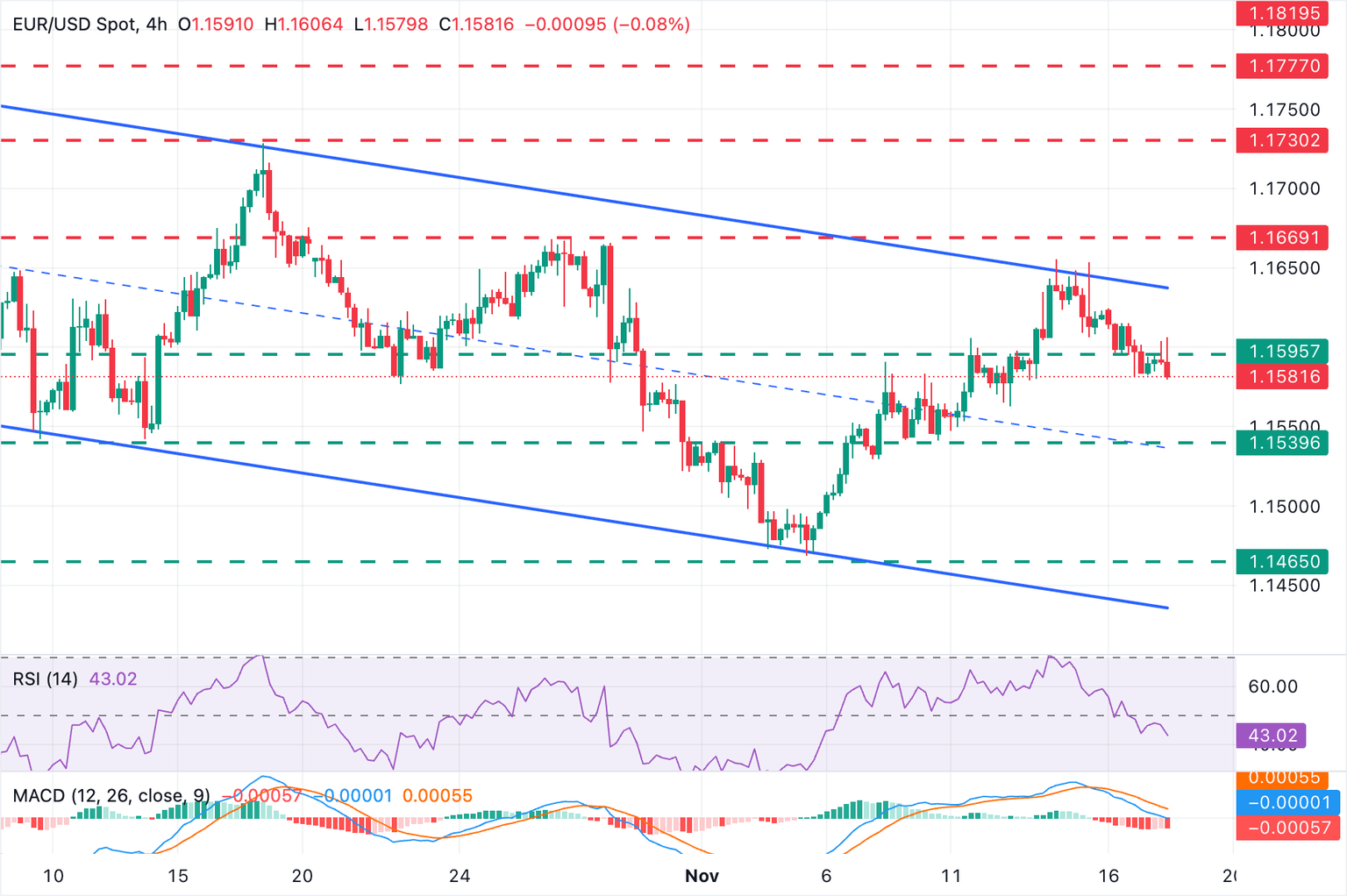
EUR/USD has come under renewed bearish pressure after rejection at the 1.1600 level. The 4-hour Relative Strength Index (RSI) indicator is capped below the 50 level, and the Moving Average Convergence Divergence (MACD) keeps trending lower, suggesting the possibility of a deeper correction.
The pair is retreating from a trendline resistance. If the pair confirms below Monday’s low at 1.1585, the November 7, 10, and 11 lows in the 1.1535-1.1545 area come to the focus ahead of the November 5 lows, near 1.1470.
To the upside, a previous support area around 1.1610 is likely to challenge bulls ahead of the top of the bearish channel, which now lies at the 1.1635 area. Above, the October 28 and 29 highs around 1.1670 would come into focus.
US Dollar FAQs
The US Dollar (USD) is the official currency of the United States of America, and the ‘de facto’ currency of a significant number of other countries where it is found in circulation alongside local notes. It is the most heavily traded currency in the world, accounting for over 88% of all global foreign exchange turnover, or an average of $6.6 trillion in transactions per day, according to data from 2022.
Following the second world war, the USD took over from the British Pound as the world’s reserve currency. For most of its history, the US Dollar was backed by Gold, until the Bretton Woods Agreement in 1971 when the Gold Standard went away.
The most important single factor impacting on the value of the US Dollar is monetary policy, which is shaped by the Federal Reserve (Fed). The Fed has two mandates: to achieve price stability (control inflation) and foster full employment. Its primary tool to achieve these two goals is by adjusting interest rates.
When prices are rising too quickly and inflation is above the Fed’s 2% target, the Fed will raise rates, which helps the USD value. When inflation falls below 2% or the Unemployment Rate is too high, the Fed may lower interest rates, which weighs on the Greenback.
In extreme situations, the Federal Reserve can also print more Dollars and enact quantitative easing (QE). QE is the process by which the Fed substantially increases the flow of credit in a stuck financial system.
It is a non-standard policy measure used when credit has dried up because banks will not lend to each other (out of the fear of counterparty default). It is a last resort when simply lowering interest rates is unlikely to achieve the necessary result. It was the Fed’s weapon of choice to combat the credit crunch that occurred during the Great Financial Crisis in 2008. It involves the Fed printing more Dollars and using them to buy US government bonds predominantly from financial institutions. QE usually leads to a weaker US Dollar.
Quantitative tightening (QT) is the reverse process whereby the Federal Reserve stops buying bonds from financial institutions and does not reinvest the principal from the bonds it holds maturing in new purchases. It is usually positive for the US Dollar.
About The Author