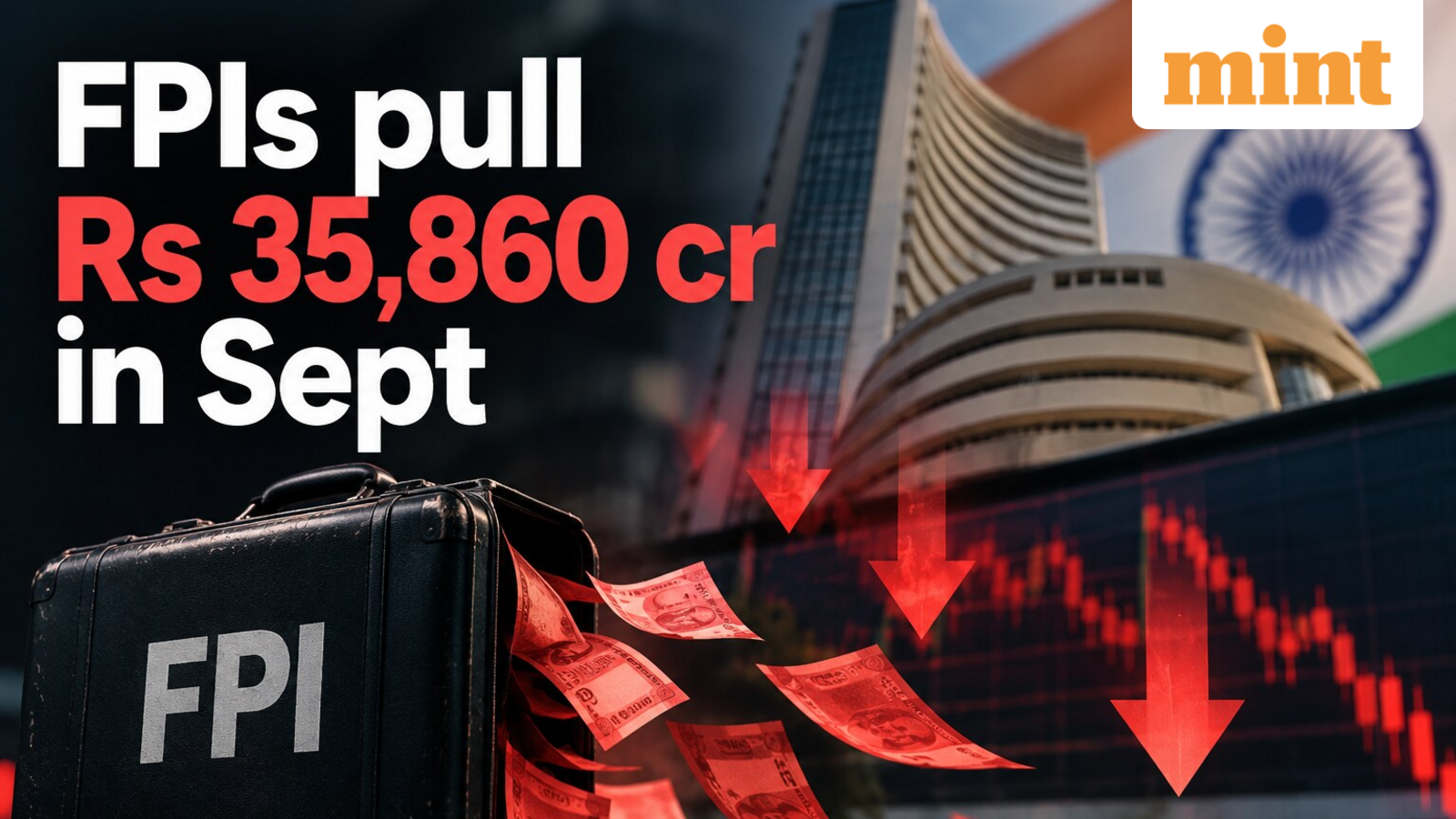
Foreign portfolio investors (FPIs) returned to selling Indian equities in September after two consecutive months of inflows, highlighting a problem that goes beyond the ease of entering the Indian market.
While the Securities and Exchange Board of India (SEBI) has been working with the Reserve Bank of India (RBI) to simplify onboarding and reduce regulatory friction, foreign investors continue to weigh India against competing markets on the basis of returns, yields, currency and global risk.
FPIs withdrew ₹35,860 crore from Indian equities in September, according to depository data reported after the close of the month. This came after they invested ₹20,200 crore in July and ₹29,630 crore in August, marking a sharp reversal in foreign flows.
The September selling also came as Indian equities suffered a steep correction. The Nifty 50 and Sensex declined almost 6% each.
SEBI is reducing friction
SEBI Chairman Tuhin Kanta Pandey has made it clear that the regulator is trying to address the operational hurdles faced by foreign investors.
Speaking to Moneycontrol on October 3, Pandey said SEBI had already eased the onboarding process and access for FPIs and was working with the RBI on further measures.
“We have eased their onboarding process, eased their access. We are working with the Reserve Bank of India (RBI) on further steps. We have to move forward in a collaborative manner,” Pandey said.
The regulatory push includes faster and digital FPI registration, streamlined KYC requirements and measures to reduce documentation and operational costs. SEBI has also introduced measures for trusted foreign investors, while further easing regulatory requirements for FPIs investing only in government securities.
SEBI’s SWAGAT-FI framework is designed to provide a more streamlined onboarding route for trusted, lower-risk foreign investors. The regulator has also introduced a framework for net settlement of funds for FPI transactions, which is aimed at reducing operational friction and costs. Securities and Exchange Board of India
But the September FPI numbers show why easier access cannot by itself guarantee higher equity inflows. Pandey pointed to the fundamental consideration for global investors: net returns.
“However, FPI look at returns on a net basis for their investment choices,” Pandey said, adding that India was “in a competitive situation” when it came to the choices foreign investors make.
That distinction is important. An investor may find it easier and faster to access Indian markets, but that does not necessarily mean the investor will allocate more money to Indian equities if competing markets offer better risk-adjusted or net returns.
US yields, crude and rupee add to India’s FPI challenge
The September sell-off came against a difficult global backdrop for emerging-market assets.
Higher US interest rates and bond yields increased the relative attractiveness of dollar-denominated assets. At the same time, elevated crude oil prices created additional pressure for India, a major oil importer, while a weaker rupee can reduce dollar-based returns for overseas investors. Higher US rates, geopolitical tensions in the Middle East and rising oil prices were also among the factors behind the September foreign outflows.
“FPI selling in the recent days has been huge. The surge in the US 10-year bond yield to above 5.2 % and concern that crude might remain elevated for longer also influenced the renewed FPI selling. Sustained FPI selling has significantly weakened the Indian market, which witnessed eight consecutive weeks of losses. The poor monsoons this year, with 13% deficient rains, also impacted sentiment.
The sharp correction in the market has made the valuations of large-caps attractive. But a reversal of the FPI selling will need positive developments, including a decline in crude and US bond yields. In the coming days, the market will be influenced by the FY27 Q2 results. Companies that report good Q2 numbers along with positive management commentary are likely to witness buying. Sustained buying by DIIs and retail investors has been supporting the market, preventing a major crash,” said V K Vijayakumar, Chief Investment Strategist, Geojit Investments.
This provides a broader explanation for why regulatory simplification may have limited influence over short-term FPI flows. If yields in competing economies rise, or if the dollar strengthens sharply, the relative attractiveness of Indian equities can change even without any deterioration in India’s domestic regulatory framework.
Dheeraj Gaur, Chief Investment Strategy Officer at Choice Wealth, further pointed out that with global investors finding attractive opportunities in dollar assets and parts of the Asian technology heavy markets, India has had to compete harder for incremental foreign capital – the significantly reduced “non-AI” trade.
The silver lining, if there is that the selling continues to look more like global asset-allocation and risk management than a wholesale loss of confidence in India’s underlying domestic growth story. Solution to the “equity return + currency return + US Treasury yield + portfolio allocation” equation does not seem to be in sight immediately. And, unfortunately, there’s no “make this painless” button on dealing screens either, he added.
For India, therefore, the challenge has two layers. SEBI and the RBI can make the market easier to access, reduce compliance costs and improve the investment process. But the ultimate allocation decision remains dependent on how Indian assets compare with opportunities elsewhere.
Disclaimer: The views and recommendations made above are those of individual analysts or broking companies, and not of Mint. We advise investors to check with certified experts before making any investment decisions.
About The Author