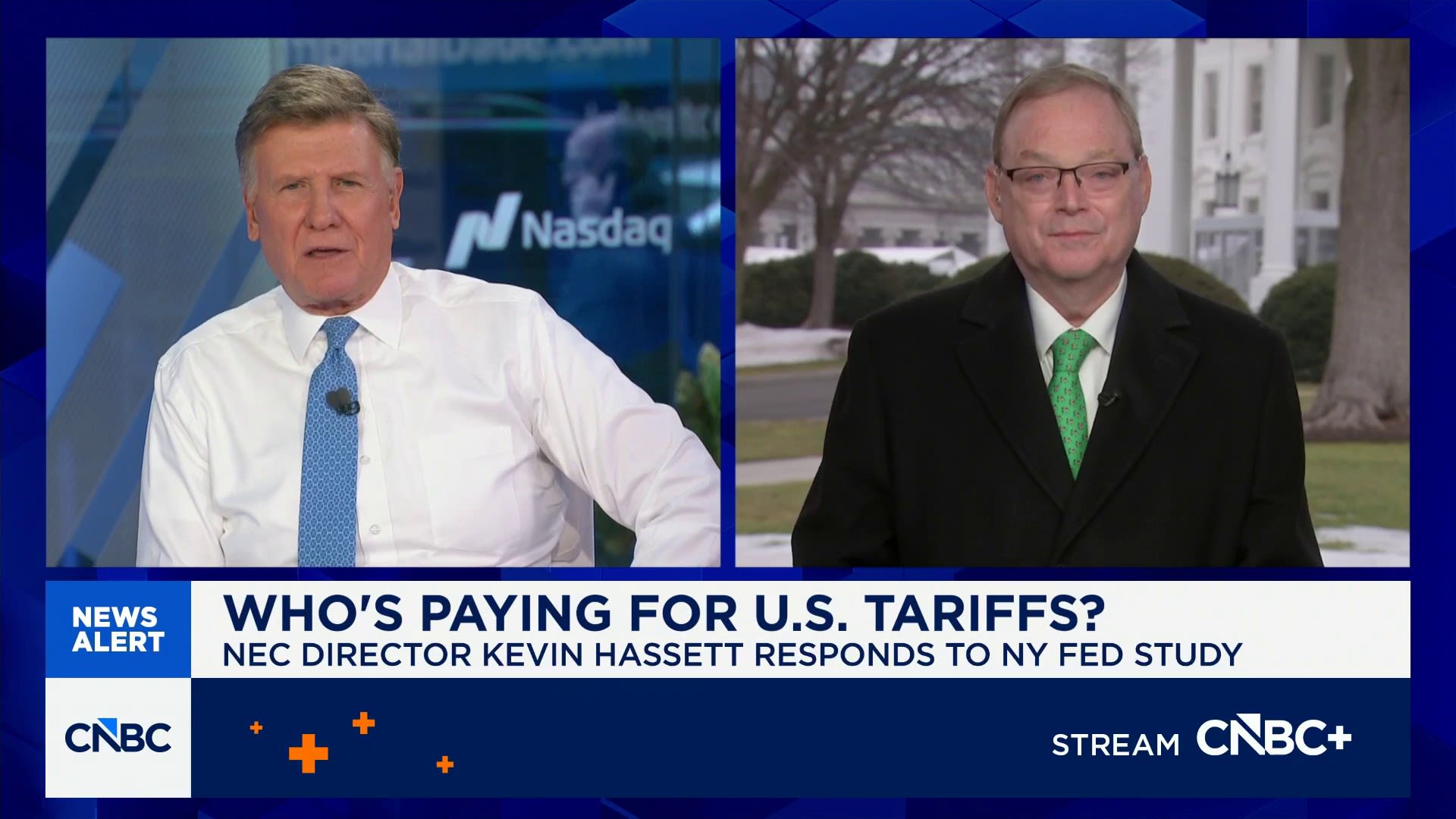

White House economic advisor Kevin Hassett said Wednesday that the authors of a recent New York Federal Reserve paper that found U.S. companies and consumers are shouldering most of the tariff burden should be “disciplined.”
In a CNBC interview, the National Economic Council director ripped the report, saying that central bank researchers ignored key aspects of how the duties worked and instead simply focused on prices. Hassett said the research also should have included the upward impact on wages and benefits that U.S. companies see by bringing more production onshore.
“I mean, the paper is an embarrassment,” Hassett said during the “Squawk Box” interview. “It’s, I think, the worst paper I’ve ever seen in the history of the Federal Reserve system. The people associated with this paper should presumably be disciplined, because what they’ve done is they’ve put out a conclusion which has created a lot of news that’s highly partisan based on analysis that wouldn’t be accepted in a first-semester econ class.”
The paper in question was published Feb. 12 on the New York Fed’s website.
Essentially, the researchers looked at whether countries that export products to the U.S. were lowering their prices, or in effect eating the tariffs, or raising their prices and passing them onto consumers and companies. The paper found that some 90% of the added costs from tariffs were being passed on, though it noted that the impact waned slightly as the year progressed.
However, Hassett insisted that the tariffs had little impact on prices and were responsible for a better standard of living.
“Prices have gone down. Inflation is down over time. Import prices dropped a lot in the first half of the year, that leveled off, and real wages were up $1,400 on average last year, which means that consumers were made better off by the tariffs,” he said. “So consumers couldn’t have been made better off by the tariffs, if this New York Fed analysis was correct. It’s really just an embarrassment. I can’t imagine who signed off on it.”
The consumer price index in January rose 2.4% from a year ago and is up nearly 2% from April 2025, when President Donald Trump first announced the tariffs. Core CPI, which excludes food and energy, was up 2.5% in January, its lowest annual gain since March 2021. Import prices in December were flat from a year ago while export prices rose 3.1%, according to the Bureau of Labor Statistics.
A New York Fed official declined comment.
About The Author