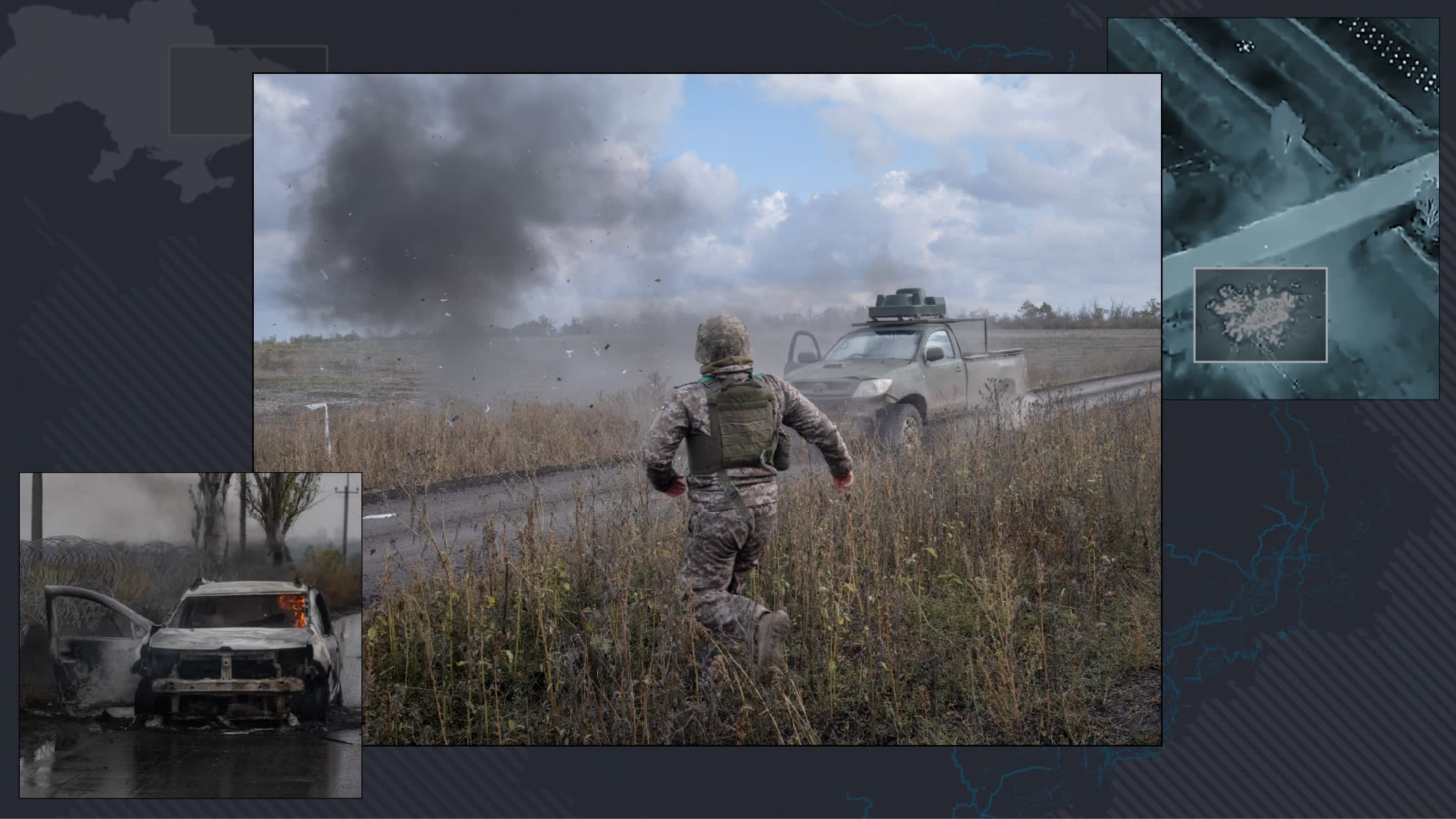
Even on a 30-minute drive from Russia’s positions in eastern Ukraine, being visible can be fatal.
The buzz of rotors overhead is constant. Fibre-optic cables criss-cross cratered fields. Pick-up trucks are encased in prickly metal cages for protection. In cities such as Kherson, nets are strung across roads and hospitals in an attempt to tame the sky.
Long gone are the days of large, concentrated troop movements, whether on foot or by vehicle. Soldiers crawl for days under cover of darkness and anti-thermal cloaks, or wait for fog thick enough to mask a rotation. Supplies arrive by drone; the wounded sometimes leave by robot.
Taras Chmut, a marine veteran and founder of Come Back Alive, one of the largest Ukrainian charities arming the military, refers to this netherworld as the “kill zone” — where anything that moves can be instantly targeted and destroyed.
Warfare had changed in a “radical way”, he said. And every month the kill zone grows in size. “For Europeans, it is still difficult to comprehend.”
A new reality
The old “rear”, where supply vehicles once moved freely, is now a target grid. And at the centre of this new warfare is the first-person-view (FPV) drone — loitering over supply lines, hunting vehicles and striking opportunistically with devastating precision.
The result is a near-total retreat of conventional transport from the forward-most combat area. “Almost no transport is used in the kill-zone closer to the frontline,” said Iryna Rybakova, press officer for the 93rd Kholodnyi Yar Separate Mechanized Brigade.
Movement by road is largely confined to bad weather — rain, snow or high winds — when visibility drops and drone control and optics are degraded.
About The Author