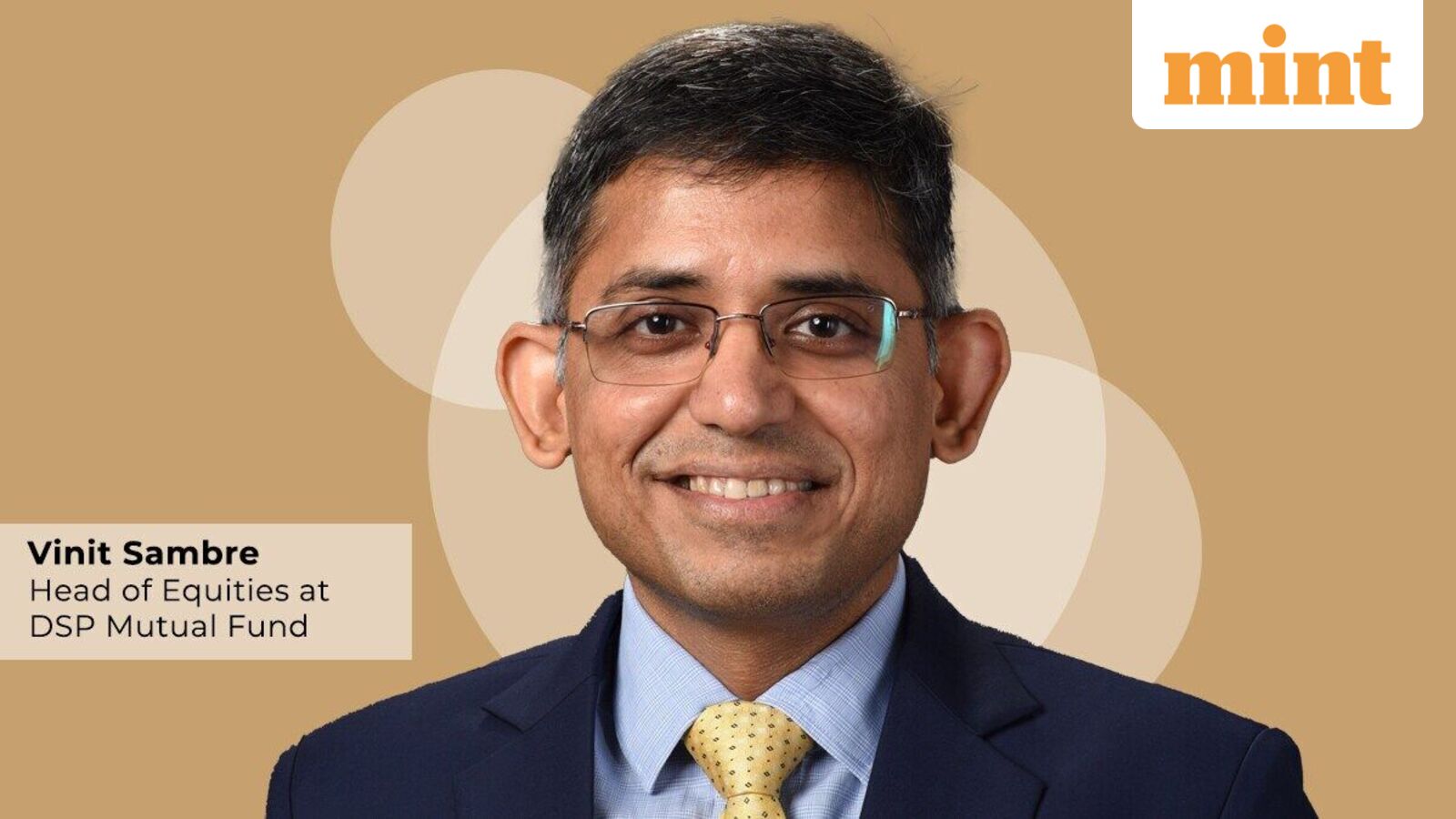
Vinit Sambre, the head of equities at DSP Mutual Fund, is optimistic about the Indian stock market for 2026.
“We believe there are enough catalysts for recovery in earnings growth and hence market outlook in the coming year,” Sambre says in an interview with Mint.
He says while the near-term outlook looks hazy at times, structural growth has not disappeared.
“We continue to remain constructive on India’s long-term ability to create wealth for patient investors,” says Sambre.
Here are edited excerpts of the interview:
How do you assess the market’s performance in 2025?
If we look at 2025, the market moved from a phase of strength to a period of consolidation.
After four consecutive years of strong double-digit earnings growth for the Nifty 50 (FY21-24), corporate earnings slowed to low single digits through FY25 and into the first half of FY26, and the full year looks similar.
Several factors came together at once. Post-election, government spending moderated, while private-sector capex didn’t fully step up to bridge the gap.
Banking liquidity dried up towards the beginning of 2025, household consumption remained soft, and uncertainty surrounding US tariffs hurt investor sentiment, particularly among foreign investors, while also pressuring export-oriented sectors such as textiles, gems and jewellery, and parts of the engineering industry.
At the same time, globally, market leadership became narrow, dominated by AI-linked technology giants. India didn’t have comparable large AI beneficiaries, so we naturally lagged in relative terms.
Add to this the extended monsoon, which disrupted agriculture and consumer-linked categories.
You had a year where the headwinds simply outweighed the tailwinds. So, it wasn’t about any single shock.
It was a confluence of cyclical factors that led to temporary underperformance versus global peers.
How is the market poised for 2026?
We think 2026 is shaping up to be a year of recovery. Several of the headwinds we discussed earlier are now being addressed.
On the monetary side, the RBI has injected liquidity through OMOs, dollar swaps and CRR cuts, while policy rates have been reduced by 125 bps through CY25.
This has brought surplus liquidity back into the system and eased financial conditions.
On the fiscal side, the government has raised tax-free income thresholds and cut GST rates in several categories, effectively putting more disposable income in consumers’ hands.
With both fiscal and monetary levers now active, the backdrop for growth looks much healthier.
We are also seeing encouraging shifts where Indian IT companies are investing aggressively to build capabilities around AI, and we believe the revenue pools here would grow over time.
Of course, some pieces still need work: stronger private-sector capex, sustained job creation, and clarity on US tariff policies.
But these are evolving issues, and our sense is that they will gradually find resolution.
Taken together a low base, improving policy support and better liquidity, we believe there are enough catalysts for recovery in earnings growth and hence market outlook in coming year.
What are the structural growth areas in your view?
When we think about structural growth in India, the foundation is still the same, but the composition is evolving in interesting ways.
India remains a consumption-driven economy. With an average age of just 27–28 years, our working population will stay supportive for many years, and that naturally feeds into rising consumption.
Consumption accounts for roughly 60–62% of GDP. Within that, urbanisation and premiumisation themes remain firmly intact.
Yes, we’ve seen softness in some categories like rural demand, low-income consumption, FMCG and building materials, for example.
But at the same time, entirely new growth pockets have opened up: quick commerce, air travel, tourism and other experience-led spending are growing at a rapid clip.
What we are really seeing is a shift in where and how people are spending.
Beyond consumption, another structural theme is clearly the energy transition.
India is moving decisively toward cleaner power. 2025 has been one of our strongest years for solar capacity addition, and installed renewable capacity is now nearly at par with conventional.
For a country of our size, that is a significant milestone. And finally, while India may have missed the early phase of the global AI boom, our IT companies are investing to participate meaningfully in the ecosystem.
As capabilities scale, this can open new growth vectors over time. So even if the near-term outlook looks hazy at times, structural growth has not disappeared.
We continue to remain constructive on India’s long-term ability to create wealth for patient investors.
What are your expectations for Q3 earnings? Can we expect banking and IT to deliver better results?
For Q3, we expect earnings momentum to stay fairly muted. Our channel checks suggest that demand has tapered off post the festive season, and some of that recovery now looks pushed out.
On banking, there has been a modest improvement in credit growth, but we still see pressure on margins.
With the RBI cutting rates further, lending rates adjust faster than deposit costs, which could weigh on NIMs in the near term.
In IT, we would temper expectations as well. Q3 is seasonally weak because of furloughs, and we don’t yet see a meaningful deviation from the Q2 run-rate.
What are your key expectations from Budget 2026 from the market’s perspective?
Budget 2026 carries a crucial opportunity: to catalyse investment, lift productivity, and help India move decisively into its next phase of growth.
A key priority, in our view, should be bigger incentives for manufacturing, especially in areas like electronics manufacturing services and engineering.
Anything that unlocks meaningful private-sector capex deserves attention.
This naturally supports job creation as well, which is critical at a time when forces such as AI-led deflation and global trade disruptions could pressure employment.
Well-designed tax incentives that reward companies for hiring, training, and formalising workers can generate significant long-term social and economic benefits.
India will have to build a credible domestic AI ecosystem. Policy support for data centres, including capital refunds and selective customs duty waivers on critical equipment, can materially reduce project costs and speed up adoption.
Alongside this, continued focus on renewables remains essential. Expanding the share of clean power not only reduces energy risk but also attracts long-term capital.
And finally, AI and other emerging technologies must be embedded across the education system. That is how we create the talent pipeline India will need over the next decade.
Read all market-related news here
Read more stories by Nishant Kumar
Disclaimer: This story is for educational purposes only. The views and recommendations expressed are those of the expert, not Mint. We advise investors to consult with certified experts before making any investment decisions, as market conditions can change rapidly and circumstances may vary.
About The Author