Proceeds from the fresh issue are earmarked for technology and cloud infrastructure ( ₹190 crore), marketing ( ₹90 crore), and lease payments ( ₹75 crore).
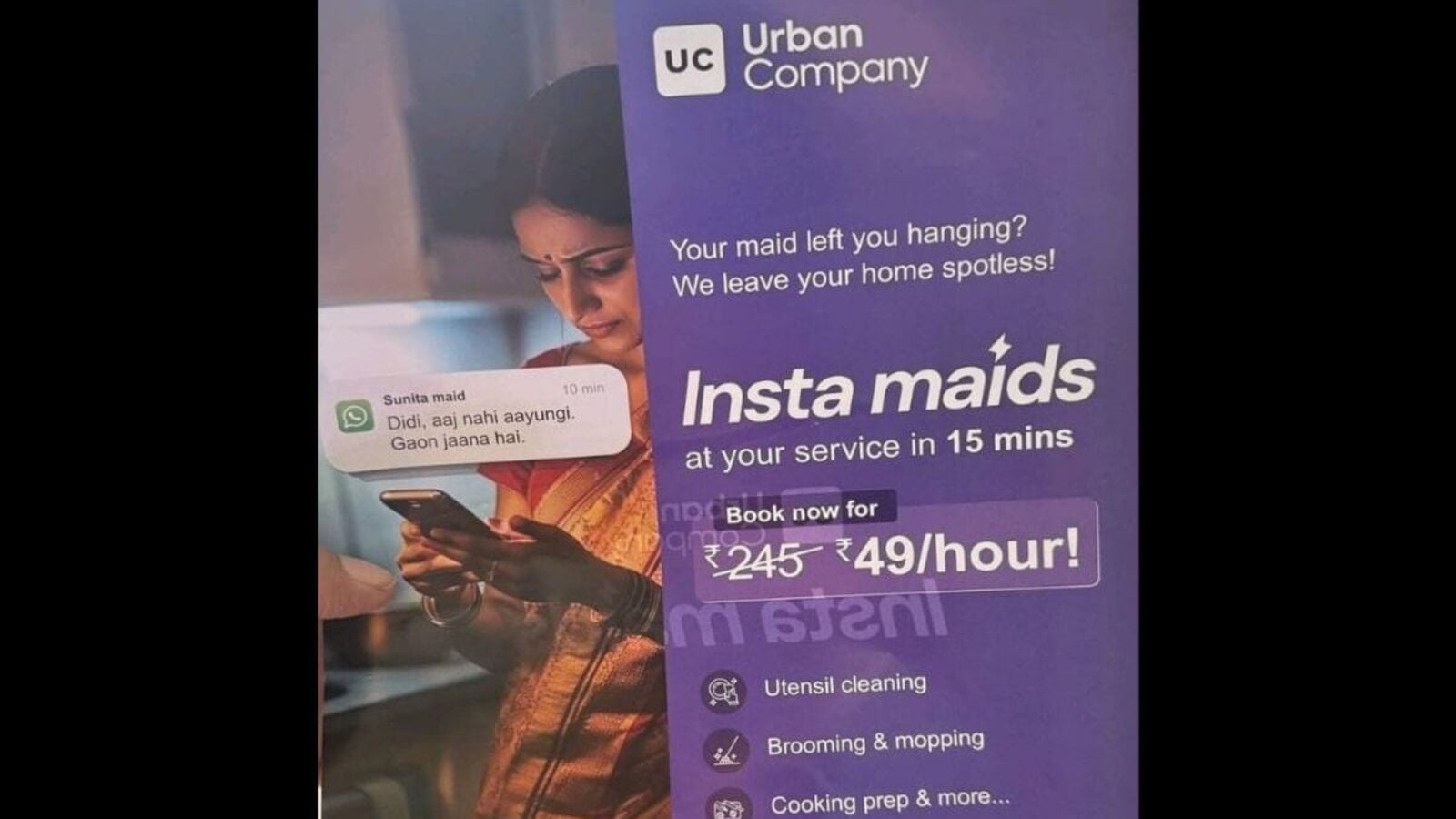
Operating in 51 cities across India, along with overseas bases in the United Arab Emirates (UAE) and Singapore, Urban Company connects millions of households with trained professionals for services ranging from appliance repair to at-home beauty treatments. The company has recently ventured into branded products under its “Native” line—water purifiers and smart locks—and expanded InstaHelp, its on-demand house-help vertical.
The company reported a financial turnaround in FY25, moving from losses to a reported profit, a milestone that strengthens its IPO pitch. Yet challenges remain, including accounting nuances, overseas losses, reputational risks, and ongoing litigation.
Structural shifts
Urban Company’s growth reflects a platform still in transition. Revenue as a percentage of net transaction value (NTV) rose from 30.6% in FY23 to 35.6% in Q1FY26.
“Our revenue has grown nearly five times in the last four years, driven by more customers, higher spending, more transactions, and better monetization. We believe we’re just getting started,” Abhiraj Singh Bhal, chief executive of Urban Company, told Mint in an interview.
“The home services market in India is massive, yet largely unorganised. Our focus is to bring it online, set standards, ensure quality and reliability for users, and empower professionals through training, tools, and technology,” Bhal said.
Analysts, however, advise caution.
“The improvement in revenue as a percentage of NTV is structural. UCL has shifted towards higher-value services and monetization through tools/consumables sales,” said Ratiraj Tibrewal, director, Choice Capital. “However, some of the gains also reflect short-term pricing actions and better take rates in newer categories, which could flatten if competition pressures pricing. Expecting it to sustain at current levels may be optimistic; stabilization, however, is more realistic in the long term.”
“This shows structural pricing power, as Urban Company captures both service and ecosystem spend. The challenge is whether take-rates hold up as competition with fresh funding pushes down commissions, especially in price-sensitive categories. Strong repeat usage at 82% of NTV suggests stickiness, but margins could be pressured if the company leans too much on products with higher costs and legal risks,” noted Harshal Dasani, business head at INVasset PMS.
User stickiness
Urban Company has steadily expanded its customer base and engagement. Annual transacting users rose from 4.93 million in FY23 to 7.02 million in Q1FY26. Active service professionals increased from 42,523 to 54,347 over the same period. By June, nearly 14.6 million consumers had transacted at least once, nearly half joining in the last three years.
The company is focused on converting one-time users into multi-service loyal customers.
“Users on our platform don’t stick to just one category. They expand into multiple services, making it more of a home platform than a single-transaction app. To strengthen this, we’re investing in multi-category checkout, subscriptions and loyalty programmes,” Bhal said.
Analysts, however, note that growth durability will be tested.
“Adding 6.81 million new consumers in three years shows rapid acquisition, driven by urban expansion and category breadth. Sustainability will hinge on repeat usage, not just sign-ups. Retention will be tested as vertical specialists ramp up discounts,” said Tibrewal.
Geographically, too, the company has deepened its footprint. Service micro-markets rose from 8,931 in FY23 to 10,578 in Q1FY26, highlighting deeper local penetration.
Profitability puzzle
The company reported a net profit of ₹239.7 crore in FY25, though ₹211.2 crore stemmed from deferred tax credits, raising questions about the sustainability of earnings.
“The key is to keep margins expanding in core India services, which are profitable, while carefully managing international and new verticals that are loss-making,” Bhal said.
Analysts stress the need for fundamental improvement.
“Earnings are likely to stay thin in the near term, though efficiency gains and stronger retention could improve margins gradually,” noted Dasani
“Urban Company’s FY25 profit was largely driven by tax credits, with core operations still in loss. Sustainable profitability hinges on scaling higher-margin services, cutting attrition costs, and tightening expenses, with breakeven likely only over the longer term,” Tibrewal added.
Subsidiaries further complicate the picture. Handy Home, which contributed 17% of Q1FY26 revenues, has been loss-making for three years, including a ₹4.6 crore loss in the June quarter. International operations also weighed on results: Singapore-based Urban Home lost ₹12 crore, while UAE-based UrbanClap DMCC reported a ₹1.26 crore loss. Some subsidiaries have even been deregistered.
Working capital pressures are also mounting, with trade receivables doubling from ₹10.68 crore in FY23 to ₹26.6 crore in FY25.
Reputational risks add another layer. Consumer complaints surged from 0.35 million to 1.06 million in the last three years. Though resolution rates remain high at 97-99%, the sheer volume of complaints threatens brand credibility.
“Complaints rose in FY25, reflecting higher volumes and some service gaps. While resolution rates remain strong, the rising complaint load poses a reputational risk for a trust-led brand, underscoring the need to prevent quality lapses rather than just resolve them,” Tibrewal said.
Structural threats
The company’s dependence on its professional partner network is both its engine and its Achilles’ heel. Onboarding costs have averaged over 27% of its domestic revenues between FY23 and FY25, while attrition has hovered around 45%.
Bhal acknowledged the challenge: “High onboarding costs mean we must recover them over time, which is only possible if churn falls.”
Analysts concur.
“With onboarding costs exceeding 27% of India revenues and attrition at 45%, margins face significant pressure. High churn forces continual reinvestment in training and hiring, limiting operating leverage. Scalability will remain constrained until attrition drops, onboarding costs reduces, and adoption of tools and consumables improves,” said Tibrewal.
Highlighting scalability concerns, Dasani pointed: “Benefits for professionals may reduce attrition, but they also increase costs. Unless churn declines, supply-side fragility will remain a risk.
Moreover, competition remains stiff in this segment. Offline operators dominate the unorganised sector, while online penetration of home services in India is still below 1%. Risks of disintermediation persist: users and professionals may bypass the platform after initial contact.
Legal overhang
Urban Company’s product push under the “Native” brand has already run into legal trouble. Kent RO Systems has filed a patent infringement suit against the company over its water purifiers. The case, pending in the Delhi High Court, involves both an injunction request and a ₹120 million countersuit.
“The patent dispute poses a manageable but notable risk. An adverse outcome could restrict product scaling in home solutions, though the core services business remains unaffected,” Tibrewal noted.
Market opportunity
Despite headwinds, the opportunity is vast.
India’s home services industry, valued at ₹4.2 trillion in FY23, is projected to more than double in the next seven years. Online penetration, still less than 1%, is expected to grow at a compounded annual growth rate of 18-22%, expanding the online segment to ₹41-43 billion by 2030.
Full-stack platforms like Urban Company are expected to nearly double their market share, from 0.7% to 1.3% over the same period.
About The Author