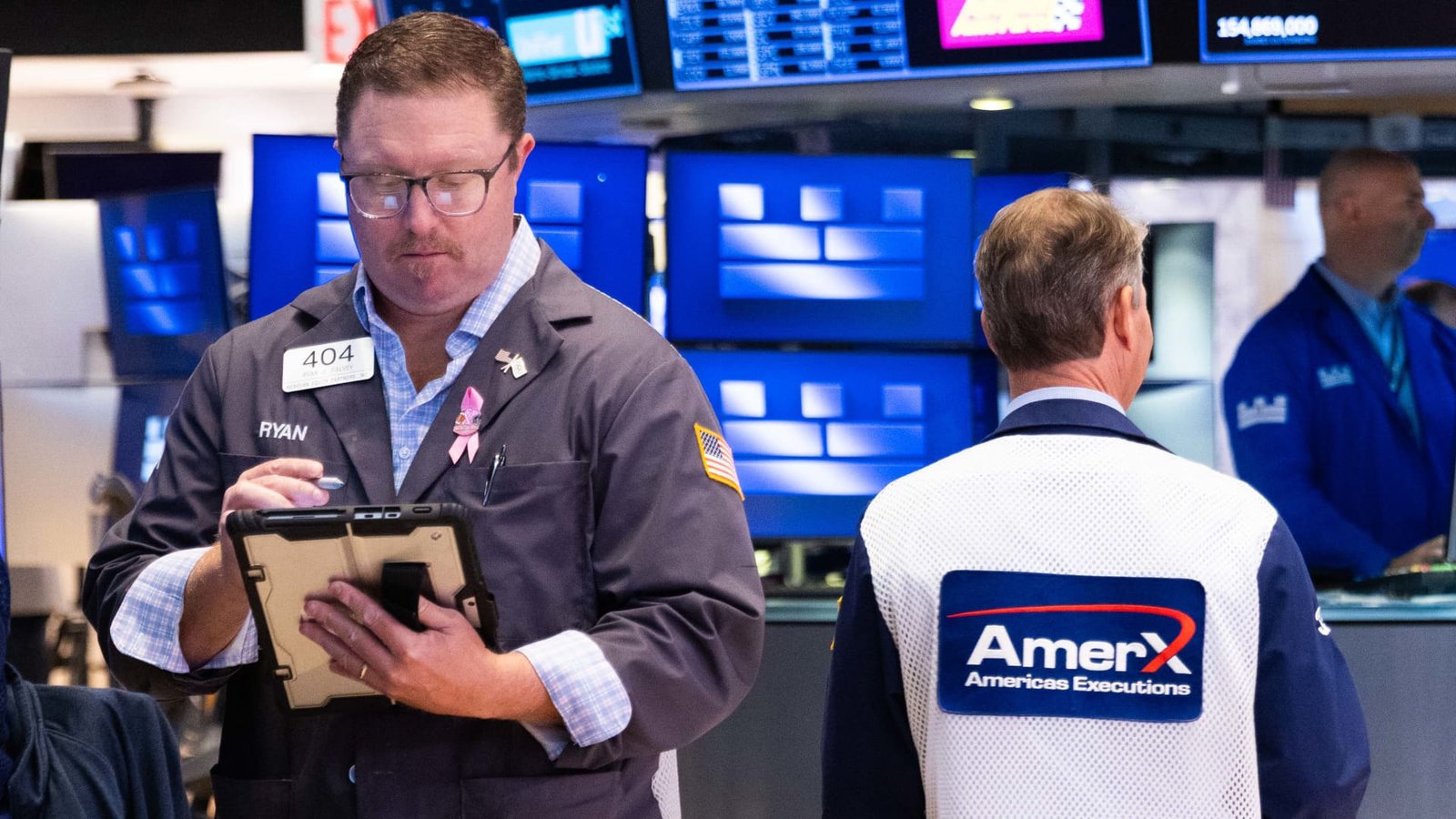
Traders work at the New York Stock Exchange on Aug. 25, 2026.
NYSE
Treasury yields were little changed Wednesday, as traders assessed the Federal Reserve’s preferred inflation gauge which came mostly in line with estimates.
The yield on the10-year Treasury note— the key benchmark for mortgages, auto loans and credit card debt — was little changed at 4.645%.
The longer-dated30-year Treasurybond yield was also flat at 5.175%, while the yield on the 2-year Treasury note was unchanged at 4.205%.
One basis point equals 0.01%, or 1/100th of 1%, and yields and prices move inversely to one another.
July’spersonal consumption expenditure reading — the Fed’s preferred inflation gauge — came in slightly higher than expected. The inflation rate rose a seasonally adjusted 0.2% for the month, and 3.7% for the year, according to the Commerce Department. They were both 0.1 percentage point above the Dow Jones consensus estimate.
But core PCE, which excludes volatile food and energy prices, rose 0.2% and 3.3% on the month and year, respectively, in line with forecasts. Central bank policymakers typically see core inflation as a better measure of longer-term trends.
The data comes ahead of the Fed’s Jackson Hole conference, at which Fed Chairman Kevin Warsh is expected to address persistently high inflation amid conflict in the Middle East. The Jackson Hole Economic Policy Symposium starts Thursday. Warsh is set to deliver a speech on Friday.
Oil prices offered some reprieve on that front this week, extending declines on Tuesday, amid reports that Iran and Oman are nearing a deal to secure safe transit through the Strait of Hormuz.
Brent futures, the international benchmark, fell 2.8% to $86.08 per barrel. U.S. West Texas Intermediate crude was down 3% at $79.93 a barrel.
— CNBC’s Jeff Cox contributed to this report.
About The Author