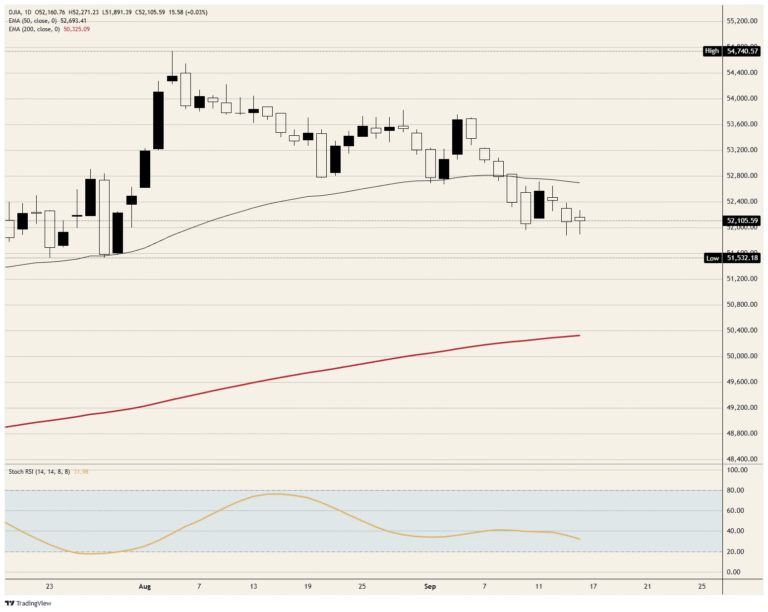
- The S&P Global flash PMIs for September are expected to show continued expansion in the month.
- The employment and inflation sub-indices will gather modest attention ahead of PCE inflation data.
- EUR/USD likely to remain rangebound in the near term, bulls in pause.
S&P Global will release on Tuesday the September flash Purchasing Managers’ Indices (PMIs) for most major economies, including the United States (US). These surveys of top private sector executives provide an early indication of the business sector’s economic health.
Market participants anticipate that the Services PMI will print at 53.9, following the 54.5 posted in August, while manufacturing output is expected to print at 52.0, slightly below the 53.0 reading of the previous month. Finally, the Composite PMI is expected to match the August final reading at 54.6.
S&P Global separates manufacturing activity from services activity, reporting them separately through the Manufacturing PMI and the Services PMI. Additionally, they present a weighted combination of the two, the Composite PMI. Generally speaking, a reading of 50 or more indicates expansion, while below the threshold, the indexes indicate contraction.
The report has two versions, a preliminary estimate and a final revision, which comes around two weeks later. These preliminary versions or flash estimates tend to have a broader impact on the US Dollar.
Nevertheless, the encouraging recovery of the Manufacturing PMI above the 50 mark that separates contraction from expansion fueled hopes for healthy economic progress. Chris Williamson, Chief Business Economist at S&P Global Market Intelligence, argued, “A strong flash PMI reading for August adds to signs that US businesses have enjoyed a strong third quarter so far. The data are consistent with the economy expanding at a 2.5% annualised rate, up from the average 1.3% expansion seen over the first two quarters of the year.”
What can we expect from the next S&P Global PMI report?
The unexpected recovery in manufacturing output has lifted the bar for the September release. Investors will look for confirmation that the US economy is progressing at a steady pace and remains in expansionary territory.
With that in mind, figures in line with expectations will be viewed as positive news, particularly in relation to the Manufacturing PMI. Upbeat numbers could result in Wall Street extending its record rally and partially revive demand for the US Dollar. Finally, a worse-than-anticipated outcome will likely push the USD further down amid fresh speculation of steeper interest rate cuts.
Beyond the headline readings, the reports include sub-indices on employment and inflation, closely watched by market players. More punctual inflation data will be released on Friday, when the US will publish the Personal Consumption Expenditure (PCE) Price Index, which mitigates the potential impact of the PMIs subindex. Still, given the absence of other relevant data, expect financial markets to react to the preliminary S&P Global estimates.
When will the September flash US S&P Global PMIs will be released and how could they affect EUR/USD?
The S&P Global Manufacturing, Services, and Composite PMIs reports will be released at 13:45 GMT on Tuesday, and as previously noted, are expected to show that US business activity continued to expand in September.
Ahead of the release, the USD trades with a weak tone against most major rivals. The Greenback consolidates not far from yearly lows against the Euro (EUR).
Valeria Bednarik, FXStreet Chief Analyst, notes: “The EUR/USD pair has been trading in a well-limited range since mid-August, reaching a fresh 2025 peak of 1.1918 in the Fed’s monetary policy announcement aftermath, but quickly retreating to sub-1.1800. The technical outlook indicates that bulls retain the lead, but are hesitant to push it further upward. The daily chart for the pair shows that buyers are defending the downside at around a mildly bullish 20 Simple Moving Average (SMA) at 1.1720. At the same time, technical indicators bounced from near their midlines and offer modest upward slopes within positive levels, albeit far below the previous week’s peak. Indicators have remained within positive levels since September began.”
Bednarik adds: “Immediate resistance for EUR/USD comes at 1.1830, the former 2025 peak ahead of the aforementioned 1.1918 level. Additional gains, unlikely to be triggered by the S&P Global PMIs release, expose the 1.2000 threshold. On the contrary, initial support comes at the aforementioned 1.1720 region, ahead of the 1.1660 area. Further slides expose the 1.1600 mark, an unlikely extreme for this particular event.”
US Dollar FAQs
The US Dollar (USD) is the official currency of the United States of America, and the ‘de facto’ currency of a significant number of other countries where it is found in circulation alongside local notes. It is the most heavily traded currency in the world, accounting for over 88% of all global foreign exchange turnover, or an average of $6.6 trillion in transactions per day, according to data from 2022.
Following the second world war, the USD took over from the British Pound as the world’s reserve currency. For most of its history, the US Dollar was backed by Gold, until the Bretton Woods Agreement in 1971 when the Gold Standard went away.
The most important single factor impacting on the value of the US Dollar is monetary policy, which is shaped by the Federal Reserve (Fed). The Fed has two mandates: to achieve price stability (control inflation) and foster full employment. Its primary tool to achieve these two goals is by adjusting interest rates.
When prices are rising too quickly and inflation is above the Fed’s 2% target, the Fed will raise rates, which helps the USD value. When inflation falls below 2% or the Unemployment Rate is too high, the Fed may lower interest rates, which weighs on the Greenback.
In extreme situations, the Federal Reserve can also print more Dollars and enact quantitative easing (QE). QE is the process by which the Fed substantially increases the flow of credit in a stuck financial system.
It is a non-standard policy measure used when credit has dried up because banks will not lend to each other (out of the fear of counterparty default). It is a last resort when simply lowering interest rates is unlikely to achieve the necessary result. It was the Fed’s weapon of choice to combat the credit crunch that occurred during the Great Financial Crisis in 2008. It involves the Fed printing more Dollars and using them to buy US government bonds predominantly from financial institutions. QE usually leads to a weaker US Dollar.
Quantitative tightening (QT) is the reverse process whereby the Federal Reserve stops buying bonds from financial institutions and does not reinvest the principal from the bonds it holds maturing in new purchases. It is usually positive for the US Dollar.
Economic Indicator
S&P Global Manufacturing PMI
The S&P Global Manufacturing Purchasing Managers Index (PMI), released on a monthly basis, is a leading indicator gauging business activity in the US manufacturing sector. The data is derived from surveys of senior executives at private-sector companies from the manufacturing sector. Survey responses reflect the change, if any, in the current month compared to the previous month and can anticipate changing trends in official data series such as Gross Domestic Product (GDP), industrial production, employment and inflation. A reading above 50 indicates that the manufacturing economy is generally expanding, a bullish sign for the US Dollar (USD). Meanwhile, a reading below 50 signals that activity in the manufacturing sector is generally declining, which is seen as bearish for USD.
Read more.
Next release:
Tue Sep 23, 2025 13:45 (Prel)
Frequency:
Monthly
Consensus:
52
Previous:
53
Source:
S&P Global
About The Author