Gold (XAU/USD) attracts some sellers for the second consecutive day and drops to a one-week low, around the $4,575 region, during the first half of the European session on Wednesday. Persistent geopolitical uncertainties continue to support the safe-haven US Dollar (USD) and undermine demand for the commodity. Moreover, inflationary concerns have raised expectations for more hawkish central banks, including the US Federal Reserve (Fed), contributing to driving flows away from the yellow metal.
US forces launched self-defense strikes on southern Iran on Monday, targeting Iranian missile sites and boats attempting to place mines. Iran’s Foreign Ministry condemned the US attacks as a violation of a ceasefire that has been in place since early April. Adding to this, the Islamic Revolutionary Guard Corps (IRGC) said that Iran had the legitimate and definite right to retaliate against any US ceasefire violations. Furthermore, Iranian Supreme Leader Mojtaba Khamenei declared that regional countries would no longer act as protective zones for US military bases. This keeps geopolitical risk premium in play and underpins the Greenback’s reserve currency status, weighing on the Gold price.
Meanwhile, the US-Iran standoff, along with the effective closure of the Strait of Hormuz and the US blockade of Iranian ports, might continue to support Crude Oil prices and fuel inflation fears. This, in turn, prompts major central banks to adopt a more hawkish stance, with the Reserve Bank of Australia (RBA) hiked interest rates in May, while the European Central Bank (ECB), the Bank of Japan (BoJ), and the Reserve Bank of New Zealand (RBNZ) are expected to raise interest rates by the end of this year. Adding to this, traders are now pricing in roughly a 50% chance of a rate increase by December. This offers additional support to the USD and contributes to capping the upside for the non-yielding Gold.
Moving ahead, there isn’t any relevant market-moving economic data due for release from the US on Wednesday, leaving the USD at the mercy of comments from influential FOMC members and fresh developments surrounding the Middle East crisis. Traders, however, might refrain from placing aggressive bets and opt to wait for the release of the US Personal Consumption Expenditures (PCE) Price Index, along with the Preliminary (second estimate) US GDP report on Thursday. In the meantime, the aforementioned fundamental backdrop seems tilted firmly in favor of the XAU/USD bears, warranting some caution before positioning for any meaningful intraday recovery in the Gold price.
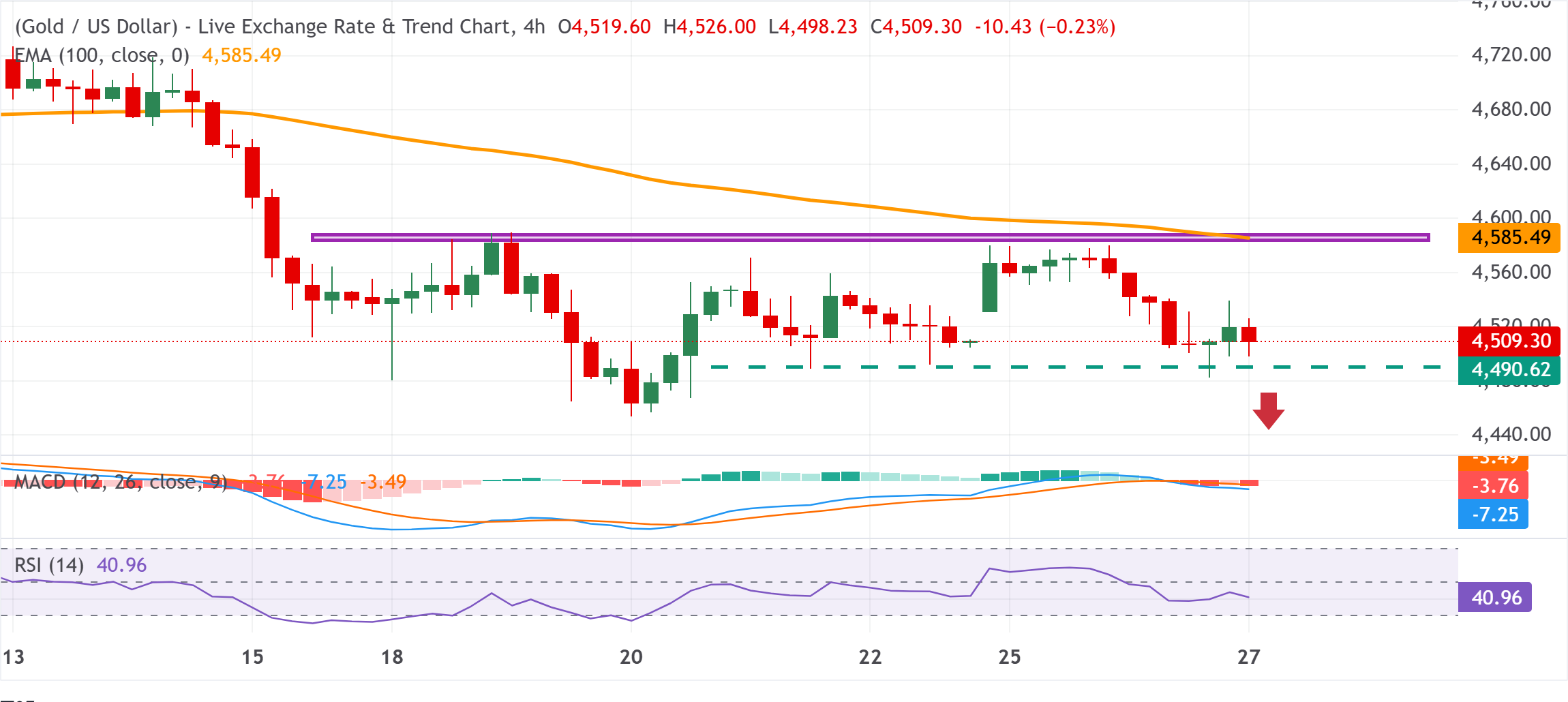
XAU/USD 4-hour chart
Gold bears seize control as breakdown below $4,500 pivotal support comes into play
From a technical perspective, the precious metal keeps a mildly bearish near-term tone following this week’s failure near the $4,580 horizontal barrier. The said area now coincides with the 100-period Exponential Moving Average (EMA) on the 4-hour chart and should now act as a key pivotal point. A sustained recovery above this hurdle is needed to ease the current bearish structure and open the way for a more durable rebound.
Meanwhile, the Relative Strength Index (RSI) stays below the neutral band, near 41, and the Moving Average Convergence Divergence (MACD) sits in negative territory. Momentum indicators, in turn, suggest persistent downside pressure despite a lack of fresh momentum extremes. Nevertheless, a clean break below the monthly swing low, around the $4,450 area, would likely invite an extension of the current corrective phase.
(The technical analysis of this story was written with the help of an AI tool.)
Central banks FAQs
Central Banks have a key mandate which is making sure that there is price stability in a country or region. Economies are constantly facing inflation or deflation when prices for certain goods and services are fluctuating. Constant rising prices for the same goods means inflation, constant lowered prices for the same goods means deflation. It is the task of the central bank to keep the demand in line by tweaking its policy rate. For the biggest central banks like the US Federal Reserve (Fed), the European Central Bank (ECB) or the Bank of England (BoE), the mandate is to keep inflation close to 2%.
A central bank has one important tool at its disposal to get inflation higher or lower, and that is by tweaking its benchmark policy rate, commonly known as interest rate. On pre-communicated moments, the central bank will issue a statement with its policy rate and provide additional reasoning on why it is either remaining or changing (cutting or hiking) it. Local banks will adjust their savings and lending rates accordingly, which in turn will make it either harder or easier for people to earn on their savings or for companies to take out loans and make investments in their businesses. When the central bank hikes interest rates substantially, this is called monetary tightening. When it is cutting its benchmark rate, it is called monetary easing.
A central bank is often politically independent. Members of the central bank policy board are passing through a series of panels and hearings before being appointed to a policy board seat. Each member in that board often has a certain conviction on how the central bank should control inflation and the subsequent monetary policy. Members that want a very loose monetary policy, with low rates and cheap lending, to boost the economy substantially while being content to see inflation slightly above 2%, are called ‘doves’. Members that rather want to see higher rates to reward savings and want to keep a lit on inflation at all time are called ‘hawks’ and will not rest until inflation is at or just below 2%.
Normally, there is a chairman or president who leads each meeting, needs to create a consensus between the hawks or doves and has his or her final say when it would come down to a vote split to avoid a 50-50 tie on whether the current policy should be adjusted. The chairman will deliver speeches which often can be followed live, where the current monetary stance and outlook is being communicated. A central bank will try to push forward its monetary policy without triggering violent swings in rates, equities, or its currency. All members of the central bank will channel their stance toward the markets in advance of a policy meeting event. A few days before a policy meeting takes place until the new policy has been communicated, members are forbidden to talk publicly. This is called the blackout period.
About The Author