
Federal Reserve Chairman Kevin Warsh speaks during a news conference at the William McChesney Martin Jr. Federal Reserve Board Building in Washington, July 29, 2026.
Brendan Smialowski | Afp | Getty Images
Central bankers, policymakers and economists will gather in Jackson Hole, Wyoming, on Thursday for the Federal Reserve Bank of Kansas City’s annual economic policy symposium.
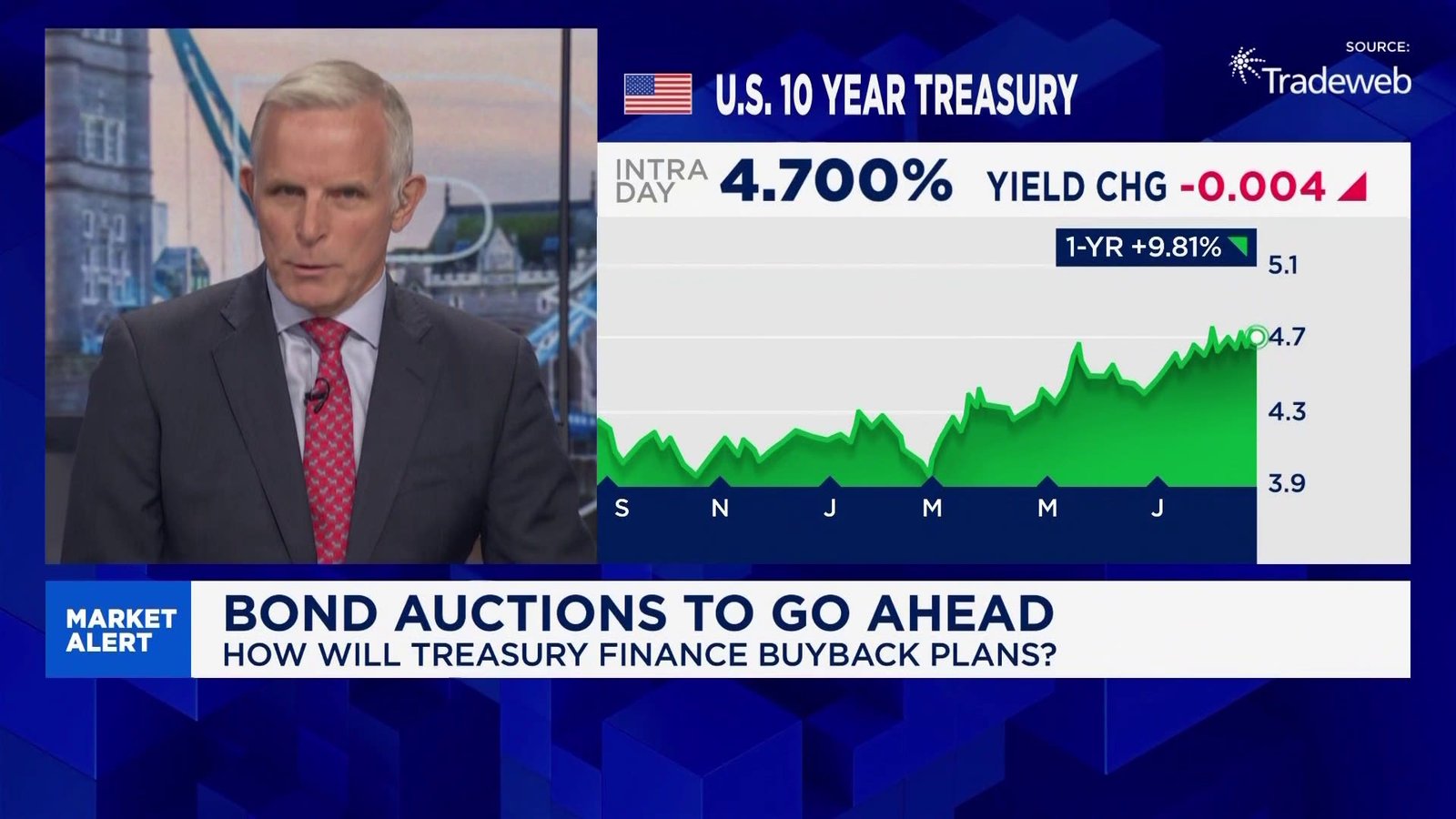
Markets are closely monitoring the event for Fed Chair Kevin Warsh’s keynote speech after long-term borrowing costs hit a near-two-decade high last week and the Treasury’s bombshell bond market intervention.
Warsh is due to speak at the event on Friday, with market watchers expecting what he says — or doesn’t say — to shape investors’ expectations for Fed policy and potentially trigger trading activity.
Last week, the U.S. Treasury Department announced it would increase its buybacks of long-term government debt, saying it would at least double the maximum size of its repurchasing operation to $4 billion from Sept. 9.

The move, which some investors and analysts interpreted as an effort to lower U.S. government bond yields, helped curb a sell-off that had gripped bond markets in the preceding days. That stress in the market saw the yield on the 30-year Treasury note surge to a 19-year high, amid mounting concerns about inflation and the U.S. fiscal deficit.
But U.S. Treasury Secretary Scott Bessent’s plans came under fire from some prominent market watchers, who said increasing the buybacks could put pressure on the economy, complicate the Federal Reserve’s inflation fight and intensify political pressure on the independent central bank.
Inflation remains above target, with data published Wednesday showing the personal consumption expenditures price index — the Fed’s preferred inflation gauge — rose 3.7% in the year to July.
In a note on Wednesday, Bank of America FX strategists said the U.S. dollar was “on edge” ahead of Jackson Hole, with the greenback vulnerable to an extended sell-off if Warsh “disappoints markets.”
Since the Fed’s last Federal Open Market Committee meeting in July, the partial unwinding of long positions in the U.S. dollar has been a key theme in foreign exchange markets, according to BofA analysis.

U.S. dollar index
In an earlier note, strategists at the investment bank had labeled Jackson Hole a “key risk event” for both bonds and the dollar.
They said that, following the Treasury’s bond market intervention, the Fed can “also do its part” to help contain long-end Treasury yields either by taking a more hawkish policy stance, or by giving clearer guidance on the inflation outlook and its reaction function.
“We expect Chair Warsh to change his communication to help contain the bond. If he does not, wewould beconcernedabouta potentialrapid [long end] bond rise to 5.5%+,” they wrote, explaining that “if he uses thespeech to focussolelyon broader structural themes such as productivity or demographics, we worry markets could interpret the message as dovish.”
As of 7 a.m. Wednesday, the 30-year Treasury yield was trading at 5.173%, while the benchmark 10-year yield was around 4.64%.
U.S. 30-year Treasury
BofA’s strategists added in their note that the FX market is also approaching Jackson Hole “on the back foot.”
“Thedollar depreciated sharplyandbroadly on last week’sU.S. Treasury’s buyback announcement, servingits roleas the pressure release valve amid thisactiveattempt to suppress UST yields,” they said. “Thisis the latest in a recent string of USD-negative events, includingthe surprisingly’dovish’July FOMC and the broader trend of moderating U.S. growth and inflation dataprinted in August.”
Others are less hopeful that Warsh will give clues on policy outlook in the coming days.
“We believe Fed Chair Kevin Warsh is sincere in his desire to communicate less and we do not expect him to provide anything that would clarify his thinking on the near-term outlook for the economy and monetary policy,” Morgan Stanley economists said in a note on Monday.
“We expect a dovish Jackson Hole message, steepening the yield curve and weakening the dollar,” a note from Stifel said this week.

Meanwhile, Benjamin D. Jones, global head of research at Invesco, said in a note on Wednesday that how much closer the 10-year Treasury yield gets to the critical 5% mark “could well depend on the tone Kevin Warsh takes at Jackson Hole this week.”
“I will be listening for three things: how he balances growth against inflation, whether he acknowledges the rise in term premia, and whether he thinks financial innovation is changing the transmission of monetary policy,” Jones said.
“A dovish speech helps the front end of the curve but risks the long end and inflation expectations moving higher. It would also reinforce dollar weakness, gold strength, and curve steepening in my opinion.”
A hawkish speech, he added, might restore some credibility and help the long-end of the Treasury curve, but it would tighten conditions for parts of the consumer sector that are already struggling with high gasoline prices.
“Regardless of his comments, I think the path of least resistance is for higher U.S. yields,” he added. “Long-term yields are being pushed higher by several forces: resilient nominal growth, persistent inflation risk, large sovereign financing needs, rising Japanese yields, and competition for capital from the AI investment boom.”
While many market watchers still underestimate the possibility of a 5% U.S. 10-year Treasury yield, Jones said he did not believe breaching 5% would be particularly damaging for the economy or equity markets.
The Treasury’s recent decision to step up long-dated buybacks is “revealing,” he added, arguing that it suggests U.S. officials are uncomfortable with higher long-term yields.
“If Warsh at all shares that view then the more likely outcome is a speech that errs on the hawkish side,” he said.
— CNBC’s Michael Bloom contributed to this report.
About The Author

