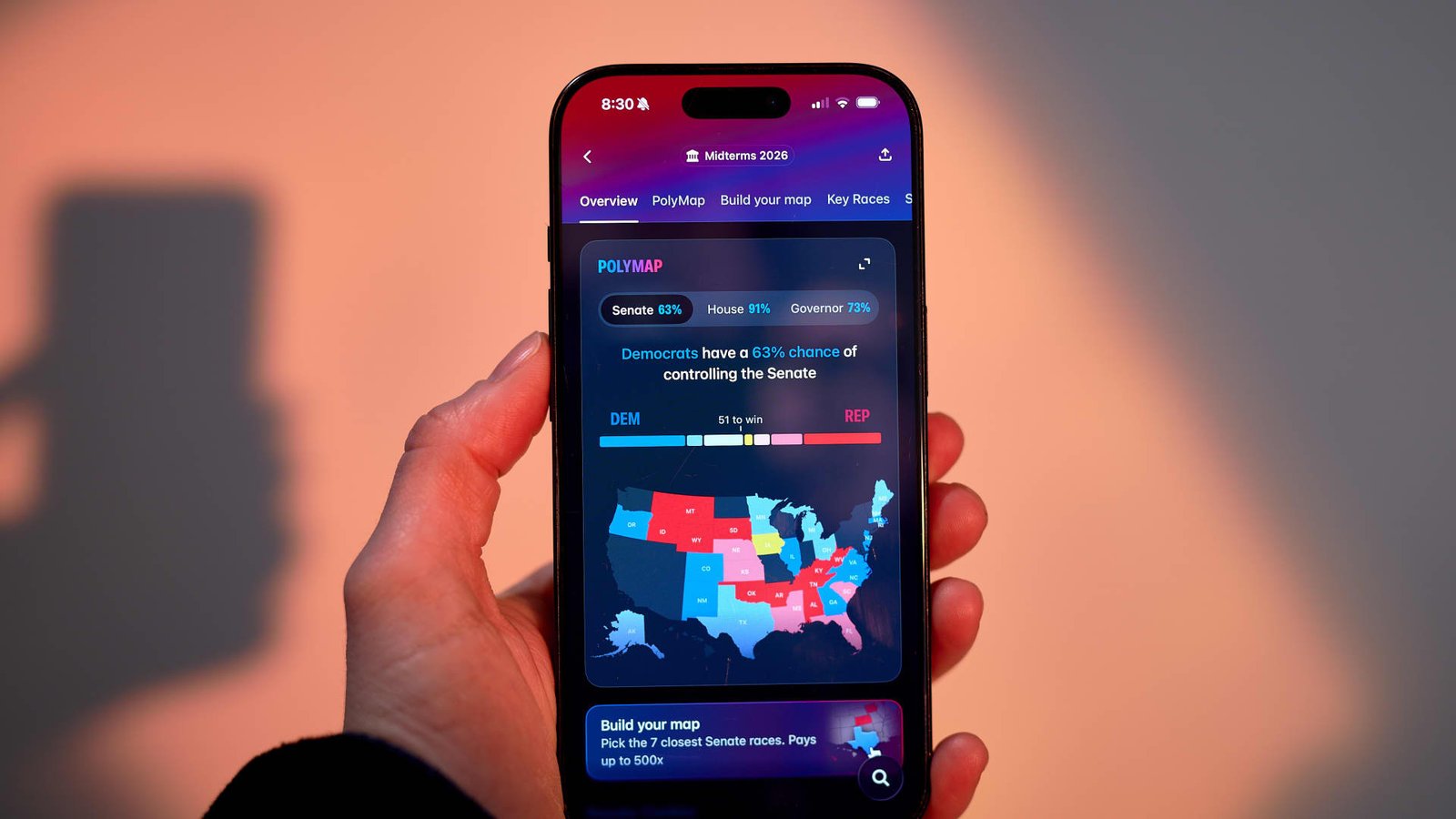
Prediction market platforms cemented their role in election forecasting on Tuesday, when markets accurately predicted a host of races before the polls closed, and projected outcomes before news outlets.
Democrats were seen as favored to flip both the U.S. House of Representatives and Senate on prediction markets before the first polls closed at 6:00 p.m. ET Tuesday, and were seen as narrow favorites to take at least 53 Senate seats, while a 54th was forecast as a toss-up.
So far, Democrats have won 54 Senate seats — including wins in Iowa, which prediction markets placed at 50-50 odds, and South Carolina, where Republicans narrowly favored. Outstanding results remain in Mississippi and Alaska, where prediction markets give Democrat Scott Colom and Mary Peltola 90% odds of winning.
Leading prediction market platforms were actively projecting races on X Tuesday night. Those projections, at times, came before many media outlets made their own projections, or before even a substantial number of votes had been counted.
Confident calls
Kalshi was confident making those calls, as long as odds for a candidate were above 99% and trading activity for the opposite candidate “dried out,” said Jack Such, a spokesperson for the platform.
Polymarket celebrated on X how it projected races, saying that in 10 key races, the platform called races ahead of outlets including CNN, Fox News and the Associated Press by a median 31 minutes.
“It’s now routinely hours between when prediction markets call it versus the TV networks,” said Polymarket CEO Shayne Coplan in an X post. “No knock to them, but now there’s Polymarket, and many people are realizing they want to know what’s happening in real time.”
Even in races where markets initially favored the candidate who eventually lost, they quickly adjusted once initial vote counts came in. In South Carolina, Democratic Senate candidate Annie Andrews was seen as the favorite on Kalshi to win shortly after 7:30 p.m., only 30 minutes after polls closed. In Texas, where Democratic state Rep. Gina Hinojosa ousted Republican Gov. Greg Abbott, Hinojosa’s odds on Polymarket jumped from 39% to 73% within five minutes of initial poll closings.
“You now have financially motivated number crunchers doing this, around the world, that give you that signal just that much faster,” said Flip Pidot, a member of the board of directors at the Coalition for Political Forecasting.
Still, a successful night for prediction markets shouldn’t stop efforts aimed at stronger regulation of the platforms, said Michelle Kendler-Kretsch, a researcher at the Anti-Corruption Data Collective, a nonprofit. She cited a recent Reuters/Ipsos survey that found most Americans are against using prediction markets to trade on elections.
“Risks and vulnerabilities didn’t change overnight just because the markets were accurate this time around,” she said.
Before the midterms
Right before the midterms, prediction market forecasts had missed major global elections, including Brazil’s presidential race, where Luiz Inácio Lula da Silva only had about 20% odds to win on Kalshi before polls closed.
Prediction markets also whiffed in some high-profile Democratic primaries over the summer, forecasting extremely high odds for progressives in Wisconsin and Michigan, for example. The Michigan Democrat, Abdul El-Sayed, narrowly won his primary before going on to win Thursday’s general election.
Academics who’ve researched prediction markets for decades say the platforms aren’t wrong when candidates with low odds on markets end up winning races.
“If you toss two coins, there’s a 25% chance that you’ll throw two heads in a row, and nobody would be terribly surprised if you did,” said Rajiv Sethi, an economics professor at Barnard College.
Despite their early success on Tuesday, Dartmouth College economic professor Eric Zitzewitz said it’s still not clear if casual observers understand how market probabilities work.
“Some people who are coming to [prediction markets] for the first time will see 55 by 45 odds and think that, ‘Oh the candidate with 55 is way ahead,'” he said.
As prediction markets gain traction, however, the public will improve at understanding how to interpret their odds, Zitzewitz said.
With another election under their belts, prediction markets will remain a force through the next presidential election, experts said.
“Last time around [in 2024], prediction markets were in the discussion, but they were in the discussion in a way that was a little bit unsure,” said Harry Crane, a professor of statistics at Rutgers University. “This [was] the first true prediction markets election.”
Disclosure: CNBC and Kalshi have a commercial relationship that includes customer acquisition and a minority investment.
About The Author