- Australian Dollar stays muted after softer-than-expected domestic jobs data for August.
- The AUD may regain its ground as markets now price just a 20% chance of an RBA rate cut in September.
- The US Dollar continues to gain after the release of Weekly Initial Jobless Claims.
The Australian Dollar (AUD) edges lower against the US Dollar (USD) on Friday, extending its losses for the third successive session. The AUD/USD pair remains subdued as the US Dollar gains support after the release of the United States (US) Weekly Initial Jobless Claims on Thursday.
The AUD also struggled after a weaker-than-expected jobs report, which showed that Australia’s seasonally adjusted Employment Change arrived at -5.4K in August from 26.5K in July (revised from 24.5K), compared with the consensus forecast of 22K. Meanwhile, the Unemployment Rate steadied at 4.2% in August, as expected.
The Aussie Dollar found support on the fading likelihood of further Reserve Bank of Australia (RBA) rate cuts. Markets now price just a 20% chance of a September cut, while odds for November stand at 70%, with above-target inflation keeping policymakers cautious.
US President Donald Trump said that he could further extend his trade truce with Chinese President Xi Jinping when the leaders speak on Friday, in addition to brokering a sale for TikTok’s US operations, Bloomberg reported late Thursday.
Australian Dollar gains as US Dollar advances after softer Initial Jobless Claims
- The US Dollar Index (DXY), which measures the value of the US Dollar against six major currencies, is gaining ground and trading around 97.40 at the time of writing.
- The US Department of Labour (DOL) released on Thursday, the Initial Jobless Claims went down to 231K for the week ending September 13. The latest print came in short of initial estimates of 240K and was lower than the previous week’s 264K (revised from 263K). Meanwhile, Continuing Jobless Claims shrank by 7K to 1.920M for the week ending September 6.
- The Federal Reserve (Fed) lowered the funds rate by 25 basis points (bps), marking the first cut of the year, and signaled a further 50 bps of easing before year-end, slightly above its June projections.
- Fed Chair Jerome Powell pointed to growing signs of weakness in the labor market to explain why officials decided it was time to cut rates after holding them steady since December amid concerns over tariff-driven inflation.
- The National Bureau of Statistics (NBS) showed on Monday that China’s Retail Sales rose 3.4% year-over-year (YoY) in August vs. 3.8% expected and 3.7% in July. Chinese Industrial Production increased 5.2% YoY in the same period, compared to the 5.8% forecast and 5.7% seen previously.
- The NBS said during its press conference on Monday that economic operation was generally steady in August, but domestic demand will expand and promote a rebound in prices. Some firms are having difficulties in operations as the external environment is very severe, NBS added.
- Reserve Bank of Australia (RBA) Assistant Governor Sarah Hunter said on Tuesday that the central bank is “close to getting inflation to target.” Hunter noted that risks to the outlook are balanced and emphasized the need for a forward-looking approach given the delayed impact of monetary policy. She added that the RBA is closely monitoring the underlying strength of consumer spending and aims to keep the economy near full employment.
Australian Dollar falls to near 0.6600 after breaking below nine-day EMA
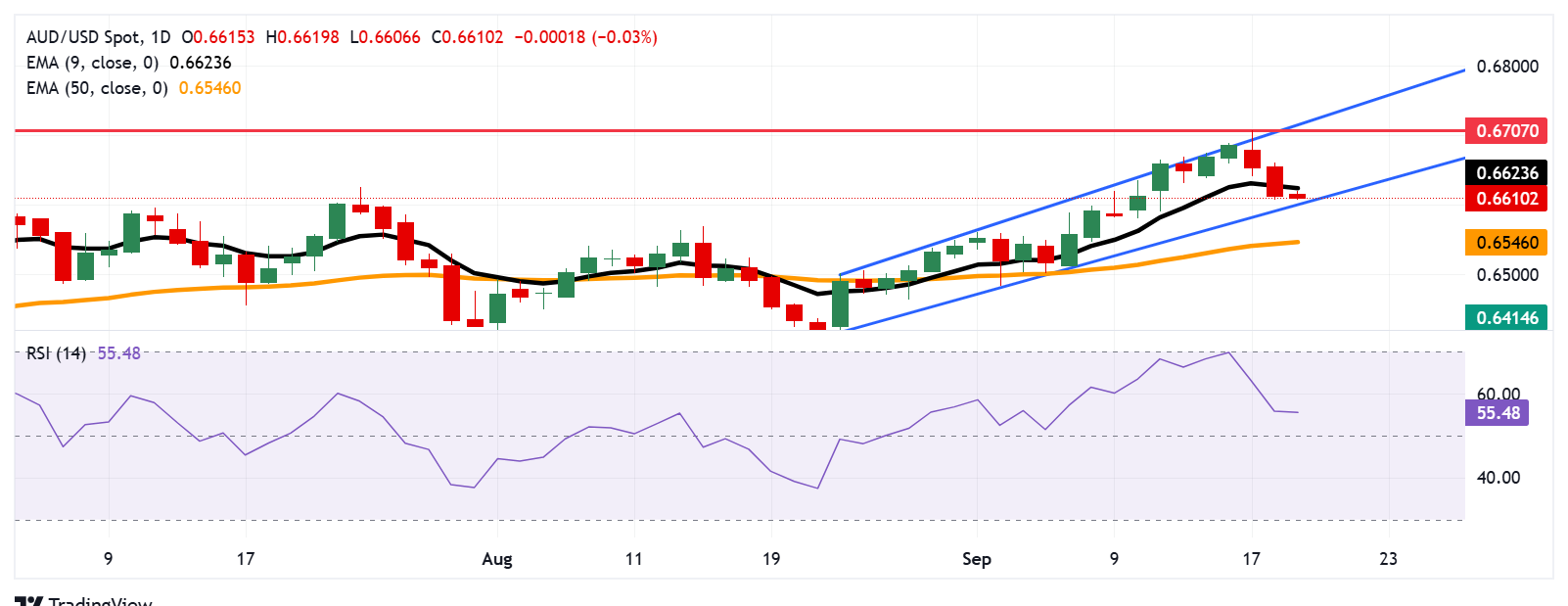
The AUD/USD pair is trading around 0.6610 on Friday. Technical analysis on the daily chart indicates that the pair is remaining within an ascending channel, strengthening the bullish bias. However, short-term price momentum turned weaker, with the price moving below the nine-day Exponential Moving Average (EMA).
The AUD/USD pair may find its initial support at the ascending channel’s lower boundary around 0.6600. A break below the channel would weaken the bullish bias and lead the AUD/USD pair to test the 50-day EMA at 0.6546.
On the upside, the AUD/USD pair may target the nine-day EMA at 0.6623. A break above this level would improve the short-term price momentum and support the pair to approach the 11-month high of 0.6707, recorded on September 17, followed by the upper boundary of the ascending channel around 0.6720.
(The story was corrected on September 19 at 2:30 GMT, to say in the second bullet point that 20% chance of an RBA rate cut in September, not a Fed rate cut.)
AUD/USD: Daily Chart
Australian Dollar Price Today
The table below shows the percentage change of Australian Dollar (AUD) against listed major currencies today. Australian Dollar was the weakest against the Japanese Yen.
| USD | EUR | GBP | JPY | CAD | AUD | NZD | CHF | |
|---|---|---|---|---|---|---|---|---|
| USD | 0.06% | 0.09% | 0.03% | 0.04% | 0.12% | 0.14% | 0.23% | |
| EUR | -0.06% | 0.06% | -0.07% | -0.02% | 0.03% | 0.08% | 0.17% | |
| GBP | -0.09% | -0.06% | -0.10% | -0.07% | -0.02% | -0.06% | 0.11% | |
| JPY | -0.03% | 0.07% | 0.10% | -0.02% | 0.21% | 0.17% | 0.05% | |
| CAD | -0.04% | 0.02% | 0.07% | 0.02% | 0.08% | 0.10% | 0.19% | |
| AUD | -0.12% | -0.03% | 0.02% | -0.21% | -0.08% | 0.04% | 0.13% | |
| NZD | -0.14% | -0.08% | 0.06% | -0.17% | -0.10% | -0.04% | 0.09% | |
| CHF | -0.23% | -0.17% | -0.11% | -0.05% | -0.19% | -0.13% | -0.09% |
The heat map shows percentage changes of major currencies against each other. The base currency is picked from the left column, while the quote currency is picked from the top row. For example, if you pick the Australian Dollar from the left column and move along the horizontal line to the US Dollar, the percentage change displayed in the box will represent AUD (base)/USD (quote).
RBA FAQs
The Reserve Bank of Australia (RBA) sets interest rates and manages monetary policy for Australia. Decisions are made by a board of governors at 11 meetings a year and ad hoc emergency meetings as required. The RBA’s primary mandate is to maintain price stability, which means an inflation rate of 2-3%, but also “..to contribute to the stability of the currency, full employment, and the economic prosperity and welfare of the Australian people.” Its main tool for achieving this is by raising or lowering interest rates. Relatively high interest rates will strengthen the Australian Dollar (AUD) and vice versa. Other RBA tools include quantitative easing and tightening.
While inflation had always traditionally been thought of as a negative factor for currencies since it lowers the value of money in general, the opposite has actually been the case in modern times with the relaxation of cross-border capital controls. Moderately higher inflation now tends to lead central banks to put up their interest rates, which in turn has the effect of attracting more capital inflows from global investors seeking a lucrative place to keep their money. This increases demand for the local currency, which in the case of Australia is the Aussie Dollar.
Macroeconomic data gauges the health of an economy and can have an impact on the value of its currency. Investors prefer to invest their capital in economies that are safe and growing rather than precarious and shrinking. Greater capital inflows increase the aggregate demand and value of the domestic currency. Classic indicators, such as GDP, Manufacturing and Services PMIs, employment, and consumer sentiment surveys can influence AUD. A strong economy may encourage the Reserve Bank of Australia to put up interest rates, also supporting AUD.
Quantitative Easing (QE) is a tool used in extreme situations when lowering interest rates is not enough to restore the flow of credit in the economy. QE is the process by which the Reserve Bank of Australia (RBA) prints Australian Dollars (AUD) for the purpose of buying assets – usually government or corporate bonds – from financial institutions, thereby providing them with much-needed liquidity. QE usually results in a weaker AUD.
Quantitative tightening (QT) is the reverse of QE. It is undertaken after QE when an economic recovery is underway and inflation starts rising. Whilst in QE the Reserve Bank of Australia (RBA) purchases government and corporate bonds from financial institutions to provide them with liquidity, in QT the RBA stops buying more assets, and stops reinvesting the principal maturing on the bonds it already holds. It would be positive (or bullish) for the Australian Dollar.
About The Author