AUD/USD gains ground after recovering its recent losses registered in the previous session, trading around 0.6590 during the Asian hours on Thursday. The Australian Dollar (AUD) holds ground against the US Dollar (USD) following the highly anticipated meeting between US President Donald Trump and China’s President Xi Jinping in South Korea. Any shift in China’s economic conditions could also affect the Australian dollar (AUD), given the close trade ties between China and Australia.
President Trump announced that tariffs on China will be reduced to 47% from the current 57%. Trump added that the rare earth dispute has been resolved, ensuring no further restrictions on China’s rare earth exports. Soybean purchases will begin immediately, and China has agreed to intensify efforts to curb the fentanyl problem. However, Trump noted that not all issues were discussed.
Chinese President Xi Jinping said following the meeting that “two sides should look at the long-term interests of cooperation.” Xi added that China has never tried to challenge, replace anyone. Both sides have good prospects for countering telecom fraud, money laundering, and AI cooperation, he added.
The AUD gained support after Australia’s hotter-than-expected Q3 inflation and August CPI data were released on Wednesday. The stronger readings reduced expectations for near-term rate cuts by the Reserve Bank of Australia (RBA). RBA Governor Bullock noted that the labor market remains somewhat tight, despite the unexpected rise in the unemployment rate.
US Dollar declines over an uncertain Fed policy outlook
- The US Dollar Index (DXY), which measures the value of the US Dollar against six major currencies, is losing ground after registering gains in the previous session and trading around 98.90 at the time of writing.
- The Federal Reserve (Fed) delivered a widely anticipated 25-basis-point interest rate cut on Wednesday. This marks the second straight interest rate cut from the Fed, albeit with some policymakers making a mental note of a general increase in some inflationary pressures through the second half of the year, but not enough to deter another leg down in interest rates.
- The US Dollar gained ground after the Fed acknowledged it would continue to ease back on Quantitative Easing (QE) practices, with the process of drawing down the Fed’s mortgage-backed asset balance sheet into long-term Treasuries by December 1.
- Fed Chair Jerome Powell stated at the post-meeting press conference that the available data indicate little change in the outlook for employment and inflation since the September meeting. Powell noted that the government shutdown will weigh on economic activity while it continues, but should reverse once it ends. He added that another rate cut in December is far from certain, emphasizing that the path forward remains uncertain.
- The RBA Trimmed Mean CPI for Q3 rose 1.0% and 3.0% on a quarterly and annual basis, respectively. Markets estimated an increase of 0.8% QoQ and 2.7% YoY in the quarter to September. The monthly Consumer Price Index jumped by 3.5% YoY in August, compared to the previous reading of a 3.0% increase. This figure came in hotter than the expectation of 3.1%.
- The US Bureau of Labor Statistics (BLS) reported on Friday that the US Consumer Price Index (CPI) rose 3.0% year-over-year (YoY) in September, following a 2.9% increase in the prior month. This reading came in below the market expectation of 3.1%. Meanwhile, the monthly CPI increased 0.3%, against the 0.4% rise seen in August. The core CPI increased 0.2% month-over-month, compared to the market consensus of 0.3%, while the yearly core CPI was up 3.0% in September.
Australian Dollar tests 0.6600 barrier due to possible bullish shift
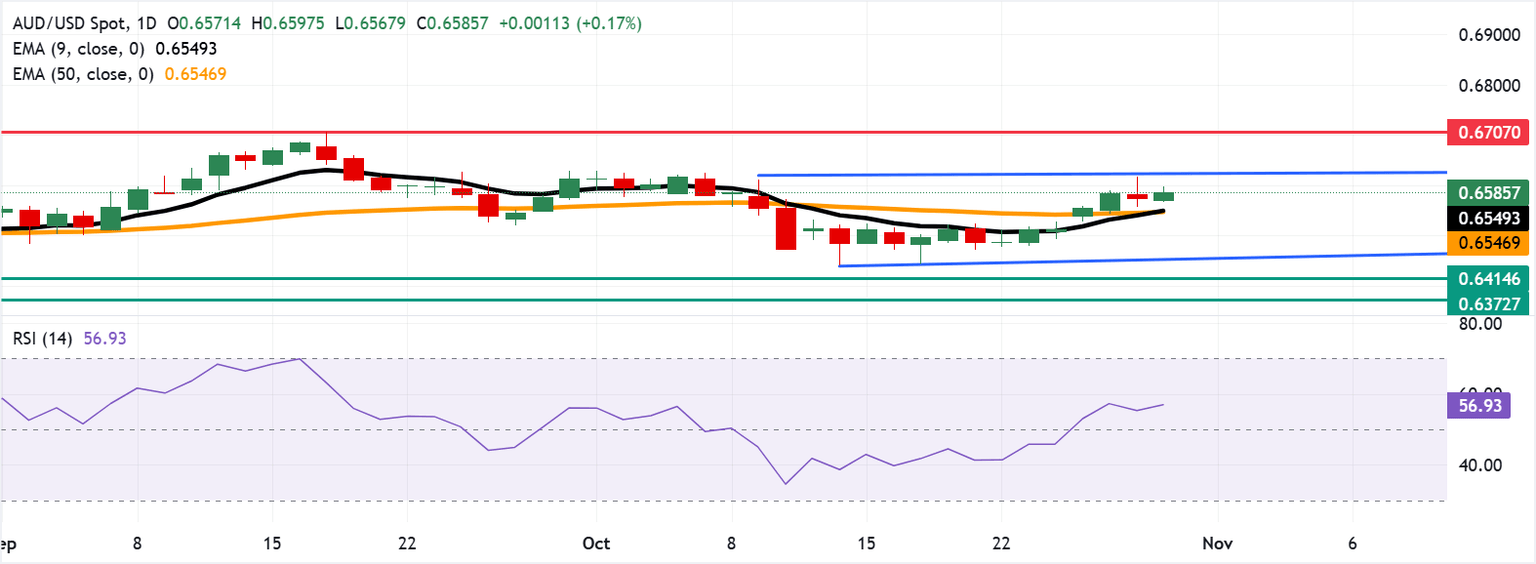
The AUD/USD pair is trading around 0.6590 on Thursday. Technical analysis of a daily chart suggests a neutral bias as the pair moves within a rectangle pattern. The pair is trading above the nine-day Exponential Moving Average (EMA), indicating that both short-term price momentum is stronger.
On the upside, the immediate barrier lies at the psychological level of 0.6600, followed by the rectangle’s upper boundary around 0.6630. A break above the rectangle would cause the emergence of the bullish bias and support the AUD/USD pair to explore the region around the 12-month high of 0.6707, which was recorded on September 17.
The primary support lies at the nine-day EMA of 0.6549, aligned with the 50-day EMA at 0.6546. A break below these levels would weaken the short- and medium-term price momentum and prompt the AUD/USD pair to test the lower boundary of the rectangle around 0.6450, followed by the four-month low of 0.6414.
AUD/USD: Daily Chart
Australian Dollar Price Today
The table below shows the percentage change of Australian Dollar (AUD) against listed major currencies today. Australian Dollar was the strongest against the Japanese Yen.
| USD | EUR | GBP | JPY | CAD | AUD | NZD | CHF | |
|---|---|---|---|---|---|---|---|---|
| USD | -0.24% | -0.12% | 0.03% | -0.05% | -0.16% | -0.29% | -0.22% | |
| EUR | 0.24% | 0.11% | 0.30% | 0.19% | 0.07% | -0.05% | 0.02% | |
| GBP | 0.12% | -0.11% | 0.16% | 0.07% | -0.05% | -0.17% | -0.10% | |
| JPY | -0.03% | -0.30% | -0.16% | -0.12% | -0.21% | -0.37% | -0.29% | |
| CAD | 0.05% | -0.19% | -0.07% | 0.12% | -0.10% | -0.25% | -0.18% | |
| AUD | 0.16% | -0.07% | 0.05% | 0.21% | 0.10% | -0.13% | -0.04% | |
| NZD | 0.29% | 0.05% | 0.17% | 0.37% | 0.25% | 0.13% | 0.09% | |
| CHF | 0.22% | -0.02% | 0.10% | 0.29% | 0.18% | 0.04% | -0.09% |
The heat map shows percentage changes of major currencies against each other. The base currency is picked from the left column, while the quote currency is picked from the top row. For example, if you pick the Australian Dollar from the left column and move along the horizontal line to the US Dollar, the percentage change displayed in the box will represent AUD (base)/USD (quote).
US-China Trade War FAQs
Generally speaking, a trade war is an economic conflict between two or more countries due to extreme protectionism on one end. It implies the creation of trade barriers, such as tariffs, which result in counter-barriers, escalating import costs, and hence the cost of living.
An economic conflict between the United States (US) and China began early in 2018, when President Donald Trump set trade barriers on China, claiming unfair commercial practices and intellectual property theft from the Asian giant. China took retaliatory action, imposing tariffs on multiple US goods, such as automobiles and soybeans. Tensions escalated until the two countries signed the US-China Phase One trade deal in January 2020. The agreement required structural reforms and other changes to China’s economic and trade regime and pretended to restore stability and trust between the two nations. However, the Coronavirus pandemic took the focus out of the conflict. Yet, it is worth mentioning that President Joe Biden, who took office after Trump, kept tariffs in place and even added some additional levies.
The return of Donald Trump to the White House as the 47th US President has sparked a fresh wave of tensions between the two countries. During the 2024 election campaign, Trump pledged to impose 60% tariffs on China once he returned to office, which he did on January 20, 2025. With Trump back, the US-China trade war is meant to resume where it was left, with tit-for-tat policies affecting the global economic landscape amid disruptions in global supply chains, resulting in a reduction in spending, particularly investment, and directly feeding into the Consumer Price Index inflation.
About The Author