According to Tuesday’s Job Openings and Labor Turnover Survey (JOLTS) from the US Bureau of Labor Statistics (BLS), job openings totalled 7.594 million at the end of May. This figure, which came in above analysts’ expectations of 7.3 million, follows the 7.585 million positions reported in April (revised from 7.618 million).
From the news release: “In May, the number of total separations changed little at 5.1 million, while the rate was unchanged at 3.2 %. Total separations changed little in all industries. In May, the number of quits changed little at 3.1 million, while the rate was unchanged at 1.9%. Quits increased in federal government (+4,000). The number of layoffs and discharges was unchanged at 1.7 million, while the rate changed little at 1.1% in May. Layoffs and discharges decreased in arts, entertainment, and recreation (-42,000).”
Market reaction
The Greenback resumes its upside following three consecutive daily pullbacks, lifting the US Dollar Index (DXY) back to the vicinity of the 101.50 level on Tuesday.
US Dollar Price Today
The table below shows the percentage change of US Dollar (USD) against listed major currencies today. US Dollar was the strongest against the Japanese Yen.
| USD | EUR | GBP | JPY | CAD | AUD | NZD | CHF | |
|---|---|---|---|---|---|---|---|---|
| USD | 0.21% | 0.26% | 0.32% | 0.06% | -0.11% | -0.26% | 0.21% | |
| EUR | -0.21% | 0.05% | 0.07% | -0.20% | -0.34% | -0.49% | -0.01% | |
| GBP | -0.26% | -0.05% | 0.02% | -0.24% | -0.37% | -0.52% | -0.06% | |
| JPY | -0.32% | -0.07% | -0.02% | -0.25% | -0.43% | -0.55% | -0.11% | |
| CAD | -0.06% | 0.20% | 0.24% | 0.25% | -0.19% | -0.31% | 0.15% | |
| AUD | 0.11% | 0.34% | 0.37% | 0.43% | 0.19% | -0.12% | 0.34% | |
| NZD | 0.26% | 0.49% | 0.52% | 0.55% | 0.31% | 0.12% | 0.44% | |
| CHF | -0.21% | 0.01% | 0.06% | 0.11% | -0.15% | -0.34% | -0.44% |
The heat map shows percentage changes of major currencies against each other. The base currency is picked from the left column, while the quote currency is picked from the top row. For example, if you pick the US Dollar from the left column and move along the horizontal line to the Japanese Yen, the percentage change displayed in the box will represent USD (base)/JPY (quote).
This section below was published as a preview of the May JOLTs Job Openings data at 08:00 GMT.
- US JOLTS are forecast to have eased to 7.3 million in May, yet remaining above the 2025 average.
- Job Openings data will be watched to confirm market expectations of Federal Reserve rate hikes.
- EUR/USD remains on the defensive, with 13-month lows at a relatively short distance.
The US Bureau of Labor Statistics will release the Job Openings and Labor Turnover Survey (JOLTS) for May on Tuesday at 14:00 GMT. The report, which gathers US employers’ estimates of job openings, hires, and separations nationwide, is closely watched by the market as it normally comes ahead of an array of employment gauges released throughout the week, culminating in the key Nonfarm Payrolls report.
May’s JOLTS figures are likely to be closely watched on Tuesday because they come in a crucial moment, with markets repricing chances of interest rate hikes by the US Federal Reserve (Fed) as inflation keeps rising well above the central bank’s target.
A high level of uncertainty surrounds the Middle East conflict, and inflationary pressures have failed to abate despite the recent decline in Crude prices. The Fed has reiterated its commitment to fight inflation, boosting investors’ hopes of at least one rate hike this year. In this scenario, this week’s labour market data might be key to assessing the timing of the next monetary policy move and give a fresh boost to US Dollar (USD) volatility.
What to expect in the next JOLTS report?
Job openings are expected to come in at 7.3 million in May, according to the market consensus. This is a moderate decline from April’s 7.61 million openings, which was the best reading since July 2024, but still a good reading, as it remains significantly above the 2025 average of 7.08 million openings. If these figures are confirmed, they are likely to endorse the theory of a stabilising US labour market and underpin the narrative of US economic exceptionality.
April’s JOLTS data beat expectations with a 4.6% monthly increase in job openings – 731,000 new vacancies – from March’s 6.88 million openings, while quits, layoffs, and discharges were little changed.
Beyond that, the US Nonfarm Payrolls release reported 172K new jobs in May, completing an impressive performance in the three months to May. These figures boosted market confidence about the US economic resilience to the Middle East war and allowed Fed policymakers to forget about the labor market and focus solely on the overshooting inflationary levels to draw their near-term monetary policy. This new scenario has prompted investors to ramp up bets of some monetary policy tightening in the coming months.
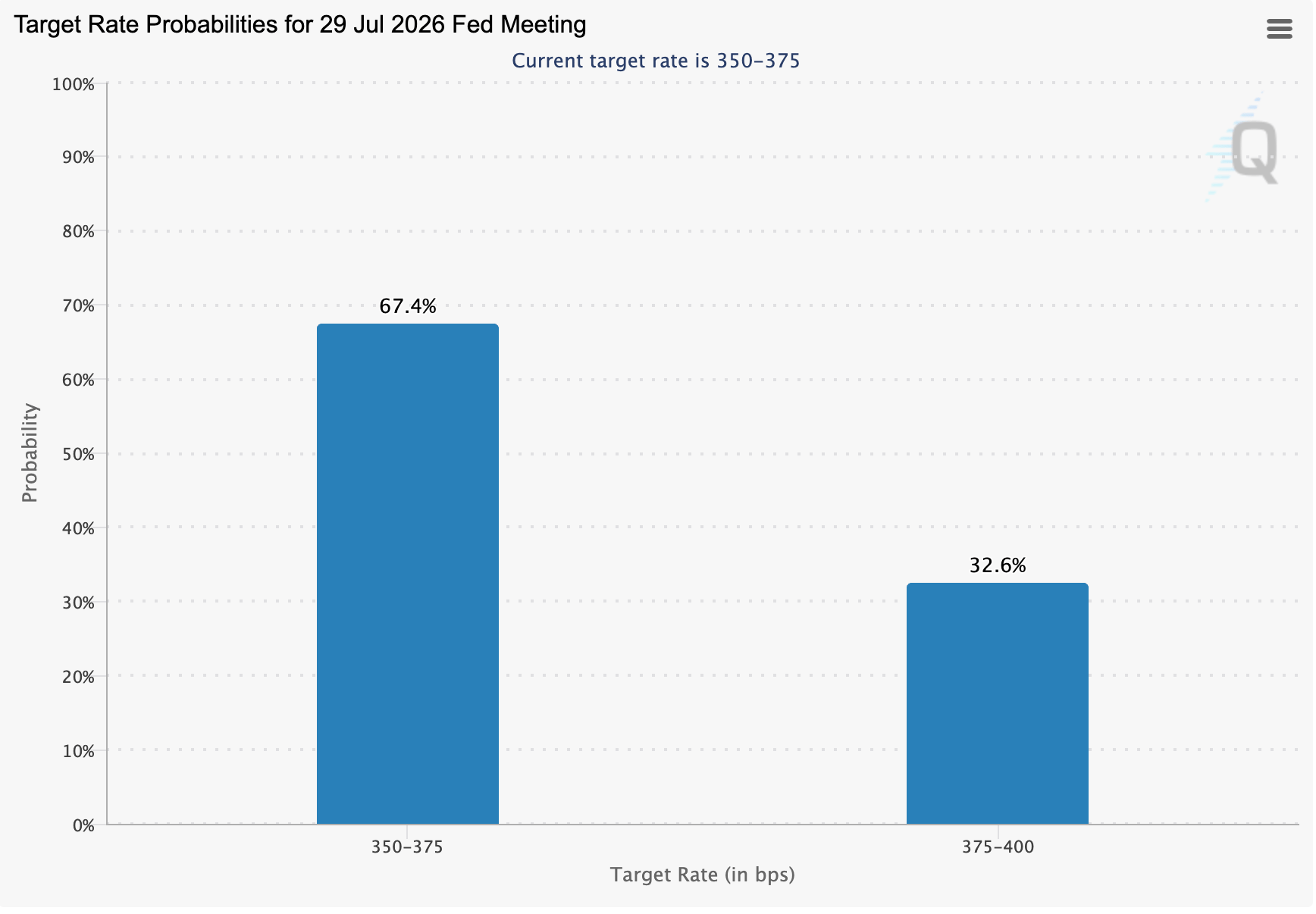
Data from the CME Group’s Fedwatch Tool shows that futures markets are pricing a 30% chance of a rate hike at next month’s Federal Open Market Committee (FOMC) meeting, and a more than 60% chance of monetary tightening in September, up from 6% and 20% respectively a month ago. This week’s employment figures will be analysed to contrast these views.
When will the JOLTS report be released and how could it affect EUR/USD?
Job Openings will be published on Tuesday at 15:00 GMT. The EUR/USD is trading at a relatively short distance from the 13-month lows, on track to a 2.17% sell-off in June, and a nearly 3% decline over the last two months.
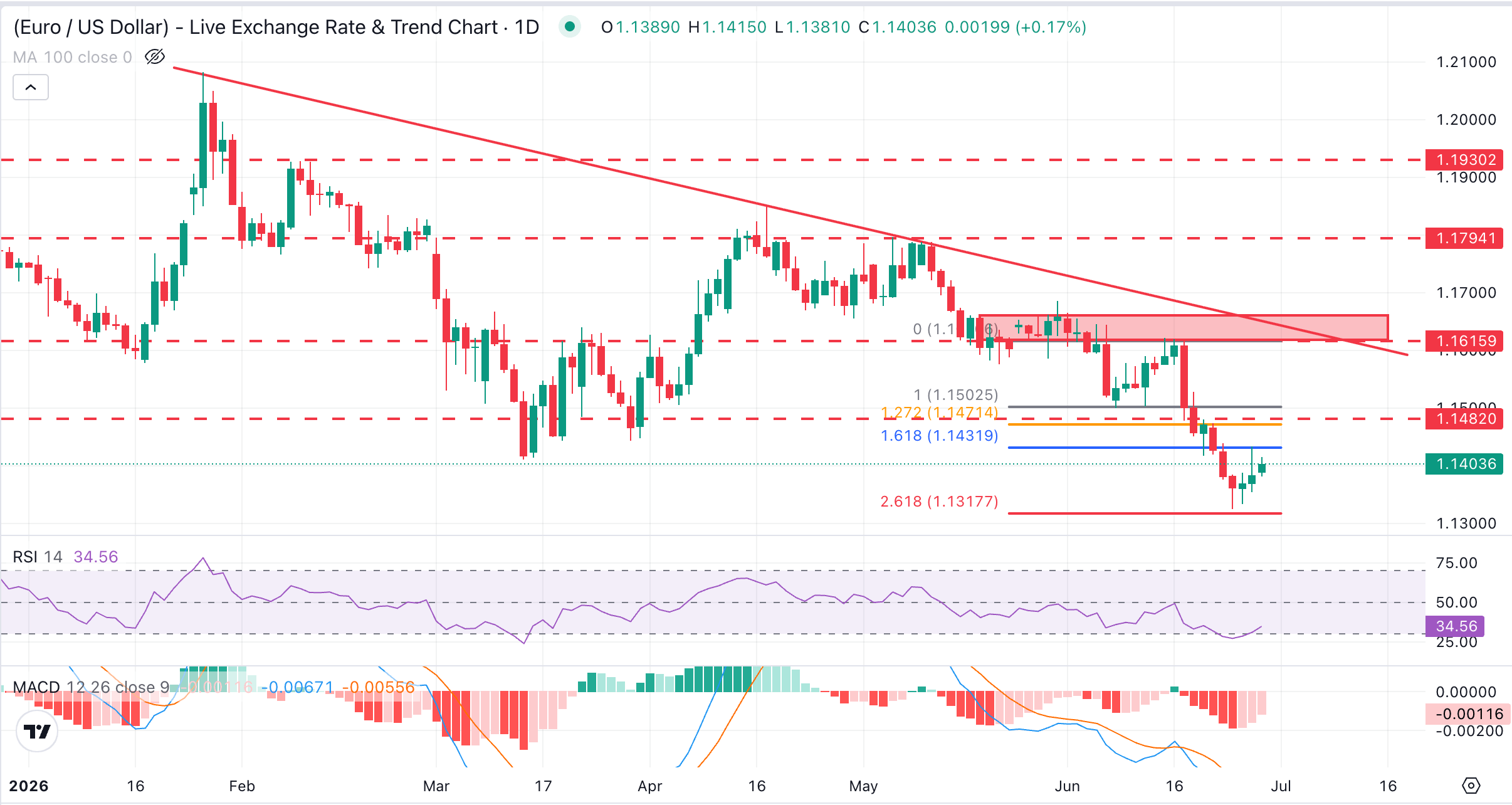
Guillermo Alcalá, analyst at FXStreet, sees the pair skewed to the downside while the US economy keeps outperforming the Eurozone’s and Iran’s war keeps dampening risk appetite: “The Euro has remained vulnerable over the last two months amid geopolitical woes and a sluggish economic growth in the Eurozone. Unless the scenario changes significantly, Euro rallies are likely to offer good entry opportunities for sellers. The 13-month low at 1.1325 remains the key support level. Further down, bears might be tempted to revisit the late May 2025 low at 1.1210.”
To the upside, Alcala sees the 1.1500 and the 1.1620-1.1640 resistance areas as the main hurdles for bulls: “The pair is struggling to consolidate above 1.1400 at the time of writing in a rebound from the mentioned 13-month lows, which, so far, seems corrective. Bulls should break the 1.1500 area (June 8,11 lows) and preferably also the area between 1.1620 and 1.1640, where late May and early June highs meet the descending trendline from the year-to-date (YTD) highs, to break the negative structure.”
Economic Indicator
JOLTS Job Openings
JOLTS Job Openings is a survey done by the US Bureau of Labor Statistics to help measure job vacancies. It collects data from employers including retailers, manufacturers and different offices each month.
About The Author