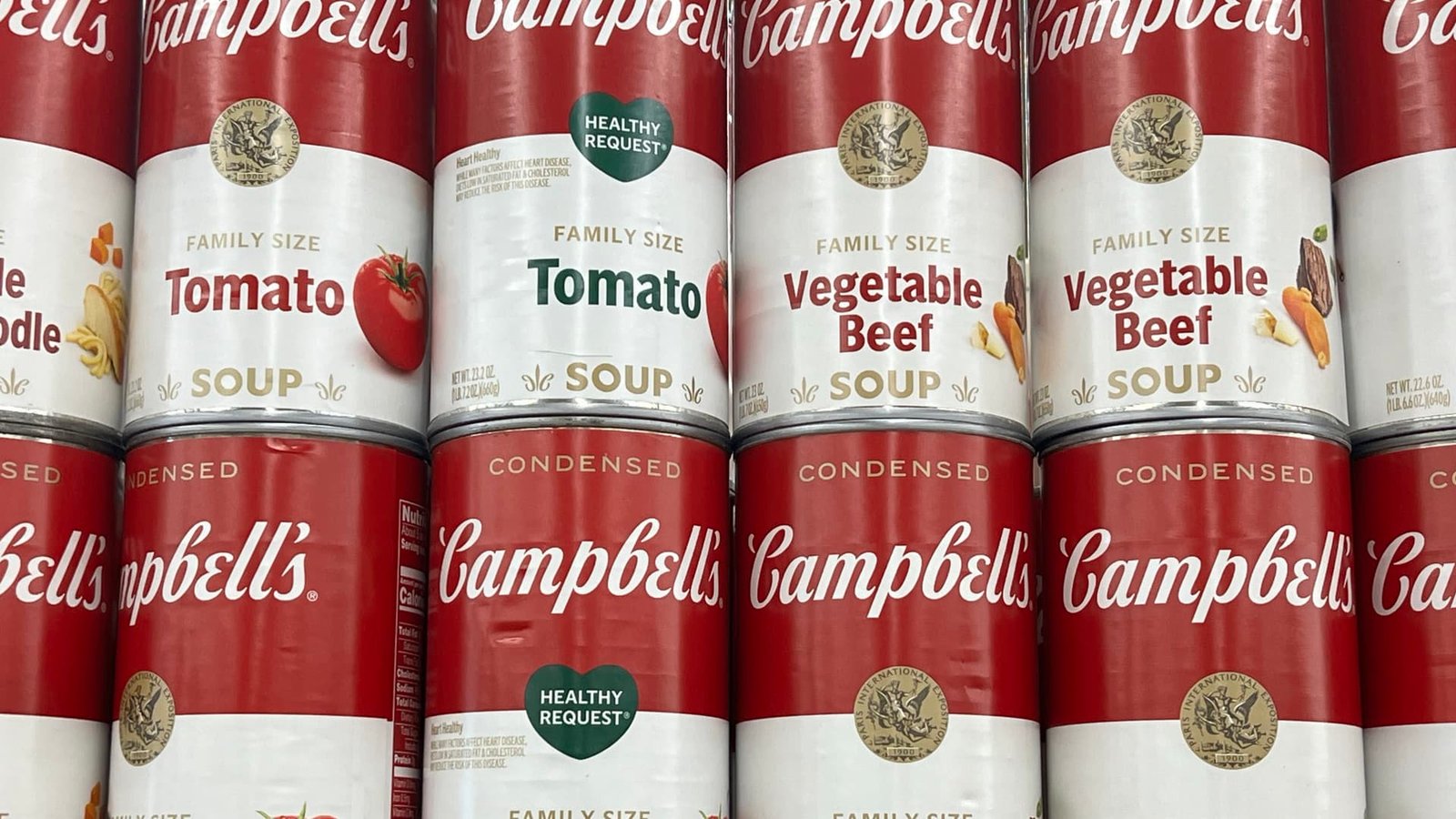
Cans of soup made by the Campbell Soup company are displayed for sale at a grocery store on September 12, 2024 in Chicago, Illinois.
Scott Olson | Getty Images
Campbell’s forecast annual profit and sales below estimates on Thursday and cut its quarterly dividend by more than a third as the soup maker struggles with soft demand for its pricier snacks.
Shares of the Goldfish cracker maker fell about 7% in early trading.
The company said it had closed some plants and completed some workforce cuts to support margins as part of a program to save about $500 million in costs by fiscal 2030.
“Our results remain unacceptable,” CEO Mick Beekhuizen said, adding that Campbell’s will be “addressing reality head-on.” The company will also adjust prices in some categories to reflect changes in commodity costs, he said.
“(Campbell’s) is clearly taking a much more aggressive self-help stance,” Barclays analyst Andrew Lazar said.
Lower-income consumers are shifting toward cheaper value brands and store-label products, pressuring sales at companies including Campbell’s that have raised prices in recent years to protect their margins.
CFO Todd Cunfer said on a call with analysts that Campbell’s had implemented average price increases of 4% to 5% across roughly 60% of its portfolio, with benefits expected to begin flowing through in the second quarter, even as sales will be impacted.
Campbell’s expects fiscal 2027 net sales to fall between 2% and 4%, compared with analysts’ estimate of a 0.8% drop, according to data compiled by LSEG.
It expects fiscal 2027 adjusted profit per share in the range of $1.65 to $1.80, compared with estimates of $1.86 per share.
The company faces inflation in raw material costs due to geopolitical and trade tensions, along with higher logistics costs and investments behind soup and sauce launches and holiday promotions.
Net sales fell 8% to $2.14 billion in the fourth quarter, sightly missing analysts’ average estimate of $2.15 billion, while adjusted earnings per share of 39 cents were in line with expectations.
Volumes in the company’s snacks segment fell 6%, while prices rose 1%. For its meals and beverages segment, where prices remained the same, volumes rose 3%.
About The Author