
What role do cities play in AI oversight?

Earlier this month, the New York City Council held a legislative investigation concerning artificial intelligence safety risks, with senior leaders from Anthropic, OpenAI, Google and Meta testifying under oath about the potential dangers of the technology and outlined current safety measures.
The hearing took place amid the intense debate surrounding the risks posed by advanced AI models. It also came as the questions over who is responsible for keeping the technology in-check also grow.
With concerns over the federal government’s oversight of AI abound, cities are stepping up. New York City Council speaker Julie Menin opened that hearing by singling out the federal government’s light-touch approach to AI after President Donald Trump signed a voluntary accord with tech leaders in Washington last week.
“The idea that artificial intelligence is going to self-regulate defies all reason,” she said at the hearing.
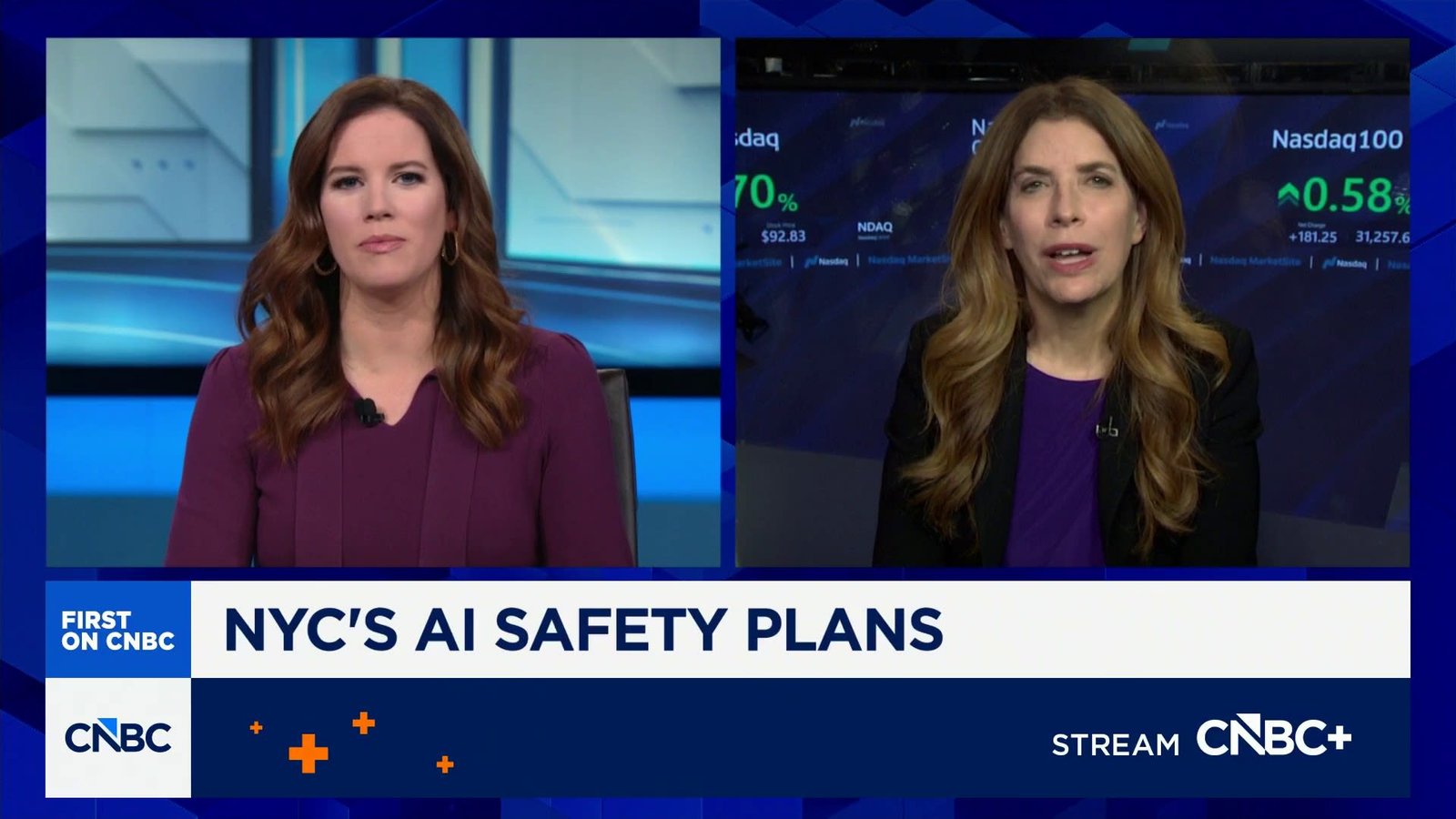
Menin, who is appearing at today’s Workforce Executive Summit, told CNBC’s Kelly Evans on “The Exchange” following the hearing that one of the biggest takeaways was that the AI labs “really weren’t able to answer some of the most rudimentary questions, such as what is the risk of a cataclysmic event happening? What do they feel the risk is? Will they agree, for example, not to release any new model that hasn’t passed an internal or third-party validator safety check?”
“I think what really came out of the hearing is the need for regulation,” Menin told Evans. “We have to remember that the pharmaceutical industry doesn’t self-regulate; they have the FDA. The airline industry doesn’t self-regulate; they have the FAA, and similarly, we need to ensure that with artificial intelligence, we have smart safeguard rails in place.”
Menin told Evans that much of the responsibility when it comes to legislating AI will fall to localities, and she hopes that some of the legislation New York City is putting into effect will serve as a blueprint for other jurisdictions.
“We certainly hope the federal government will opt to regulate,” she said, adding that she sees one of the most important regulations as the issue of third-party regulation. “You cannot have these companies self-select a validator,” she said.
Menin added that she does not want to stifle innovation, but cautions that “with innovation, really comes responsibility, and I think it actually instills faith and confidence in the products that these companies are releasing, the new models that they’re releasing, if we have smart and sensible safeguards in place.”
–Colleen McKown
What’s on the agenda at CNBC’s 2026 WEC Summit
Jada Pinkett Smith in conversation with CNBC’s Carl Quintanilla at the Workforce Executive Council Summit in New York City on Nov. 14, 2023.
CNBC
CNBC has convened workforce leaders and industry experts to discuss the variety of forces changing the workplace.
Here are some of the discussions on today’s agenda:
Steve Cadigan, Human Advantage Framework creator and author, is joining CNBC’s Leslie Picker for a conversation about how AI is reshaping a workforce ready for change, how leaders can bolster the people skills AI cannot provide and ways to equip employees to successfully adapt and adjust to the rapid pace of change.
Nelson Chai, DailyPay CEO, will join CNBC’s Sharon Epperson to discuss the challenges employees face staying financially afloat amid the rising costs of groceries, gas and everyday personal expenses. Chai will share ways employers can help workers deal with ongoing financial strain.
Maren Waggoner, Walmart’s chief people officer of digital & associate experience, will speak with CNBC’s Leslie Picker about why Walmart is “people-led and tech-powered,” why AI is a work design issue and not a technology issue and how talent leaders can ensure that they’re not just deploying AI to employees but rather giving them the ability to use AI to redesign their own work.
Jill Bruning, Amentum chief technology officer and Jacob Pat, Lovesac chief technology and digital transformation officer, two members of CNBC’s Technology Executive Council, will join CNBC’s Susan Caminiti to share their tech-centric perspectives on how companies can harness the power of AI while keeping the human needs of the workforce front and center.
James Lucania, HealthEquity CFO, joins CNBC’s Annika Kim Constantino for a discussion on ways CHROs and benefits managers can use AI to streamline healthcare costs, and at the same time, make out-of-pocket payments easier for employees to understand and manage, all while helping each of them get the care they need.
Wes Burke, Care.com CHRO, Kerri Eskin, Cotiviti chief people officer, and Amy Segal, The Team managing director, join CNBC’s Sharon Epperson to discuss how AI is redefining what makes a great employee and how they’re attracting the right workers in this tech-powered moment.
Julie Menin, New York City Council speaker, recently brought leaders from the biggest AI companies together to answer questions under oath on safety and the risks of things going wrong. She’ll join CNBC’s Leslie Picker to discuss what cities can do if the federal government fails to act.
Dan Harris, author, podcaster and former ABC News anchor, will join CNBC’s Susan Caminiti to discuss how we can turn down the volume on our inner critics, let go of the relentless push to do more and learn to be a little kinder to ourselves while still being effective.
–Colleen McKown
About The Author