(WO) — The global oil market could face a prolonged inventory deficit and sustained price strength even if flows through the Strait of Hormuz continue to recover, according to new analysis from Enverus Intelligence Research (EIR).
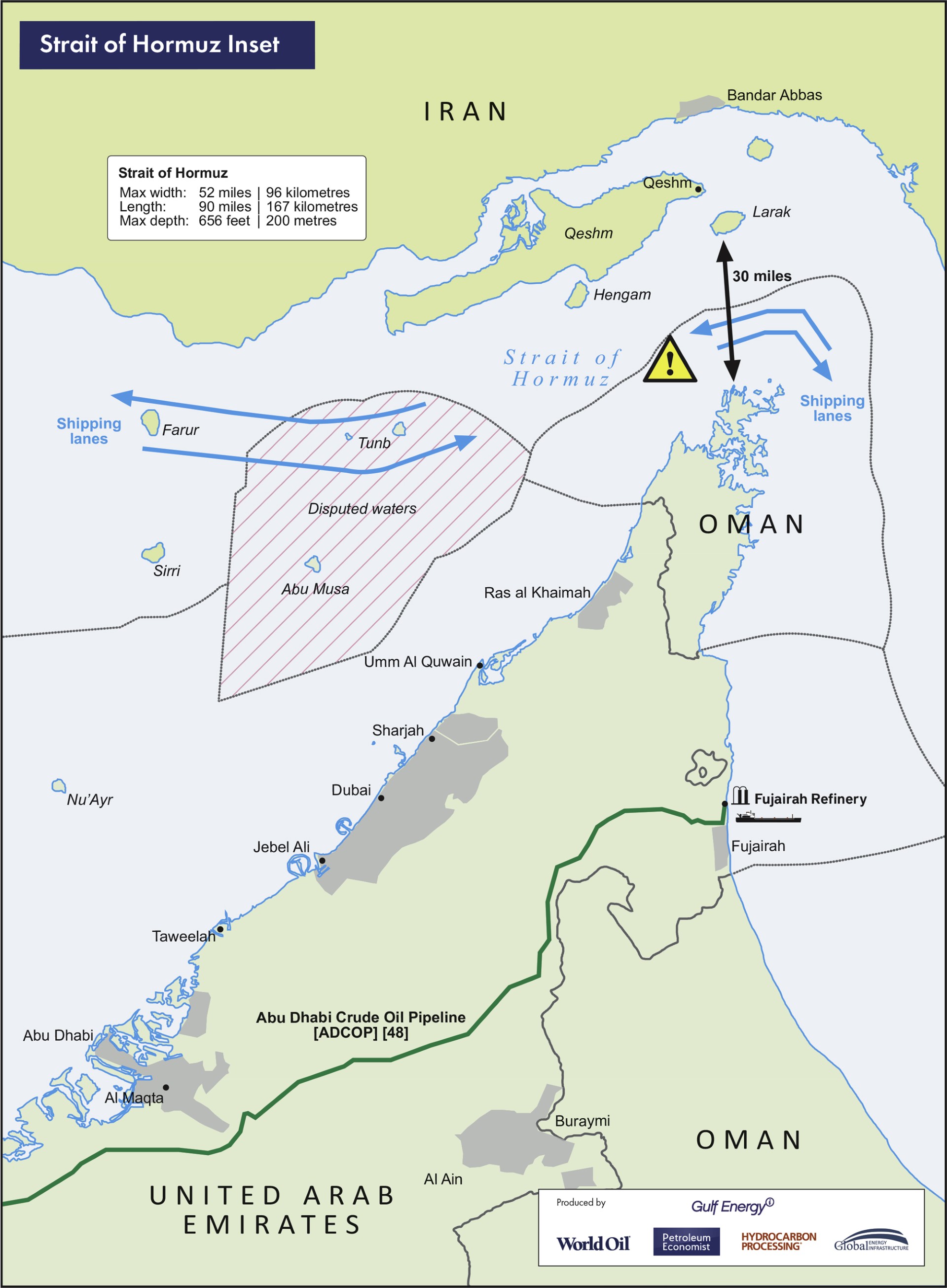
Map of the Strait of Hormuz. (Map Source: Global Energy Infrastructure.)
In a report examining the aftermath of the disruption, EIR said market participants may be underestimating the long-term impact on global crude and product inventories, arguing that the supply losses already incurred will continue to influence oil prices well beyond the immediate crisis.
According to EIR’s base-case outlook, OECD crude and product inventories are projected to fall from 2.82 Bbbl at the end of 2025 to approximately 2.36 Bbbl by the fourth quarter of 2026, a level the firm describes as a 20-year low.
“The key takeaway in our modeling is that the inventory ‘stock hole’ can outlast the headline,” said Al Salazar, director at EIR and author of the report. “Even if diplomacy advances, OECD stocks are projected to bottom at levels that historically correlate with stronger prices.”
EIR forecasts Brent crude will average approximately $110/bbl during the second half of 2026, peak near $117/bbl in the fourth quarter, and remain above $100/bbl until the third quarter of 2027.
The report also suggests the market may retain a lasting geopolitical premium even after normal shipping patterns resume through the Strait of Hormuz.
“Furthermore, we think the crisis likely leaves behind a more durable geopolitical premium that doesn’t fully get unpriced,” Salazar said.
EIR estimates that a $5-$10/bbl geopolitical risk premium could become embedded in oil prices following the disruption, reflecting heightened concerns about future supply security and the vulnerability of one of the world’s most important energy transit corridors.
The firm also highlighted the sensitivity of prices to any further delays in restoring normal trade flows. According to its modeling, each additional month of disruption could add roughly $10-$15/bbl to average Brent prices during the second half of the year.
The Strait of Hormuz remains one of the world’s most critical chokepoints for crude oil and petroleum product exports, and recent disruptions have intensified concerns over inventory levels, supply security and the ability of global markets to replenish lost barrels.
While diplomatic efforts continue and shipping activity has gradually improved, EIR argues that rebuilding inventories may take considerably longer than restoring physical flows, leaving oil markets vulnerable to higher prices well into 2027.
About The Author