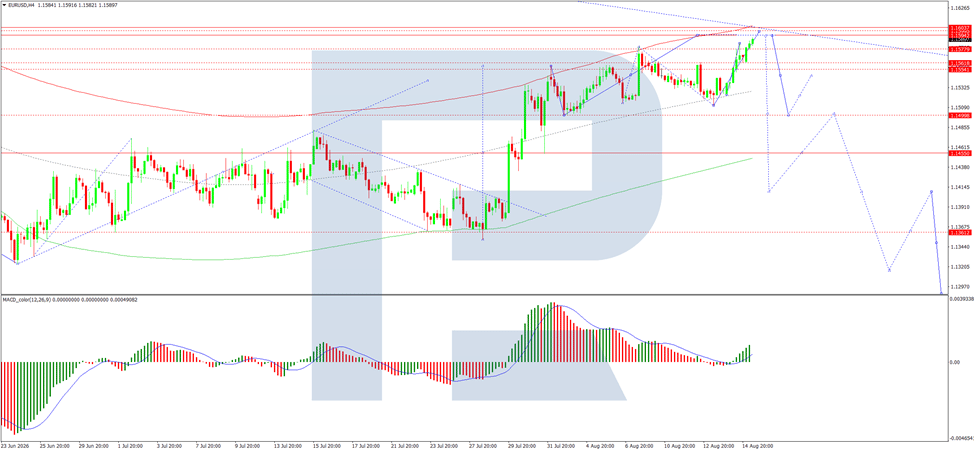
EUR/USD begins the week around 1.1588, reaching its highest level in eight weeks. The euro has been supported by dollar weakness following fresh US economic data, which revived doubts about the stability of the US economy and reduced expectations of imminent Federal Reserve tightening.
The University of Michigan’s preliminary consumer sentiment index fell to 51.0 in August, down from 54.2 in July and below the 55.2 forecast. The current conditions index declined to 51.8 from 54.8, while the expectations component dropped to 50.6 from 55.4. At the same time, short-term inflation expectations ticked up to 4.3% from 4.2%, while five-year expectations held steady at 3.3%.
Estimates of US economic growth have also become less confident. The Atlanta Fed’s GDPNow model lowered its Q3 GDP growth forecast to 4.3% from 5.8%, while the New York Fed’s Nowcast estimates growth at approximately 2.1%. This widens the tension between continued economic activity and deteriorating consumer expectations.
For the dollar, the outlook remains mixed. Weak consumer indicators and lower growth forecasts weigh on the US currency, but elevated short-term inflation expectations prevent markets from completely abandoning the prospect of a hawkish Fed policy stance.
As a result, the baseline for EUR/USD remains moderately positive, but further direction will depend on new signals regarding the US economy and the Federal Reserve’s policy stance.
Technical analysis
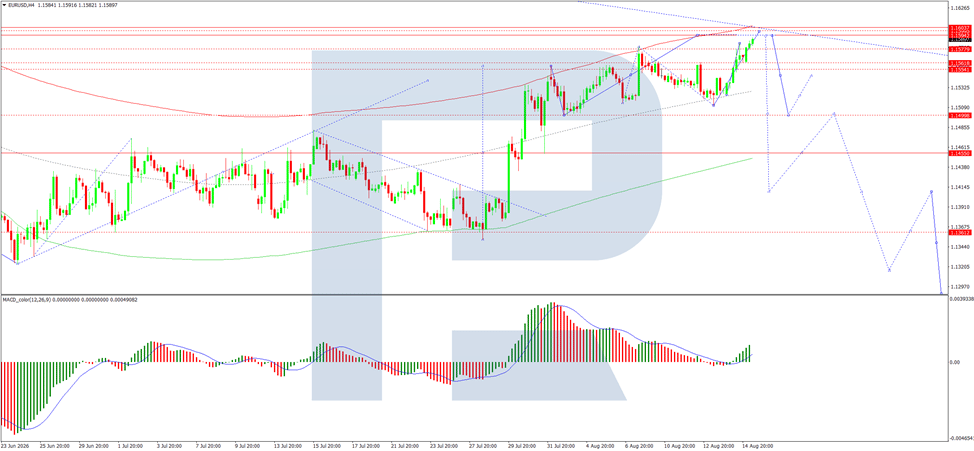
On the H4 chart of EUR/USD, the market continues to develop its consolidation range. The consolidation range around the 1.1561 level has practically formed. An upside breakout would suggest a corrective wave developing to 1.1594, followed by a decline to 1.1500. A direct downside breakout would open potential for a downward wave to 1.1400, with the prospect of the trend continuing to 1.1260. Technically, this scenario is confirmed by the MACD indicator-its signal line is above the zero level but pointing strictly downwards, reflecting continued bearish momentum with the potential for the downward trend to persist.
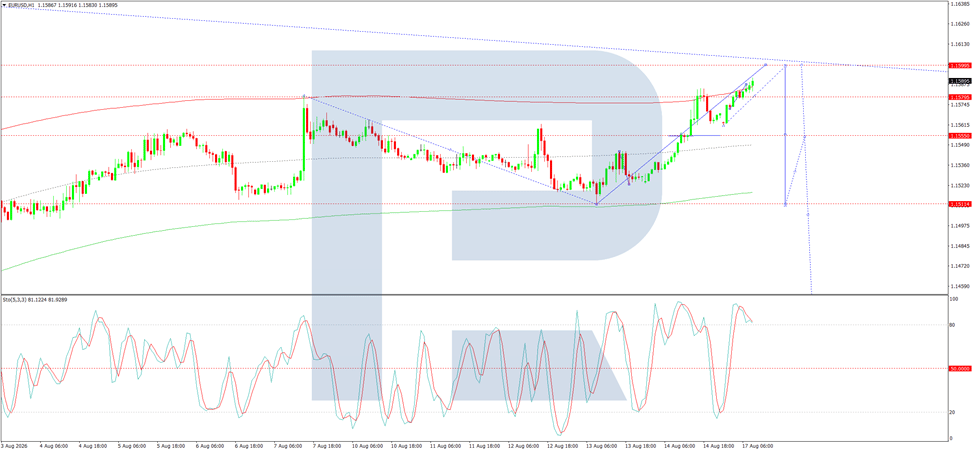
On the H1 chart, the market has completed the next growth wave to the 1.1555 level. A consolidation range is currently forming around this level. A range expansion up to 1.1594 is expected, followed by a decline to 1.1500, with the prospect of continuing the wave to 1.1400. Technically, this scenario is confirmed by the Stochastic oscillator-its signal line is above the 80 level and pointing strictly downwards to 20.
Conclusion
EUR/USD has climbed to an eight-week high, supported by a weaker dollar following disappointing US consumer sentiment data and downward revisions to growth forecasts. The University of Michigan survey showed a sharp decline in confidence, while the Atlanta and New York Fed growth estimates have been trimmed. However, rising short-term inflation expectations keep the prospect of Fed tightening alive, limiting the dollar’s downside. Technically, the pair may see a further push towards 1.1594 before a potential pullback to 1.1500, with the broader trend dependent on upcoming US economic data and Fed signals. The bearish structure remains intact, suggesting that any upside may be temporary.
About The Author