- The Euro retreats from recent highs as the US Dollar picks up on risk aversion.
- Investors are bracing for a steady Eurozone inflation report due later on Tuesday.
- The US Dollar remains vulnerable amid Trump’s attacks on the Fed and hopes of rate cuts.
The EUR/USD pair is putting an end to a five-day positive streak on Tuesday, retreating from Monday’s highs at 1.1735 to the lower range of the 1.1600s at the time of writing. Investors are selling the Euro with market sentiment souring ahead of the preliminary Eurozone Consumer Prices Index (CPI) release, due later on the day.
Eurozone inflation is forecast to have remained steady near the European Central Bank (ECB) 2% target rate, which provides further reasons for the bank to keep interest rates steady at its September meeting. The stronger-than-expected manufacturing activity data seen on Monday and comments from ECB board member Isabel Schnabel endorse that view.
On the other hand, the war between US President Donald Trump’s Government and the Fed is eroding the credibility of the last one and scaring investors away from the US Dollar (USD) at a critical moment, when the bank is about to resume its rate-cutting cycle.
Recent comments by US Treasury Secretary Scott Bessent saying that the “Fed has made a lot of mistakes” have failed to ease markets, already concerned by Trump’s attempts to replace committee members with loyalist doves, which have led to a likely lengthy legal battle with Fed Governor Lisa Cook.
In the US economic calendar, manufacturing and services activity data, and the all-important Nonfarm Payrolls report, due on Friday, will be a key test for Trump’s trade policies and provide further clues about September’s Fed monetary policy decision.
Euro Price Today
The table below shows the percentage change of Euro (EUR) against listed major currencies today. Euro was the strongest against the British Pound.
| USD | EUR | GBP | JPY | CAD | AUD | NZD | CHF | |
|---|---|---|---|---|---|---|---|---|
| USD | 0.52% | 1.00% | 0.94% | 0.16% | 0.63% | 0.78% | 0.38% | |
| EUR | -0.52% | 0.46% | 0.40% | -0.36% | 0.14% | 0.26% | -0.15% | |
| GBP | -1.00% | -0.46% | -0.06% | -0.82% | -0.34% | -0.24% | -0.61% | |
| JPY | -0.94% | -0.40% | 0.06% | -0.76% | -0.29% | -0.13% | -0.50% | |
| CAD | -0.16% | 0.36% | 0.82% | 0.76% | 0.45% | 0.65% | 0.22% | |
| AUD | -0.63% | -0.14% | 0.34% | 0.29% | -0.45% | 0.13% | -0.27% | |
| NZD | -0.78% | -0.26% | 0.24% | 0.13% | -0.65% | -0.13% | -0.40% | |
| CHF | -0.38% | 0.15% | 0.61% | 0.50% | -0.22% | 0.27% | 0.40% |
The heat map shows percentage changes of major currencies against each other. The base currency is picked from the left column, while the quote currency is picked from the top row. For example, if you pick the Euro from the left column and move along the horizontal line to the US Dollar, the percentage change displayed in the box will represent EUR (base)/USD (quote).
Daily digest market movers: The US Dollar might remain vulnerable ahead of key data
- The Euro (EUR) is pulling back on Tuesday, but holds most of the ground taken over the last few days. Trump’s attacks on the Fed and market expectations that the US central bank will cut interest rates later in September are keeping US bulls in check, while in Europe, solid macroeconomic figures and hawkish ECB rhetoric are likely to underpin the Euro.
- ECB board member Isabel Schnabel affirmed on Tuesday that interest rates are “mildly accommodative” at the moment and sees no reason for further monetary easing in the near term.
- On Monday, ECB President Christine Lagarde provided further support to the Euro, dismissing concerns about the French banking system and affirming that economic uncertainty has been “considerably reduced” in a speech suggesting that monetary policy will remain unchanged after September’s meeting.
- Recent Eurozone data support that view, as the Eurozone HCOB Manufacturing Purchasing Managers’ Index (PMI) was revised up to 50.7, from the 50.5 previous estimate, confirming that the sector’s activity expanded in August for the first time in the last three years.
- Tuesday’s highlight is August’s preliminary Eurozone CPI release. Consumer Inflation is expected to have grown at a 2% year-on-year rate, while the core CPI is seen moderating to a 2.2% yearly reading from 2.3% in July.
- In the US, the main attraction will be the ISM Manufacturing PMI due at 14:00 GMT, still, which is forecasted to have improved to 49 in August, from 48 in July, still at levels pointing to a contraction of the sector’s activity.
Technical Analysis: EUR/USD remains in range, with 1.1740 resistance holding bulls
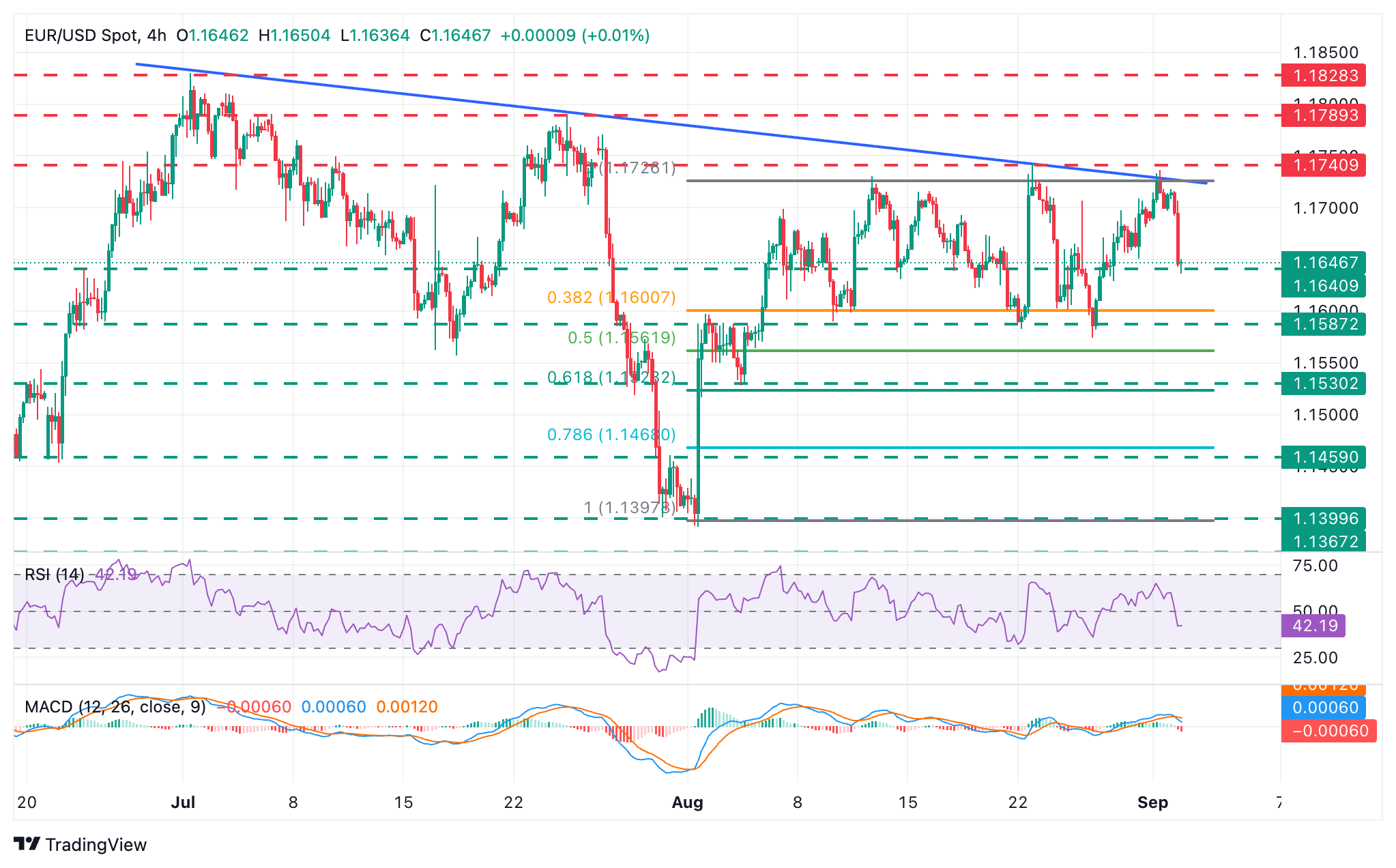
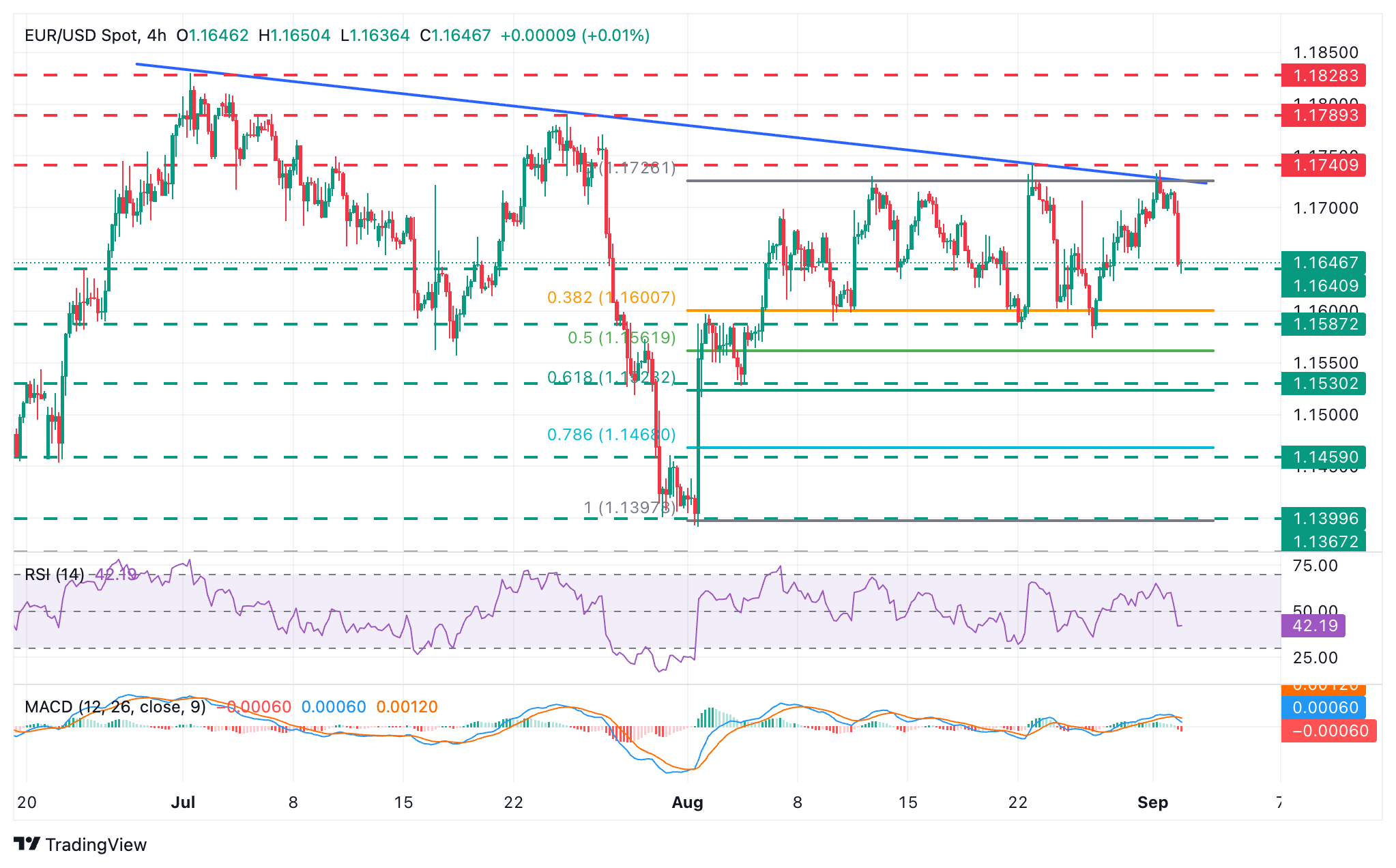
The EUR/USD near-term bias has improved, but the pair remains looking for direction within the broadly 150-pip range that has contained price action for most of August. The 4-hour Relative Strength Index (RSI) is at positive levels, at 56, but daily technical indicators suggest a frail upside momentum.
To the upside, the confluence between the descending trendline resistance, now around 1.1730 and 1.1740, which encompasses the peaks of August 13 and 22, as well as Monday’s high, is likely to pose a serious challenge for bulls. A confirmation beyond here would clear the way towards the late-July lows around 1.1790, ahead of the July 1 high at 1.1830.
Bearish attempts, on the other hand, are likely to meet support at the August 29 low, around 1.1650, ahead of the bottom of the monthly range, between 1.1575 and 1.1590, which capped bears on August 11, 22, and 27. Further down, the 50% Fibonacci retracement level of the early August bullish run, at 1.1560, might provide some support ahead of the August 5 low, near 1.1530.
Inflation FAQs
Inflation measures the rise in the price of a representative basket of goods and services. Headline inflation is usually expressed as a percentage change on a month-on-month (MoM) and year-on-year (YoY) basis. Core inflation excludes more volatile elements such as food and fuel which can fluctuate because of geopolitical and seasonal factors. Core inflation is the figure economists focus on and is the level targeted by central banks, which are mandated to keep inflation at a manageable level, usually around 2%.
The Consumer Price Index (CPI) measures the change in prices of a basket of goods and services over a period of time. It is usually expressed as a percentage change on a month-on-month (MoM) and year-on-year (YoY) basis. Core CPI is the figure targeted by central banks as it excludes volatile food and fuel inputs. When Core CPI rises above 2% it usually results in higher interest rates and vice versa when it falls below 2%. Since higher interest rates are positive for a currency, higher inflation usually results in a stronger currency. The opposite is true when inflation falls.
Although it may seem counter-intuitive, high inflation in a country pushes up the value of its currency and vice versa for lower inflation. This is because the central bank will normally raise interest rates to combat the higher inflation, which attract more global capital inflows from investors looking for a lucrative place to park their money.
Formerly, Gold was the asset investors turned to in times of high inflation because it preserved its value, and whilst investors will often still buy Gold for its safe-haven properties in times of extreme market turmoil, this is not the case most of the time. This is because when inflation is high, central banks will put up interest rates to combat it.
Higher interest rates are negative for Gold because they increase the opportunity-cost of holding Gold vis-a-vis an interest-bearing asset or placing the money in a cash deposit account. On the flipside, lower inflation tends to be positive for Gold as it brings interest rates down, making the bright metal a more viable investment alternative.
About The Author