The Euro has pulled back from session highs and is trading at 1.1815 against the US Dollar (USD), at the time of writing, showing marginal losses in the daily chart. The Eurozone’s preliminary Harmonized Index of Consumer Prices (HICP) has confirmed the cooling inflationary pressures, and the region’s services activity growth has been revised lower.
Preliminary Eurozone HICP figures revealed that consumer inflation slowed down to a 16-month low of 1.7% in January, although the core inflation, more relevant from a monetary policy point of view, remained steady. Beyond that, producer prices posted a slightly shorter-than-expected contraction, which might have kept the Euro from retreating further.
The US Dollar remains steady. US President Trump has signed a bill into law that ends a two-day government shutdown, easing markets, which are still celebrating the pick of Kevin Warsh as the replacement for Federal Reserve Chairman Jerome Powell. Warsh is a respected policymaker who is expected to be cautious with rate cuts and guarantee the central bank’s autonomy.
Investors maintain a cautious mood on Friday, awaiting the release of the ADP Employment Change report, due later on Wednesday, which will be observed with particular interest, as the key Nonfarm Payrolls report will be delayed due to the recent government shutdown.
Euro Price Today
The table below shows the percentage change of Euro (EUR) against listed major currencies today. Euro was the strongest against the Japanese Yen.
| USD | EUR | GBP | JPY | CAD | AUD | NZD | CHF | |
|---|---|---|---|---|---|---|---|---|
| USD | 0.13% | -0.00% | 0.67% | 0.18% | 0.04% | 0.61% | 0.22% | |
| EUR | -0.13% | -0.13% | 0.56% | 0.05% | -0.09% | 0.47% | 0.09% | |
| GBP | 0.00% | 0.13% | 0.67% | 0.16% | 0.04% | 0.61% | 0.23% | |
| JPY | -0.67% | -0.56% | -0.67% | -0.48% | -0.62% | -0.06% | -0.44% | |
| CAD | -0.18% | -0.05% | -0.16% | 0.48% | -0.14% | 0.42% | 0.04% | |
| AUD | -0.04% | 0.09% | -0.04% | 0.62% | 0.14% | 0.57% | 0.18% | |
| NZD | -0.61% | -0.47% | -0.61% | 0.06% | -0.42% | -0.57% | -0.38% | |
| CHF | -0.22% | -0.09% | -0.23% | 0.44% | -0.04% | -0.18% | 0.38% |
The heat map shows percentage changes of major currencies against each other. The base currency is picked from the left column, while the quote currency is picked from the top row. For example, if you pick the Euro from the left column and move along the horizontal line to the US Dollar, the percentage change displayed in the box will represent EUR (base)/USD (quote).
Daily Digest market Movers: Weak services data and soft inflation hurt the Euro’s recovery
- The Euro turned lower after Eurostat data revealed that yearly inflation eased to 1.7% in January from 2% in December. The core inflation, however, grew at a steady 2.3% year-on-year pace. The monthly HICP accelerated to 2% from 0.2% in the previous month. The core HICP grew at a 0.3% monthly rate, unchanged from December.
- Eurozone’s Producer Prices index contracted 0.3% in December, as expected, from a 0.7% growth in November. Year-on-year, the PPI fell by 2.1% following a 1.4% conttraction in November, but above market expectations ops a sharper, 2.3% contracion.
- Earlier on Tuesday, HCOB Services PMI data revealed that the sector’s activity slowed down to a four-month low of 51.6, below the preliminary expectations of a 51.9 reading, down from December’s 52.4.
- Likewise, the German HCOB Services PMI has been revised lower to 52.4 from preliminary estimations of a 53.3 reading, and also down from the 52.7 reading seen in December. These figures confirm that business activity in the Eurozone’s main economy remains sluggish.
- In the US, the focus will be on January’s ADP private payrolls report, which will be the main employment data this week. Net job creation is expected to have increased to 48K last month from 41K in December, still at relatively low levels.
Technical Analysis: EUR/USD must break above 1.1875 to confirm a trend shift
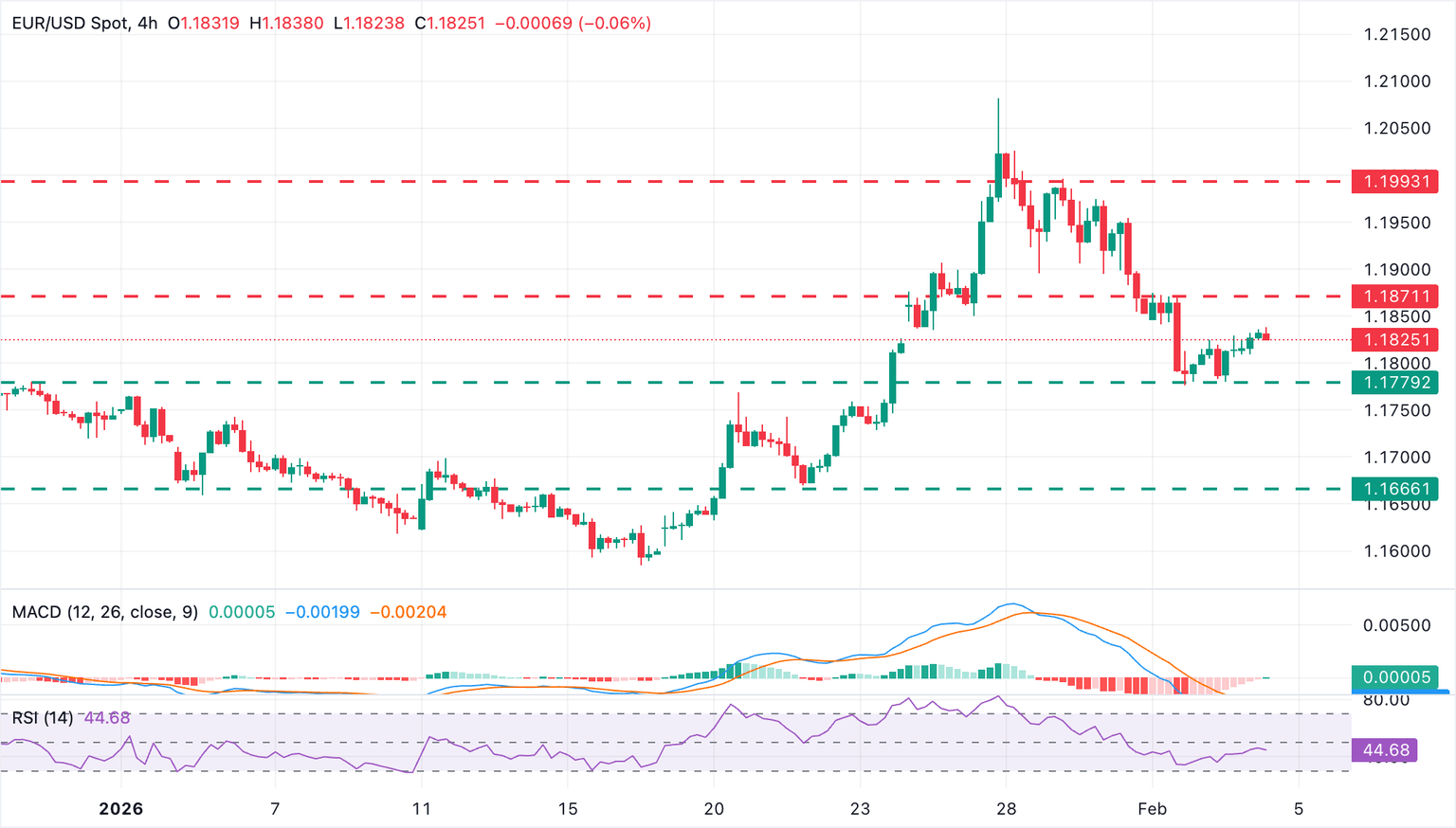
EUR/USD shows a moderate recovery from Monday’s lows at 1.1775, with indicators on the 4-hour chart highlighting a fading bearish pressure. The Moving Average Convergence Divergence (MACD) line seems about to cross above the signal line, in what would be a bullish move, and the Relative Strength Index (RSI) has reached levels right below the 50 line, which divides the bearish from the bullish area.
Price action, however, remains trapped within Monday’s trading range. Bulls would need to break the weekly top at the 1.1875 area to confirm the pair’s recovery and aim for the resistance area between the January 29 high, at 1.1995, and the 1.2000 psychological level.
Immediate support is at the February 2 and 3 lows, in the mentioned 1.1775 area. Further down, bears might be attracted by the January 21 low, near 1.1660.
(The technical analysis of this story was written with the help of an AI tool.)
Economic Indicator
Harmonized Index of Consumer Prices (YoY)
The Harmonized Index of Consumer Prices (HICP) measures changes in the prices of a representative basket of goods and services in the European Monetary Union. The HICP, released by Eurostat on a monthly basis, is harmonized because the same methodology is used across all member states and their contribution is weighted. The YoY reading compares prices in the reference month to a year earlier. Generally, a high reading is seen as bullish for the Euro (EUR), while a low reading is seen as bearish.
Last release:
Wed Feb 04, 2026 10:00 (Prel)
Frequency:
Monthly
Actual:
1.7%
Consensus:
1.7%
Previous:
1.9%
Source:
Eurostat
Economic Indicator
Producer Price Index (YoY)
The Producer Price Index (PPI) released by the Eurostat is an index that measures the change in prices received by domestic producers of commodities in all stages of processing (crude materials, intermediate materials, and finished goods). Generally, a high reading is seen positive (or bullish) for the EUR, while a low reading is seen as negative (or bearish).
Last release:
Wed Feb 04, 2026 10:00
Frequency:
Monthly
Actual:
-2.1%
Consensus:
-2.3%
Previous:
-1.7%
Source:
Eurostat
About The Author