EUR/USD posts mild gains on Tuesday’s European session, but remains trapped below 1.1550, changing hands at 1.1530 at the time of writing. German GDP data has not been particularly supportive, but the US Dollar has been trading lower during most of the European session, with all eyes on the release of the delayed US Retail Sales and Producer Prices Index (PPI) data, due later today.
Data released earlier on Tuesday revealed that Germany’s Gross Domestic Product (GDP) has confirmed the preliminary estimations of a stalled economic growth in the third quarter, following a 0.3% contraction in the second.
On Monday, Fed Governor Christopher Waller seconded last week’s comments from the New York Fed President John Williams and called for a quarter-point interest rate cut next month. Waller affirmed that the available data points to a weakening labour market while inflation is expected to ease.
These comments boosted market expectations that the central bank will ease its monetary policy further in December, although investors know that the decision will be a coin toss amid the wide divergence among policymakers.
Furthermore, US President Donald Trump posted on social media on Monday that relations with China are “extremely strong” after a phone call with Chinese President Xi Jinping. Trump called Japanese Prime Minister Sanae Takaichi shortly afterwards, in an attempt to ease the geopolitical frictions between the two Asian countries.
Some European Central Bank (ECB) speakers will take the stage later in the day, although the main focus will be in the US, with September’s Producer Prices Index (PPI), and Retail Sales figures, and November’s Consumer Confidence data on tap.
Euro Price Today
The table below shows the percentage change of Euro (EUR) against listed major currencies today. Euro was the strongest against the New Zealand Dollar.
| USD | EUR | GBP | JPY | CAD | AUD | NZD | CHF | |
|---|---|---|---|---|---|---|---|---|
| USD | -0.05% | -0.06% | -0.20% | 0.08% | 0.30% | 0.33% | 0.23% | |
| EUR | 0.05% | -0.00% | -0.16% | 0.13% | 0.34% | 0.38% | 0.27% | |
| GBP | 0.06% | 0.00% | -0.14% | 0.17% | 0.35% | 0.38% | 0.28% | |
| JPY | 0.20% | 0.16% | 0.14% | 0.29% | 0.50% | 0.52% | 0.43% | |
| CAD | -0.08% | -0.13% | -0.17% | -0.29% | 0.22% | 0.23% | 0.14% | |
| AUD | -0.30% | -0.34% | -0.35% | -0.50% | -0.22% | 0.04% | -0.07% | |
| NZD | -0.33% | -0.38% | -0.38% | -0.52% | -0.23% | -0.04% | -0.10% | |
| CHF | -0.23% | -0.27% | -0.28% | -0.43% | -0.14% | 0.07% | 0.10% |
The heat map shows percentage changes of major currencies against each other. The base currency is picked from the left column, while the quote currency is picked from the top row. For example, if you pick the Euro from the left column and move along the horizontal line to the US Dollar, the percentage change displayed in the box will represent EUR (base)/USD (quote).
The Euro wavers in range with Fed expectations grabbing the focus
- The common currency is consolidating near the 1.1500 level as Eurozone data fails to cheer investors, with investors awaiting the release of delayed US macroeconomic figures for a better picture of the Fed’s monetary policy path.
- Figures from Germany released on Tuesday confirmed that the region’s leading economy remains gripped, with the GDP showing a 0% growth in Q3, following a 0.3% contraction in Q2. Year-on-year, the German economy ticked up to a 0.3% growth from 0.2% in the second quarter.
- On Monday, the German IFO Business Climate eased to 88.1 in November, from 88.4 in October, against market expectations of a slight improvement to 88.5. The Index measuring the current economic situation improved to 85.6 from 85.3, but the economic expectations deteriorated by a whole point, to 90.6 in November from 91.6 in October.
- The US Dollar Index has pulled back to the lower boundary of the last few days’ trading range amid dovish comments from Fed officials and higher hopes of a Fed interest rate cut next month. Data from the CME Group’s Fedwatch Tool shows that the odds for a 25 basis points interest rate cut on December 10 have risen beyond 80%, from about 40% last week.
- In the US, later on Tuesday, September’s US PPI is expected to have picked up to 0.3% in the month, from a 0.1% decline in August. The yearly inflation is seen accelerating to 2.7% from 2.6% in the previous month. The Core PPI, however, is seen easing to a 2.7% yearly rate from August’s 2.8%.
- At the same time, US Retail Sales are expected to have grown at a 0.4% in September, down from 0.6% in August. Excluding automobiles, sales of all other products are seen slowing down to 0.4% from the previous month’s 0.7% growth.
Technical Analysis: EUR/USD remains capped below 1.1550 resistance
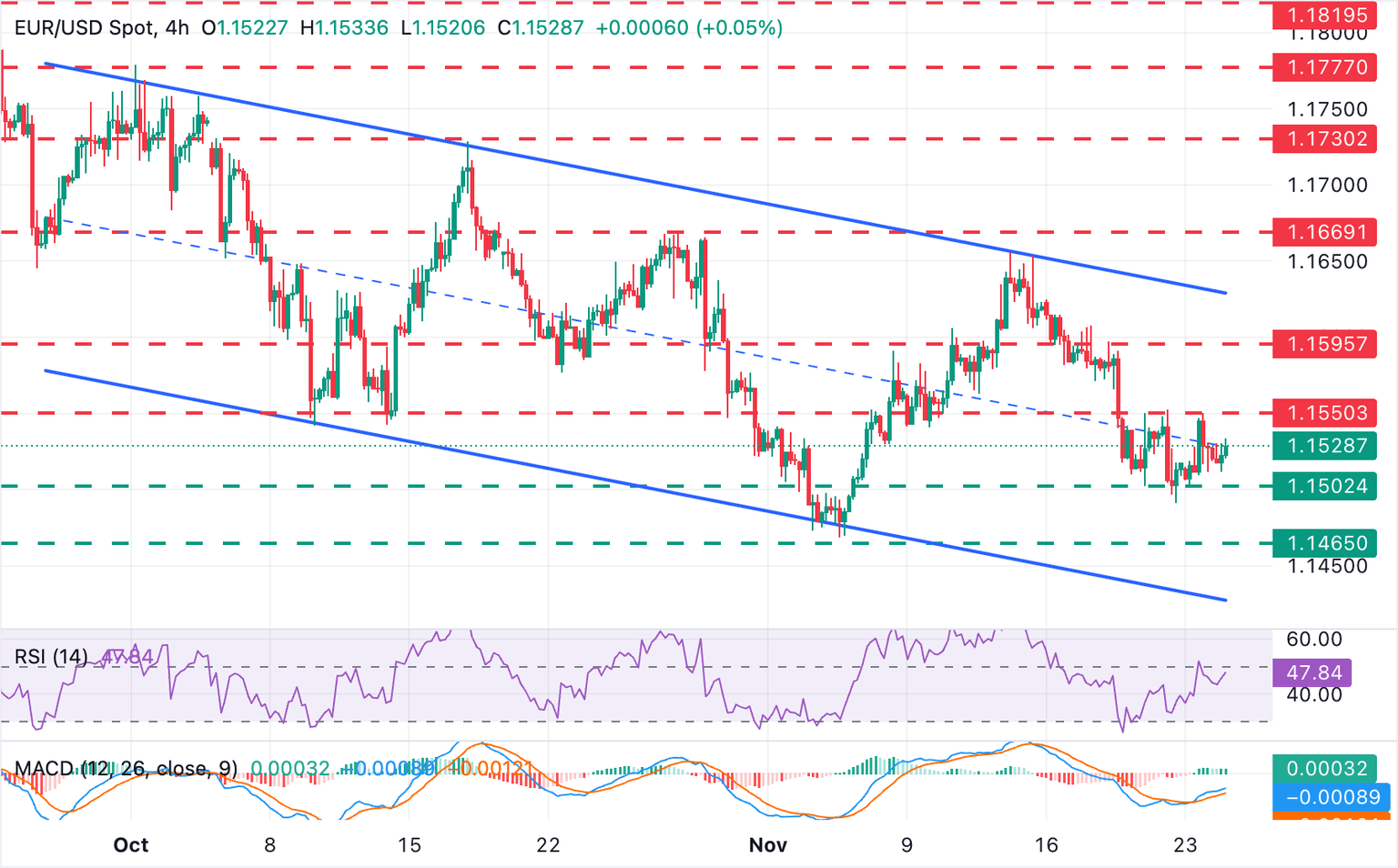
The EUR/USD pair keeps languishing near two-week lows at the 1.1500 area, with upside attempts capped below 1.1550, although the broader bearish trend is still in play. The 4-hour Relative Strength Index (RSI) failed to consolidate above the 50 level on Monday. The Moving Average Convergence Divergence (MACD) has crossed above the signal line, but remains at levels below zero, underscoring the fragility of the rebound from Friday’s lows.
Resistance at the 1.1550 level has capped bulls in the last three trading days, which leaves the pair in no man’s land above 1.1500. The pair should break that level to confirm a bullish reaction and aim for the November 18 and 19 highs, near 1.1600, and the top of a descending channel from the mid-October highs, which is now around 1.1625.
On the downside, below the 1.1500 psychological level, bears would gain confidence to retest the November 5 lows, near 1.1470, and the bottom of the descending channel from early October highs, now around 1.1425.
Euro FAQs
The Euro is the currency for the 20 European Union countries that belong to the Eurozone. It is the second most heavily traded currency in the world behind the US Dollar. In 2022, it accounted for 31% of all foreign exchange transactions, with an average daily turnover of over $2.2 trillion a day.
EUR/USD is the most heavily traded currency pair in the world, accounting for an estimated 30% off all transactions, followed by EUR/JPY (4%), EUR/GBP (3%) and EUR/AUD (2%).
The European Central Bank (ECB) in Frankfurt, Germany, is the reserve bank for the Eurozone. The ECB sets interest rates and manages monetary policy.
The ECB’s primary mandate is to maintain price stability, which means either controlling inflation or stimulating growth. Its primary tool is the raising or lowering of interest rates. Relatively high interest rates – or the expectation of higher rates – will usually benefit the Euro and vice versa.
The ECB Governing Council makes monetary policy decisions at meetings held eight times a year. Decisions are made by heads of the Eurozone national banks and six permanent members, including the President of the ECB, Christine Lagarde.
Eurozone inflation data, measured by the Harmonized Index of Consumer Prices (HICP), is an important econometric for the Euro. If inflation rises more than expected, especially if above the ECB’s 2% target, it obliges the ECB to raise interest rates to bring it back under control.
Relatively high interest rates compared to its counterparts will usually benefit the Euro, as it makes the region more attractive as a place for global investors to park their money.
Data releases gauge the health of the economy and can impact on the Euro. Indicators such as GDP, Manufacturing and Services PMIs, employment, and consumer sentiment surveys can all influence the direction of the single currency.
A strong economy is good for the Euro. Not only does it attract more foreign investment but it may encourage the ECB to put up interest rates, which will directly strengthen the Euro. Otherwise, if economic data is weak, the Euro is likely to fall.
Economic data for the four largest economies in the euro area (Germany, France, Italy and Spain) are especially significant, as they account for 75% of the Eurozone’s economy.
Another significant data release for the Euro is the Trade Balance. This indicator measures the difference between what a country earns from its exports and what it spends on imports over a given period.
If a country produces highly sought after exports then its currency will gain in value purely from the extra demand created from foreign buyers seeking to purchase these goods. Therefore, a positive net Trade Balance strengthens a currency and vice versa for a negative balance.
About The Author