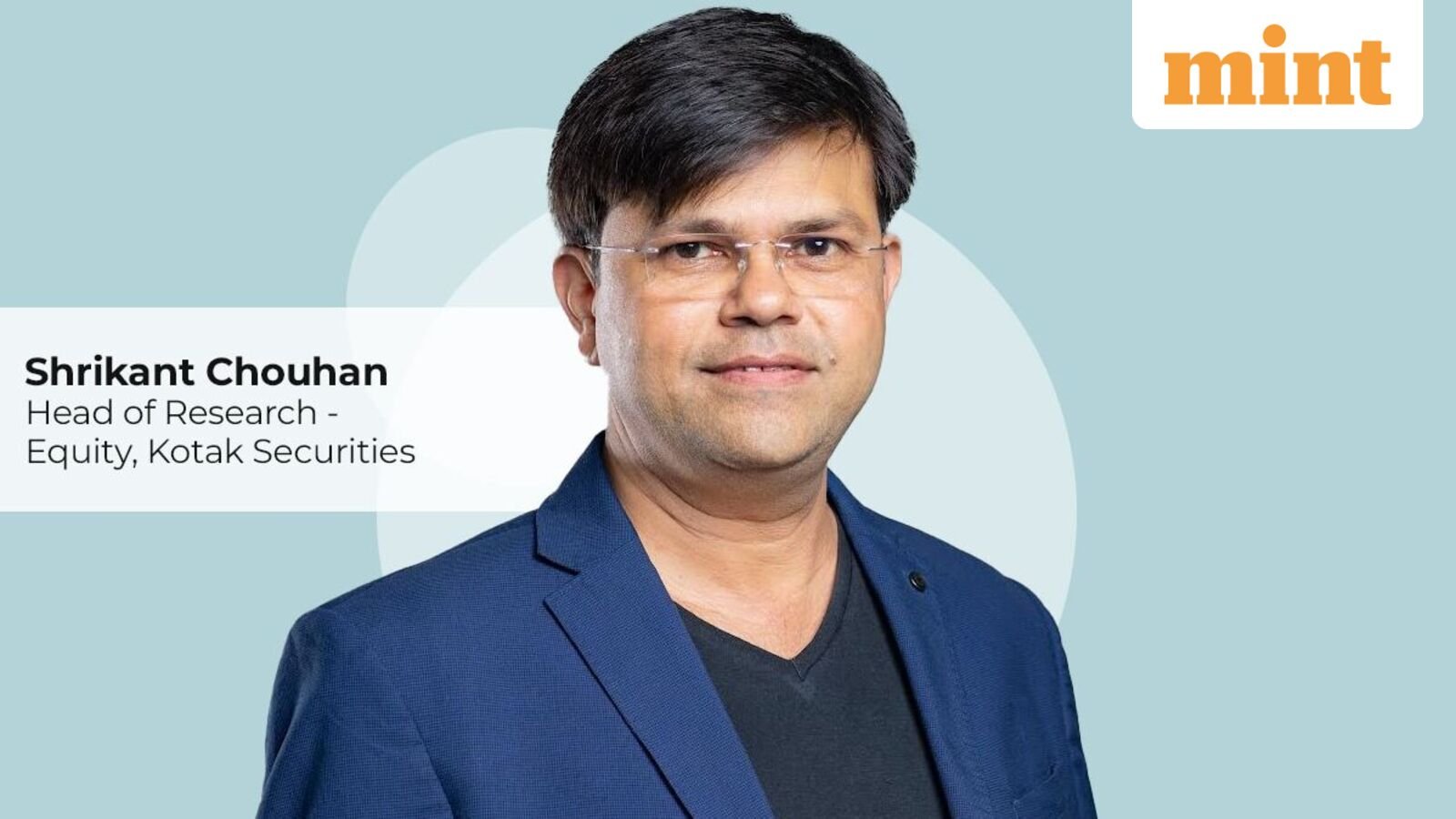
Expert view: Shrikant Chouhan, the head of equity research at Kotak Securities, believes the domestic market may still hit a new high by the end of the year. However, it is possible only if earnings momentum sustains over the next two quarters, FPI selling pauses or slows, government spending increases, and crude stabilises. In an interview with Mint, Chouhan explained why mid and small-caps are outperforming, his assessment of Q1 earnings, and areas of opportunity in this market. Edited excerpts:
Where do you see the Nifty by the end of 2026? Is a new high by the year-end still a possibility?
The Nifty 50 currently trades around 24200, down nearly 8% from its all-time high of 26,370. A new all-time high before the end of 2026 is still technically and fundamentally viable, provided earnings momentum sustains in the next two quarters, FPI selling pauses or slows, there is a government spending push, and crude stabilises.
Why are mid and small-caps outperforming, whereas large-caps tend to perform better in times of uncertainty?
Mid- and small-cap companies have delivered stronger earnings growth over the last few quarters than larger companies. This is driven by agile operational adjustments, cost-cutting, and a niche-market focus. Hence, mid and small-caps outperform.
The Indian market is among the worst-performing this year. Is it only because of the West Asian crisis and oil prices, or do you see other factors behind this downtrend as well?
The West Asian crisis and elevated crude oil prices are significant external catalysts, but they are leading to foreign portfolio investor (FPI) outflows, currency weakness, and a narrowing of the risk premium, which are the factors behind the downtrend.
Apart from these factors, a strong wave of large mainboard IPOs absorbed significant liquidity out of the secondary market, diverting capital, and a slowdown in urban mass consumption also led to a downtrend.
Is it a market to protect wealth or create wealth? Are there any opportunities in any pockets?
Capital protection or capital creation depends on market horizons, but current market conditions call for a hybrid approach. We have some high-conviction sectors like power, defence, auto ancillaries, large-cap private banks, healthcare, speciality pharma, and chemicals, which can create wealth for investors in the long run.
What is your assessment of Q1 earnings? Should we expect earnings of the coming quarters to be better than Q1? What does the macro setup indicate?
Broader market earnings showed single-digit top-line growth (nearly 6% YoY) and flat-to-modest PAT growth (nearly 3%–4% YoY). This reflects the slowest pace of profit expansion since the post-pandemic recovery phase. India’s real GDP growth remains resilient relative to peer emerging markets, anchored by domestic consumption and private capital formation. We expect markets to remain range-bound in the near term, rewarding companies that show growth and protect margins.
Do you think inflation could reach a point this year where central banks will be forced to raise rates? Will that mean more trouble for equity investors?
A rate-hike cycle is unlikely, but we expect interest rates to remain higher for a long time. Central banks (the US Fed and the RBI) may hold benchmark interest rates while managing supply-side inflation shocks. A return to rate hikes is not the baseline expectation, but persistent inflation means that rate cuts will be delayed, creating specific headwinds and opportunities for equity investors.
Read all market-related news here
Read more stories by Nishant Kumar
Disclaimer: This article is for educational purposes only and does not constitute investment advice. The views and recommendations expressed are those of the expert, not Mint. We advise investors to consult with certified experts before making any investment decisions, as market conditions can change rapidly and circumstances may vary.
About The Author