
Trump taps intel chief Jay Clayton to lead new Super Intelligence Force
President Donald Trump has named Jay Clayton, US director of national intelligence, to lead the country’s new Super Intelligence Force, according to a post on Truth Social on Sunday.
The announcement followed media reports on Friday of the appointment. Cointelegraph reported Sept. 20 that Trump planned to create an “AI Force” modeled after the Space Force and appoint an artificial intelligence czar.
“The Super Intelligence Force is tasked with coordinating the effort of the Federal Government to ensure that America continues to lead the World in Super Intelligence,” Trump wrote in his post.

Clayton led the Securities and Exchange Commission during Trump’s first term and launched a prosecution against Ripple for selling securities on his last day in office, and as U.S. Attorney for the Southern District of New York led the criminal trial against Roman Storm for his involvement in Tornado Cash. Storm commented:
“It doesn’t look like we’re headed toward a future that supports open-source AI.”
Trump’s good buddy Elon Musk is renaming SpaceXAI to SpaceXSI to honor the President’s directive renaming “artificial intelligence” to “superintelligence.”
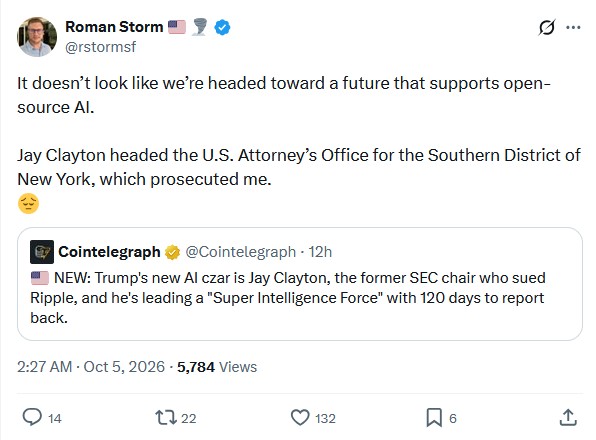
Source: Roman Storm
NEAR Intents hack has a happy ending
NEAR has been riding a wave of positive sentiment lately and has more than doubled in price over the past month. This week it received praise in some quarters — and criticism in others — after its SHIELD AI system blocked Bitget’s hacked funds from its INTENTS cross chain swaps platform. Its Bitwise ETF debuted this week with almost $60 million of inflows.
SHEILD also helped to halt a $3.8 million exploit of NEAR Intents due to a “bug in the Omni deposit and withdrawal infrastructure interaction with NEAR Intents smart contract.”
Sentiment flipped bearish for about seven and a half minutes, until NEAR Intents general manager Alex Shevchenko posted like a boss“we have identified you, sir” and issued a 48 hour ultimatum to return the funds or to presumably face the full force of the law.
“You know better than most how responsible disclosure works — this is the last window to use it. After 48 hours, that window closes.”
The funds were duly returned, and Shevchenko urged other exploiters thinking of LARPing as white hat hackers to “use bug bounties instead of disrupting the services.”
The move to block Bitget’s stolen funds was controversial however and in stark contract to THORChain which has refused to block swaps on its platform, pointing to ideals around decentralization. There is also a live debate over whether SHIELD blocking funds leaves it legally liable for everything that happens on the platform in future.
NEAR is down 11% this week.

Arthur Hayes says money printing is inevitable
Money printing is coming due to the AI revolution, the United State’s debt crisis, and increasing financial stress in France, says Arthur Hayes, chief investment officer at Maelstrom fund.
AI companies need trillions of dollars to finance data centers even as the prices of their services fall, Hayes said at a fireside chat at CONNECT by Cointelegraph: Seoul Edition, on Tuesday during Korea Blockchain Week.
“They’ve not really given themselves a lot of options other than print money and make it less bad,” he said.
Hayes also discussed China potentially moving to monetary stimulus along with increasing financial stress in France, including credit-default swaps tied to BNP Paribas and French government bond spreads.
I think the money printing will essentially happen at some point, but that’s sort of a slow motion train wreck happening underneath the surface.”

BitMEX co-founder Arthur Hayes speaking at CONNECT by Cointelegraph: Seoul Edition.
Blast to wind down Ethereum L2 after costs outpace revenue
Ethereum layer-2 network Blast is shutting down after its operating costs exceeded the revenue generated by the chain.
In a Friday post on X, Blast said it sees no “credible path” to making the network economically sustainable and asked users to withdraw their assets to Ethereum mainnet.
“We launched Blast with the goal of building a self-sustaining chain for users and developers,” the team said.
“Unfortunately, the economics of operating the chain no longer make sense.”
Blast was founded by Tieshun “Pacman” Roquerre, the founder of NFT marketplace Blur, in November 2023 with native yield on Ether (ETH) and stablecoins and a points program tied to an anticipated token airdrop.
The strategy helped attract more than $2 billion in deposits before its mainnet launched in February 2024. Its DeFi total value locked has fallen by more than 98% since its June 2024 peak, according to DeFiLlama data.
Ethereum schedules Glamsterdam upgrade on Sepolia for Oct. 6
Ethereum developers have scheduled the network’s next major upgrade, Glamsterdam, to activate on the Sepolia testnet on Oct. 6.
Sepolia node operators must update both their execution-layer and consensus-layer clients before the activation, the Ethereum Foundation said.
One of Glamsterdam’s changes is enshrined proposer-builder separation. It will move the handoff between specialized block builders and validators into Ethereum’s protocol, reducing reliance on outside middleware.
Glamsterdam will introduce block-level access lists, which record the accounts and storage locations used during each block, and will enable parallel processing by clients to speed up throughput.
Winners and Losers
At the end of the week, Bitcoin (BTC) is up 1.4% to trade at $85,821, Ethereum (ETH) is up 0.6% to trade at $2,701 and XRP (XRP) is down 0.8% to $1.50. The total market cap is at $2.92 trillion according to CoinMarketCap.
Among the biggest 100 cryptocurrencies, the top three altcoin winners of the week are Midnight (NIGHT) with a 60.6% gain, StarkNet (SRK) on 14.5%, and Pump.fun (PUMP) on 26.3%.
The top three altcoin losers of the week are Lighter (LIT) which was down 22.2%, Zcash (SEC) down 16.4% and Ethena (ENA) down 14%.
Prediction of the Week
Peter Brandt says Bitcoin may hit $600K by 2029
Veteran trader Peter Brandthas flipped bullish, after warning in Julyt that prices could fall into the high $40K zone.
“There’s a good possibility we have seen the low and now are entering a new bull market cycle in Bitcoin,” Brandt told Cointelegraph on the latest episode of Trade Secrets.
Brandt has also raised his sights for Bitcoin’s next peak, putting a late-2029 high of between $300,000 and $600,000, up from the $250,000 to $300,000 range he outlined in July.
“The bull market cycle this time has a very good chance of reaching half a million,” he said.

Top FUD of the Week
Crypto hacks top $768M in September, worst month of 2026
Crypto suffered its worst month of the year for hacks and exploits in September, with two blockchain security firms estimating losses at more than $766 million.
PeckShield counted 55 major incidents resulting in $766.5 million in stolen funds, while CertiK recorded 97 incidents and estimated losses at $768.4 million.
The month included the $388 million Bitget hack and a $320 million hack of the Liquid Network. More than $270 million was later returned, according to reports.
“September was a stark reminder of how quickly the threat landscape can shift,” CertiK said.
Other crypto hacks in the month included Safe Wallet, DCENT, and Duelbits, which lost $7.8 million, $6 million and $5.9 million, respectively.
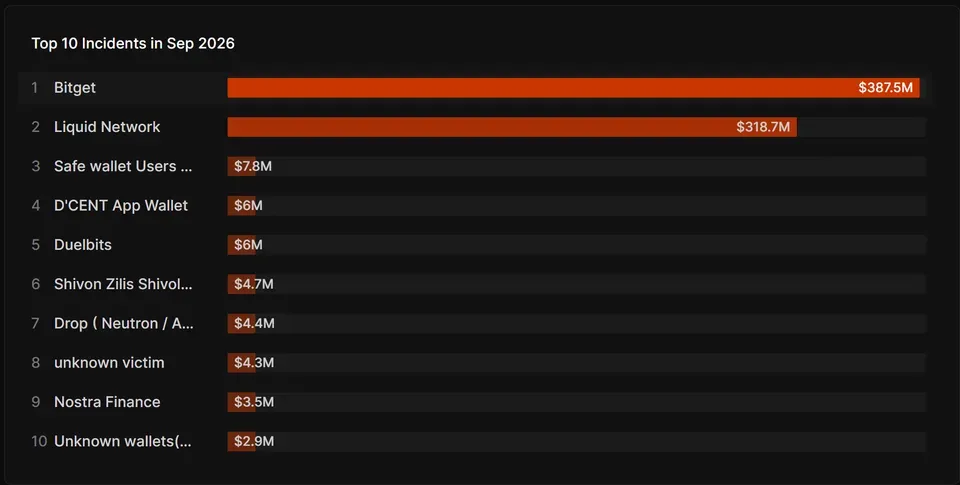
Largest incidents in September. Source: CertiK
Aave founder says V3 unaffected after third-party adapter exploit drains $305K
Aave founder Stani Kulechov said Aave v3 was unaffected by an exploit that drained roughly $305,000 from two Safe multisig wallets through a third-party adapter built on top of the lending protocol.
“This is not Aave v3 contract, it’s third party external adapter built on top of Aave, zero effect on Aave v3,” Kulechov said on X.
Tether says it helped freeze $550M in Iran-linked USDT this year
Stablecoin issuer Tether said it helped authorities freeze nearly $550 million in Iran-linked USDT during 2026,
The company said it has been working closely with international law enforcement for years. This year alone, it froze more than $130 million in USDT across four wallets, and in April, it froze more than $344 million linked to the Central Bank of Iran.
The statement from Tether came as Democratic investigators on the Senate Permanent Subcommittee on Investigations released a report alleging USDT had become a key channel for Iran to evade sanctions.
Investigators found that 84% of 846 crypto wallets sanctioned over ties to Iran had transacted exclusively or nearly exclusively in USDT. The findings prompted US Senator Richard Blumenthal to call on the Treasury and Justice departments to investigate potential sanctions violations.
Top Magazine Features of the Week
The furious debate over Bitget’s $387.7M of hacked funds comes down to whether ideals around “permissionless and decentralized” tech means never intervening — even if you could.

THORChain will not — or can not — block addresses linked to the $387.5 million Bitget hack. Can the devs be prosecuted for money laundering? It’s complicated, says crypto lawyer Yuriy Brisov.
Highly liquid and settling 24/7, stablecoins can leave banks and countries at lightning speed. But whether stablecoins are a risk — or an opportunity — depends on your perspective.
Cointelegraph publishes long-form journalism, analysis and narrative reporting produced by Cointelegraph’s in-house editorial team with subject-matter expertise. All articles are edited and reviewed by Cointelegraph editors in line with our editorial standards. Some articles contain affiliate links, from which Cointelegraph may earn a commission. These relationships do not influence which products we review or our editorial conclusions. Content published in here does not constitute financial, legal or investment advice. Readers should conduct their own research and consult qualified professionals where appropriate. Cointelegraph maintains full editorial independence.
About The Author