Protesters gather for a student demonstration at Place de la Bastille with a view of the Colonne de Juillet monument in Paris, on October 8, 2026, as part of a nationwide protest movement over learning conditions.
Simon Wohlfahrt | Afp | Getty Images
As France’s economic and political woes mount, investors are asking whether the country’s debt problems risk contaminating the rest of the euro zone.
Markets are flashing alarm bells over the euro zone’s second-biggest economy. The euro has remained under pressure, falling almost 5% against the dollar since the start of the year.
France’s benchmark borrowing cost, the yield on its 10-year bond, rose above 5% for the first time since 2002 this week before moving sharply higher.
Meanwhile, the spread between French and German 10-year bond yields — a closely watched metric of distress — reached more than 170 basis points on Thursday for the first time since the euro zone debt crisis of the early 2010s. The cost of insuring the French government against default, as measured by credit default swaps, is also the highest since that period.
Euro zone contagion
The big concern is fragmentation, when countries that share a currency face sharply different borrowing costs, compounding market stress and risking spiraling debt repayments for the worst-impacted countries.
As the euro zone sovereign debt crisis of the early 2010s showed, market stress in one country can spread rapidly through economies that share a currency and a central bank but retain separate fiscal systems. The crisis began in Greece before spreading to countries including Portugal, Ireland, Italy and Spain.
Governments were expected to rescue struggling banks, which held large amounts of sovereign debt, creating a vicious cycle.
The crisis only eased after rescue programs tied to sweeping austerity measures, and ECB President Mario Draghi pledged in 2012 to do “whatever it takes” to preserve the euro.
Economists are warning that a new vicious cycle is being created — not only in France but in big economies from the U.S. to the U.K. — as investor concern over rising government debt pushes up yields and interest costs, which in turn add to the debt burden.
A slowdown in bond purchases raises “the specter that the government will be forced into default because it simply doesn’t have the cash to pay interest and principal on its debt,” Nobel laureate Paul Krugman wrote in a blog on Oct. 8.
“Fear of default then leads to even more capital flight, which increases fears of default and the interest rate,” he said.
France’s debt risks
France in particular has one of the highest deficit-to-GDP ratios in the 21-nation euro area and a growing national debt pile. Its economy has slowed to a crawl, with the government cutting its 2026 growth forecast to just 0.5%.
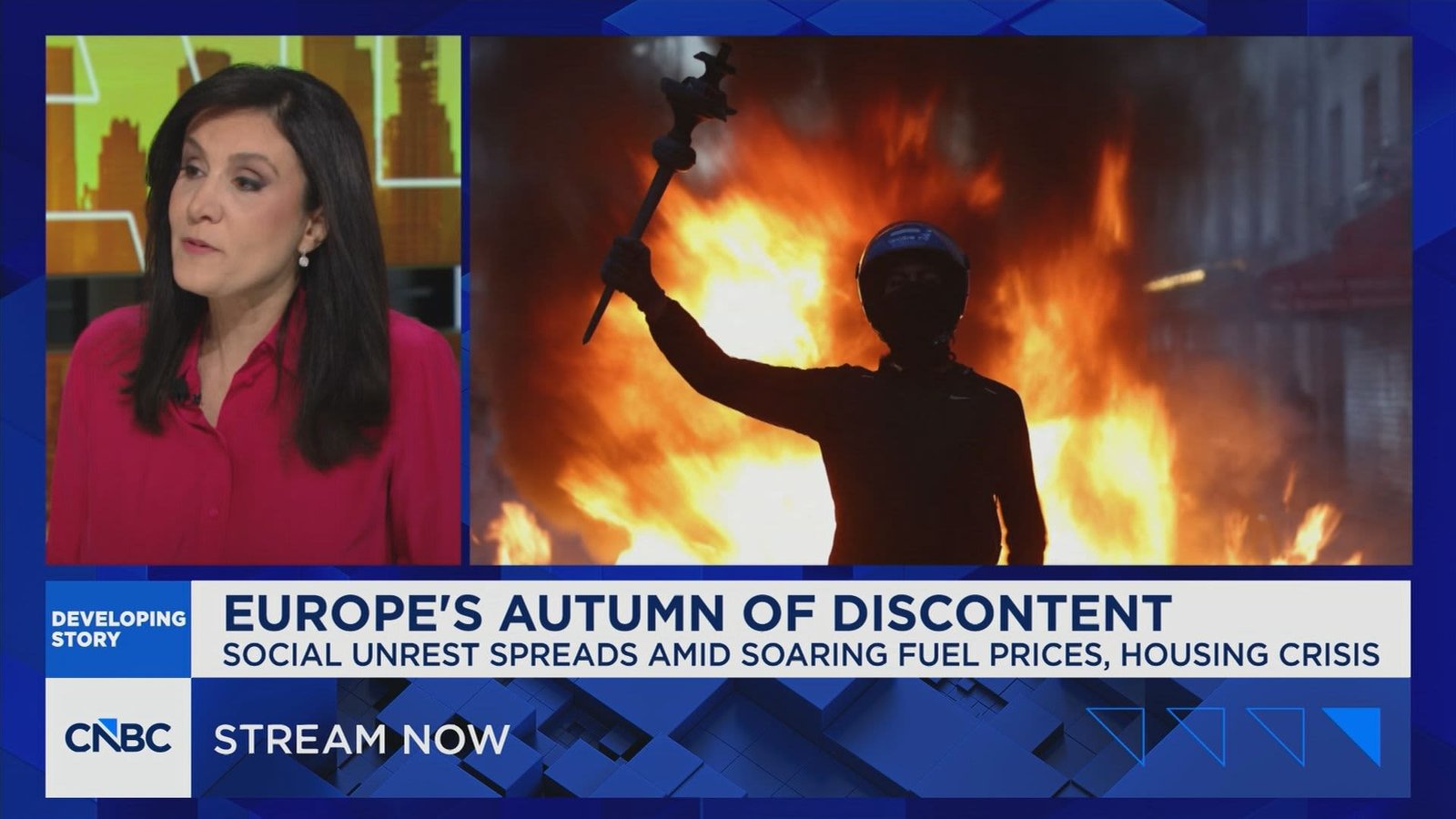
Those fiscal strains come as political volatility and social unrest raise doubts about the government’s ability to deliver measures aimed at stabilizing the public finances.

“We are deep into French crisis territory,” Carsten Brzeski, ING’s global head of macro research and chief euro zone economist, said by email.
“There is no risk of an imminent liquidity issue for the French government but the lack of trust of bond markets and the ongoing crisis should finally bring a high sense of urgency to Paris.”
John Stopford, head of multi-asset income at Ninety One, said France has gone from being a core or semi-core European country for fixed income investors to increasingly being considered on the periphery, which he labeled “bizarre” given the history of France in relation to the EU and its economic power in the continent.
“We as investors, have just chosen for the time being to pretty much avoid all of the non-core countries in Europe – it’s too fluid a situation with too much uncertainty to really want to get involved,” Stopford said on a call.
Why 2026 is different
Nonetheless, analysts CNBC spoke to broadly agreed that reforms meant that even if the market is behaving in similar ways to the post-financial crisis period, the contagion risk remained limited this time around.
Ninety One’s Stopford said spreads would likely need to be trading “in the 200s” before the situation is broadly perceived as a genuine crisis — but, he added, that the situation in France “doesn’t look great.”
“French spreads are now wider than they were at the peak of the peripheral crisis of the early 2010s, but they’re still much narrower than the extreme levels that we saw in Spain, Italy, Greece and Ireland back then, so… I think the market’s assumption is that things will need to get worse before we get to a point where EU institutions start to look to try and limit further damage,” he told CNBC.
BlackRock strategists noted the current environment is “materially different” to the one that preceded the 2011 to 2012 euro zone debt crisis, with the region now better equipped to weather financial stress, but they added that “further volatility and spillovers remain possible.”
“The French bond sell-off illustrates how competition for capital is reshaping fixed income markets amid a global rate reset,” they wrote. “Rising government borrowing and AI-related investment are pushing up financing costs, exposing borrowers with deteriorating fundamentals to greater scrutiny.”
George Lagarias, chief economist at Forvis Mazars, said France was already in a debt crisis, citing its debt-to-GDP ratio of 119% at the end of the second quarter of 2026 — close to Greece’s of 128% in late 2009.
A spillover would mean a wider French-German yield spread followed by higher credit default swap prices – the cost of insuring debt, he said.

The spread between French and German 10-year bonds continues to widen
“Italy, Spain, would see higher borrowing costs, and have to curtail fiscal expenditures, possibly raising political backlash in their own countries,” he told CNBC. “The European periphery would come under tremendous pressure, even if their finances are in much better order than a few years ago.”
However, Lagarias said crucial structural differences minimize the risk of a wider spillover akin to the early 2010s, which he estimated at 10% to 20%.
“Greece had a very bad trade deficit. France also has a trade deficit, but the numbers are much more benign,” he said by email.
He added that the Insee, France’s national statistics body, was “not likely to lie about the deficit” and contrasted this with Greece.
In 2009, Greece sharply revised its projected budget deficit from 3.7% of GDP in the spring to 12.5% by October, undermining confidence in the reliability of its public finances and helping accelerate the crisis.
“[French] debt levels are worrying but known. Markets can deal with known risks. They hate surprises,” Lagarias added. “What sunk Greece was a deficit that was suddenly revealed to be five-fold versus the official estimate. This catalysed a crisis.”
Alex Everett, investment director for rates management at Aberdeen Investments, agreed that the current environment should be treated “primarily as French risk rather than a systemic euro-area risk.”
“Compared to the early 2010s, the Eurozone has stronger banks, greater integration and numerous tools designed to limit the risk of sovereign fragmentation,” he said. “I anticipate contagion to be short-lived.”
About The Author