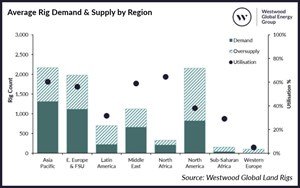

(WO) – Land drilling rig demand in the Middle East is forecast to rise 60% from 2025 levels by 2035, as global demand grows and the rig fleet shrinks, according to Westwood Global Energy Group’s Global Land Drilling Rig Outlook 3Q 2026. The report, Westwood’s first quarterly edition and its first with a 10-year forecast, projects average global demand of about 4,250 rigs a year from 2026 to 2030. That figure rises to nearly 4,550 from 2031 to 2035, 12% above the 2021–2025 average. As older rigs retire, Westwood expects global utilization to climb from an average of 48% in 2026–2030 to 53% in 2031–2035.
In the Middle East, Westwood forecasts demand will reach about 820 rigs by 2035. Drilling has been disrupted in 2026, but the firm expects a recovery from 2027, led by Saudi Arabia and by a UAE no longer bound by OPEC quotas. Continued investment in unconventional gas and crude capacity expansion will support that recovery.
“The conflict in the Middle East has significantly disrupted drilling activity this year, particularly in Iraq,” said Ben Wilby, research manager, onshore energy services, at Westwood. “A return to 2025 levels of rig demand will depend on regional security stabilizing and reliable access to export routes. Nevertheless, operators continue to make long-term commitments to the region, giving us confidence in its growth prospects once conditions allow.”
Latin American rig demand is forecast to rise 54% to about 260 units by 2035. Argentina’s Vaca Muerta shale play is expected to grow from 84 rigs in 2025 to 113. Venezuela’s demand is projected to grow more than 600% over the same period, backed by operator investment plans, U.S. government support and partial sanctions relief. Westwood noted, however, that infrastructure, workforce and supply chain constraints remain.
Westwood also expects high-horsepower rigs to average 64% utilization over 2026–2035, compared with 35% for lower-horsepower units, as operators target deeper and more complex reservoirs. That gap is driving the redeployment of underused U.S. rigs to growth markets such as Argentina, Australia and the Middle East. “Operators are drilling deeper, more complex wells and increasingly want modern technology and automation to improve efficiency and safety,” Wilby said. “Contractors need to make sure their fleets meet increasingly demanding operator specifications if they want to capitalize on that growth.”
About The Author