Gold (XAU/USD) breaks below the $4,100 mark, hitting its lowest level in nearly two weeks during the first half of the European session on Tuesday amid a bullish US Dollar (USD). Despite positive signals from US-Iran peace talks, investors remain skeptical over a final deal. This, along with the US Federal Reserve’s (Fed) hawkish tilt, lifts the USD to a fresh high since May 2025, which continues to undermine the precious metal.
Mediators Qatar and Pakistan said on Monday that the first round of negotiations between the US and Iran – aimed at securing a comprehensive agreement to end the ongoing conflict – concluded with encouraging progress. The two mediating countries said in a joint statement following talks in Switzerland that both sides have agreed on a roadmap towards reaching a final deal within 60 days. The US followed through on a key commitment and temporarily lifted sanctions on Iranian oil exports.
Adding to this, the US will mediate another round of talks to end clashes in Lebanon between Iran-backed Hezbollah and Israel. The market optimism, however, remains capped amid conflicting US-Iran messages. US Vice President JD Vance said that Iran agreed to admit nuclear monitors and is prepared to accept extensive weapons inspections as part of ongoing diplomatic efforts. However, Iran’s foreign ministry told state media that Tehran had made no new commitments on nuclear inspections.
Meanwhile, US President Donald Trump said preventing Iran from obtaining a nuclear weapon outweighs the potential economic consequences of prolonged military action. Moreover, Iran’s chief negotiator and parliamentary speaker, Mohammad Bagher Ghalibaf, told state media on Tuesday that the Strait of Hormuz will remain under Tehran’s administration and would not return to the pre-war status. This keeps geopolitical risk premium in play and underpins the safe-haven buck.
On the monetary policy front, the Fed signaled last week that it will need to raise policy rates this year if inflation remains sticky. Furthermore, Chicago Fed President Austan Goolsbee acknowledged that inflation is heading in the wrong direction and running well above the central bank’s 2% target. This reaffirms bets that the Fed will raise borrowing costs at least once, either in September or in December, which lends additional support to the buck and weighs on the non-yielding Gold.
Traders now look forward to the release of the flash US PMIs, due later during the North American session. This, along with speeches from influential FOMC members, will drive the USD and provide some impetus to the Gold. The focus, however, remains on the US Personal Consumption Expenditures (PCE) Price Index and the final Q1 GDP print on Thursday. Apart from this, the US-Iran headlines might continue to infuse volatility in the financial markets and produce meaningful trading opportunities.
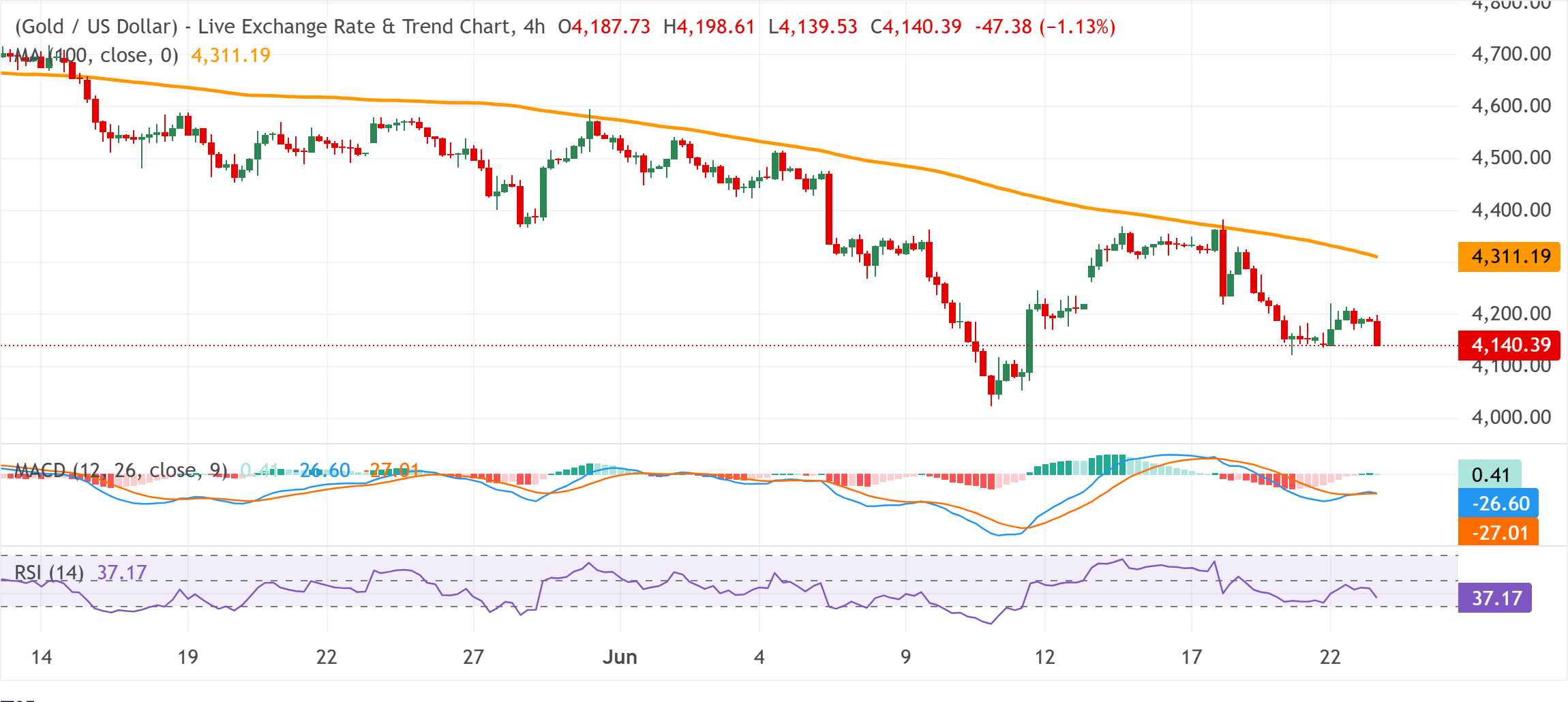
XAU/USD 4-hour chart
Gold seems vulnerable as fresh breakdown below $4,100 comes into play
From a technical perspective, the XAU/USD pair keeps a bearish near-term tone, beneath the 100-period Simple Moving Average (SMA) on the 4-hour chart. However, the Moving Average Convergence Divergence (MACD) indicator (12, 26, 9) has turned marginally positive with the signal line just above zero, hinting at tentative relief. That said, the Relative Strength Index (RSI) at 37.17 remains in weak territory and suggesting that any bounce would still unfold within a corrective context.
On the topside, the 100-period SMA at $4,311.19 is the first meaningful resistance and needs to be reclaimed on a sustained basis to ease immediate downside pressure and open the way for a more constructive recovery phase. Moreover, traders may continue to treat the current zone as a vulnerable consolidation area, with failure to challenge $4,311.19 likely to keep Gold exposed to further pullbacks on the four-hour horizon.
(The technical analysis of this story was written with the help of an AI tool.)
Economic Indicator
S&P Global Manufacturing PMI
The S&P Global Manufacturing Purchasing Managers Index (PMI), released on a monthly basis, is a leading indicator gauging business activity in the US manufacturing sector. The data is derived from surveys of senior executives at private-sector companies from the manufacturing sector. Survey responses reflect the change, if any, in the current month compared to the previous month and can anticipate changing trends in official data series such as Gross Domestic Product (GDP), industrial production, employment and inflation. A reading above 50 indicates that the manufacturing economy is generally expanding, a bullish sign for the US Dollar (USD). Meanwhile, a reading below 50 signals that activity in the manufacturing sector is generally declining, which is seen as bearish for USD.
Next release:
Tue Jun 23, 2026 13:45 (Prel)
Frequency:
Monthly
Consensus:
54.8
Previous:
55.1
Source:
S&P Global
About The Author