Gold (XAU/USD) edges higher during the Asian session on Tuesday, though it lacks follow-through as traders await further developments surrounding the Middle East crisis before placing fresh bets. Meanwhile, the uncertainty over US-Iran peace talks continues to act as a tailwind for the safe-haven US Dollar (USD). Furthermore, recovering crude oil prices keep inflation risks and US Federal Reserve (Fed) rate-hike bets on the table, helping the Greenback to build on the overnight bounce from its lowest level since mid-June and cap the non-yielding bullion.
On Monday, Iran denied that any negotiations were taking place with the US, sparking an angry backlash from President Donald Trump, who had cited the resumption of bilateral talks as justification for calling off attacks over the weekend. Moreover, Iran’s Islamic Revolutionary Guard Corps (IRGC) has reportedly attacked a US military base in Kuwait with at least three drones. This, in turn, tempers hopes for a diplomatic resolution to end a five-month-old US-Iran war, prompting traders to price in the geopolitical risk premium and supporting the safe-haven Greenback.
Meanwhile, a senior adviser to Iran’s Supreme Leader, Mohsen Rezaee, dismissed Trump’s claims that the Strait of Hormuz is on course to reopen. Rezaee further warned that Iran will not permit any unauthorised shipping route through the critical waterway other than the one designated by the Islamic Republic and that Tehran would target US warships for that purpose. This comes on top of the Iran-backed Houthi rebels’ naval blockade against Saudi Arabia and fuel concerns regarding global energy supplies, helping oil prices to recover a part of the previous day’s losses.
Investors remain worried that elevated energy prices would rekindle inflationary pressures and force the Fed to adopt a more hawkish stance. According to the CME Group’s FedWatch Tool, traders are currently assigning over a 60% probability that the US central bank will raise borrowing costs in September and see over an 85% chance of a hike by the end of this year. The bets were reaffirmed by the US ISM PMI released on Monday, which showed that US manufacturing sector activity increased to the highest level in more than four years in July. This further favors USD bulls.
Traders, however, might refrain from placing aggressive directional bets and opt to wait for the release of the closely-watched US monthly employment details, popularly known as the Nonfarm Payrolls (NFP) report on Friday. The crucial data will be looked for more cues about the Fed’s policy path, which, in turn, will play a key role in influencing the near-term USD price dynamics and providing some meaningful impetus to the Gold price. Nevertheless, the aforementioned fundamental backdrop suggests that the path of least resistance for the bullion is to the downside.
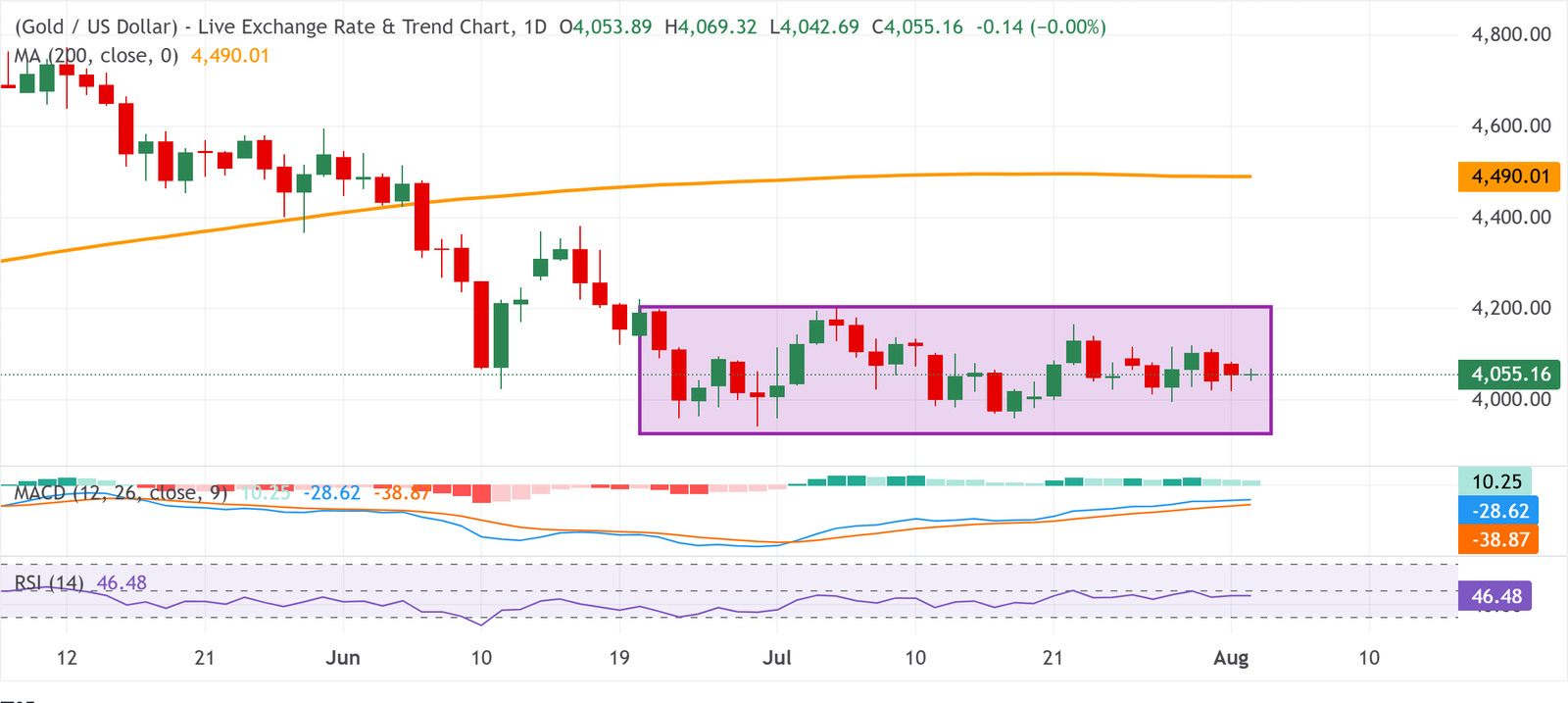
XAU/USD daily chart
Technical Analysis: Gold could attract fresh sellers at higher levels amid bearish setup
From a technical perspective, the XAU/USD pair holds well below the 200-day Simple Moving Average (SMA) and keeps a bearish near-term bias within a familiar range held over the past month or so. Moreover, the range-bound price action might still be categorized as a bearish consolidation phase against the backdrop of the recent decline, reaffirming the negative outlook for the Gold price.
Meanwhile, momentum indicators are not yet supportive of a clear recovery. The Moving Average Convergence Divergence (MACD) stays in positive territory with a modestly positive histogram, while the Relative Strength Index (RSI) at 46.48 hovers just below the neutral 50 line, hinting at lacklustre buying interest. This, in turn, suggests that bounces are likely to be capped by overhead supply.
The top boundary of the trading range, pegged ahead of the $4,200 mark, might continue to act as an immediate hurdle. A move beyond could lift Gold to the 200-day SMA near $4,490.33. Bulls would need to reclaim a technically significant barrier to alleviate the prevailing downside bias and reopen the path toward higher highs.
On the downside, immediate support is inferred from recent swing lows around the $3,976–$4,000 region, where buyers previously emerged. A daily close below would be seen as a fresh trigger for bearish traders and turn the XAU/USD pair vulnerable to declining further in the absence of clearly defined floors under the said handle.
(The technical analysis of this story was written with the help of an AI tool. Know more.)
Inflation FAQs
Inflation measures the rise in the price of a representative basket of goods and services. Headline inflation is usually expressed as a percentage change on a month-on-month (MoM) and year-on-year (YoY) basis. Core inflation excludes more volatile elements such as food and fuel which can fluctuate because of geopolitical and seasonal factors. Core inflation is the figure economists focus on and is the level targeted by central banks, which are mandated to keep inflation at a manageable level, usually around 2%.
The Consumer Price Index (CPI) measures the change in prices of a basket of goods and services over a period of time. It is usually expressed as a percentage change on a month-on-month (MoM) and year-on-year (YoY) basis. Core CPI is the figure targeted by central banks as it excludes volatile food and fuel inputs. When Core CPI rises above 2% it usually results in higher interest rates and vice versa when it falls below 2%. Since higher interest rates are positive for a currency, higher inflation usually results in a stronger currency. The opposite is true when inflation falls.
Although it may seem counter-intuitive, high inflation in a country pushes up the value of its currency and vice versa for lower inflation. This is because the central bank will normally raise interest rates to combat the higher inflation, which attract more global capital inflows from investors looking for a lucrative place to park their money.
Formerly, Gold was the asset investors turned to in times of high inflation because it preserved its value, and whilst investors will often still buy Gold for its safe-haven properties in times of extreme market turmoil, this is not the case most of the time. This is because when inflation is high, central banks will put up interest rates to combat it.
Higher interest rates are negative for Gold because they increase the opportunity-cost of holding Gold vis-a-vis an interest-bearing asset or placing the money in a cash deposit account. On the flipside, lower inflation tends to be positive for Gold as it brings interest rates down, making the bright metal a more viable investment alternative.
About The Author