Gold (XAU/USD) price reverses course and collapses to two-day lows of $4,219 as the US Federal Reserve (Fed) tilts hawkish, expecting tighter policy amid inflation that has remained above the 2% goal on the debut of new Fed Chair Kevin Warsh. At the time of writing, XAU/USD trades at $4,236, down more than 2%.
XAU/USD slides as hawkish SEP lifts Dollar and yields
Fed Chair Kevin Warsh offered little forward guidance during his press conference, acknowledging that he did not submit economic projections, including his outlook for the future path of interest rates. Still, he stressed that inflation remains well above the Fed’s 2% target and emphasized that FOMC members are united in their commitment to restoring price stability.
Commenting on the policy statement, Warsh said it was intended to present the facts rather than signal a particular policy direction. He also revealed plans to establish task forces focused on communications, the balance sheet, data quality, productivity, employment and inflation, among other areas, to reassess the Fed’s existing policy framework.
Addressing the Fed’s dual mandate, Warsh said policymakers are not facing a “cruel choice” between price stability and maximum employment. However, he acknowledged that the central bank still has work to do on inflation.
When asked about the dual mandate, he said that the Fed does not have a “cruel choice” between price stability and maximum employment but acknowledged that the Fed “have work to do on the price stability front.”
In the statement, the Fed removed forward guidance language, marking Kevin Warsh’s first leading role in monetary policy. The Fed acknowledged that the economy continues to grow robustly despite uncertainties related to the Middle East conflict and noted that the labor market remains steady, with the unemployment rate unchanged.
Additionally, “Inflation remains elevated relative to the Committee’s 2 per cent goal, partly due to supply shocks that have increased prices in sectors like energy. The Committee is committed to delivering price stability.”
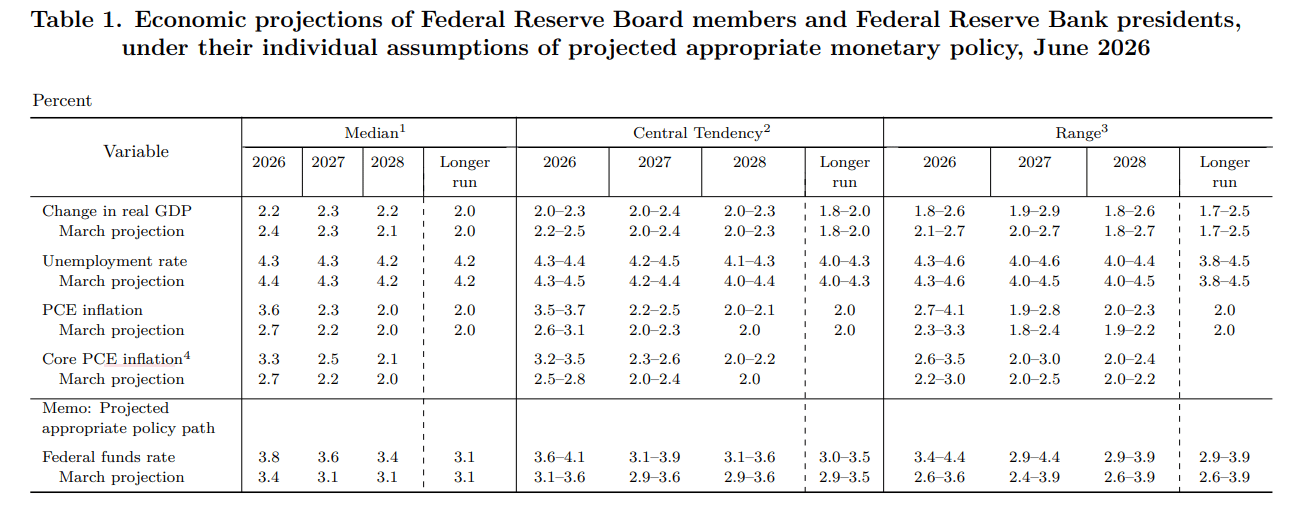
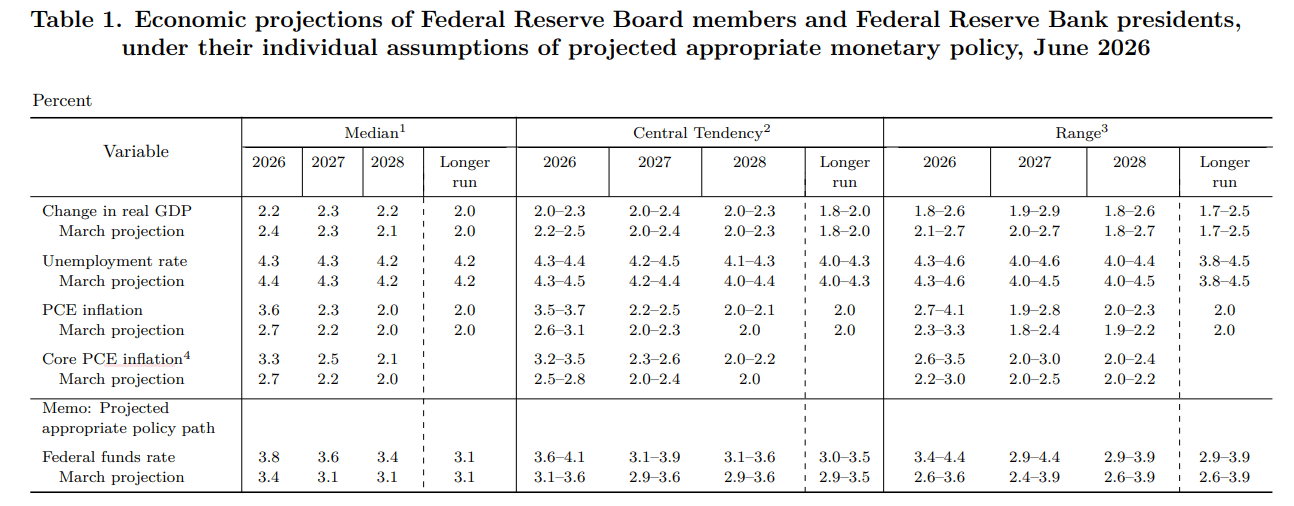
The Summary of Economic Projections (SEP) shows that the median forecast for the Fed Funds Rate is 3.8% by the end of the period, up from 3.4% in March. The economy is projected to grow by 2.2% by the end of 2026. Meanwhile, the Core PCE, the Fed’s preferred inflation indicator, is forecasted at 3.3%, which is 1.3% above the 2% target.
The swaps market had priced in 30 basis points of Federal Reserve tightening by the end of the year, according to Capital Edge data.
Earlier, US Retail Sales for May rose 0.9% MoM, beating the 0.5% forecast, as per the US Census Bureau. Gas station sales up 3.4% due to higher gasoline prices amid Iran tensions. The data shows consumer resilience, with 11 of 13 categories growing.
The US Dollar Index (DXY), which tracks the buck’s value against a basket of six currencies, trades near three-month highs of 100.57, up by 1.55%.
Geopolitical noise has tempered since the US and Iran agreed on a Memorandum of Understanding (MOU) setting the stage for a 60-day truce, aimed at talking about Tehran’s nuclear program and that they are not allowed to acquire nuclear weapons. Earlier, US President Donald Trump said that the agreement is not final and that he could resume bombing if Iran does not behave.
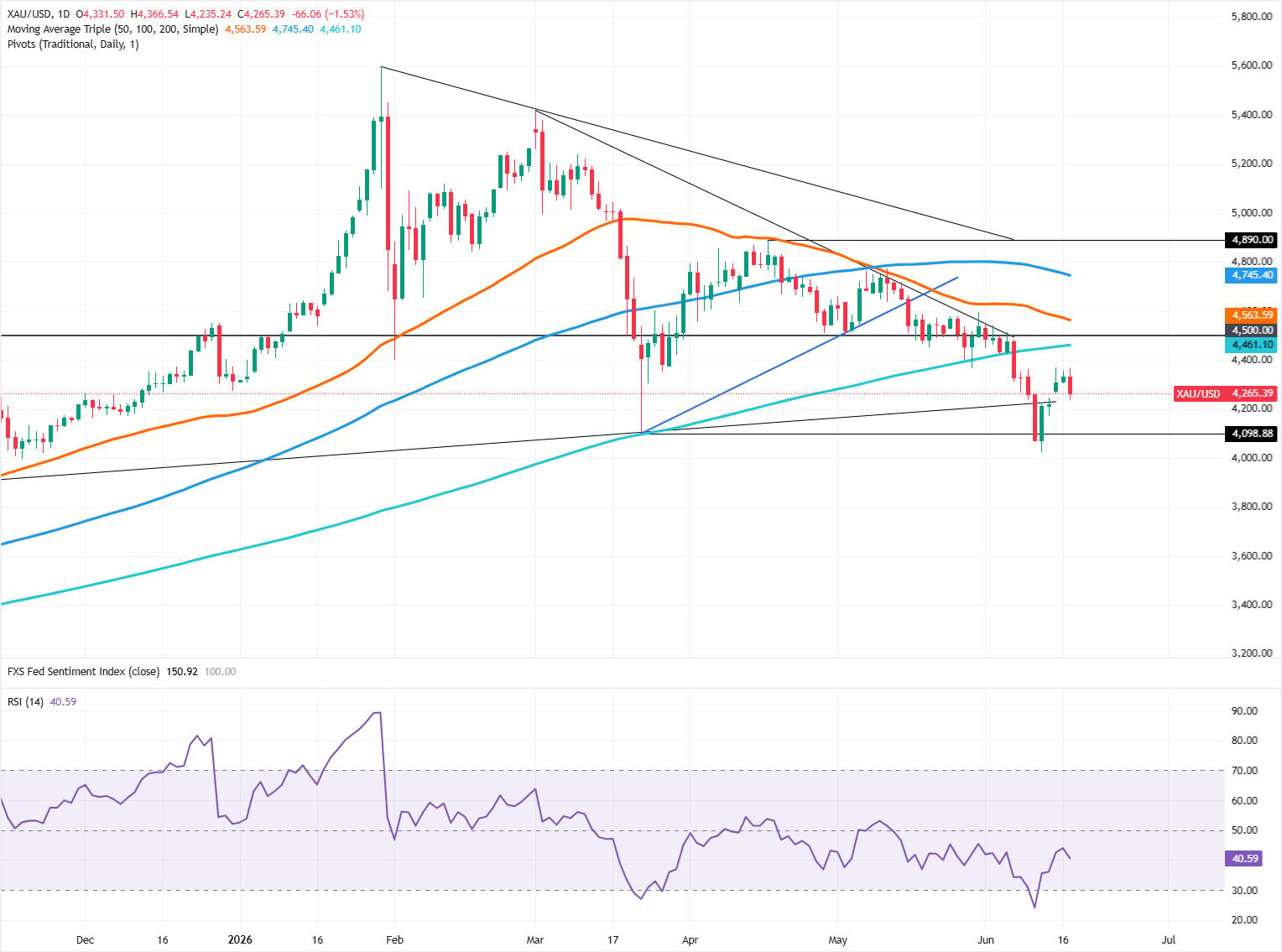
XAU/USD technical outlook: Gold stumbles below the $4,300 figure, on hawkish Fed
Gold price turned bearish after the Fed’s decision, with price action clearing June 16 support of $4,306, which opened the door to hit a two-day low of $4,219 before recovering some ground.
Momentum shifted sour, as depicted by the Relative Strength Index (RSI). The RSI is recoiling in bearish territory, a reading that hints sellers are in charge.
If XAU/USD drops below $4,200, it opens the door to test the June 11 swing low of $4,023, ahead of the $4,000 mark.
Upwards, Gold must surpass $4,300 if buyers want to test higher prices. Above this area, the key psychological levels of $4,350 and $4,400 must be cleared if buyers would like to push prices higher.
Fed FAQs
Monetary policy in the US is shaped by the Federal Reserve (Fed). The Fed has two mandates: to achieve price stability and foster full employment. Its primary tool to achieve these goals is by adjusting interest rates.
When prices are rising too quickly and inflation is above the Fed’s 2% target, it raises interest rates, increasing borrowing costs throughout the economy. This results in a stronger US Dollar (USD) as it makes the US a more attractive place for international investors to park their money.
When inflation falls below 2% or the Unemployment Rate is too high, the Fed may lower interest rates to encourage borrowing, which weighs on the Greenback.
The Federal Reserve (Fed) holds eight policy meetings a year, where the Federal Open Market Committee (FOMC) assesses economic conditions and makes monetary policy decisions.
The FOMC is attended by twelve Fed officials – the seven members of the Board of Governors, the president of the Federal Reserve Bank of New York, and four of the remaining eleven regional Reserve Bank presidents, who serve one-year terms on a rotating basis.
In extreme situations, the Federal Reserve may resort to a policy named Quantitative Easing (QE). QE is the process by which the Fed substantially increases the flow of credit in a stuck financial system.
It is a non-standard policy measure used during crises or when inflation is extremely low. It was the Fed’s weapon of choice during the Great Financial Crisis in 2008. It involves the Fed printing more Dollars and using them to buy high grade bonds from financial institutions. QE usually weakens the US Dollar.
Quantitative tightening (QT) is the reverse process of QE, whereby the Federal Reserve stops buying bonds from financial institutions and does not reinvest the principal from the bonds it holds maturing, to purchase new bonds. It is usually positive for the value of the US Dollar.
About The Author