Gold (XAU/USD) struggles to hold onto Wednesday’s gains after rebounding from a one-week low of $4,341 earlier in the day. A recovery in the US Dollar (USD) and a fresh rise in US Treasury yields weigh on the precious metal. At the time of writing, XAU/USD trades around $4,385 after reaching an intraday high near $4,434.
The US Dollar Index (DXY), which tracks the Greenback’s value against a basket of six major currencies, trades around 98.86 after recovering from 98.60, its lowest level since August 21.
US Treasury yields rise across the curve, with the benchmark 10-year yield climbing to around 4.85%, its highest level since November 2023. The move comes as the Treasury announced that it could buy back up to $6 billion of longer-dated debt on September 10, above the previously indicated minimum of $4 billion per operation.
Gold also faces pressure from rising Oil prices following tit-for-tat attacks between the United States (US) and Iran. The US military said it destroyed five Iranian crude Oil carriers after the Islamic Revolutionary Guard Corps (IRGC) attempted to strike a US Navy warship.
Tehran responded by targeting two American vessels, eight Oil tankers and another 10 ships accused of trying to pass through the Strait of Hormuz. The IRGC also said it attacked a US military base in Jordan.
West Texas Intermediate (WTI) Oil trades around $94 per barrel, near its highest level since June 3, and has gained over 5% so far this week. Markets are concerned that higher energy costs will keep inflation elevated and force major central banks, particularly the Fed, to raise interest rates. Higher borrowing costs tend to weigh on Gold by increasing the appeal of interest-bearing assets.
According to the CME FedWatch Tool, traders currently price in around a 60% chance of a 25-basis-point (bps) rate hike at next week’s meeting. Attention now turns to the US Producer Price Index (PPI) on Thursday and the Consumer Price Index (CPI) on Friday. The figures could bolster the case for a Fed rate hike at its September 15-16 meeting.
Gold outlook hinges on US inflation as structural supports limit Fed downside
According to TD Securities, upcoming US inflation data is “the next big catalyst” for gold, with an upside surprise likely to “embolden Fed pricing and weigh on the yellow metal.” In contrast, the bank argues that “less worrisome inflation could ultimately be the first catalyst to see the next wave of discretionary positioning start to enter the market.” At the same time, TD Securities highlights that the precious metals backdrop remains underpinned by “the renewed dollar-debasement theme, elevated central bank buying and renewed ETF accumulation,” suggesting that “a hawkish Fed may only postpone the timing of the next leg higher rather than catalyze material downside.”
Technical analysis: XAU/USD holds above key 200-period SMA
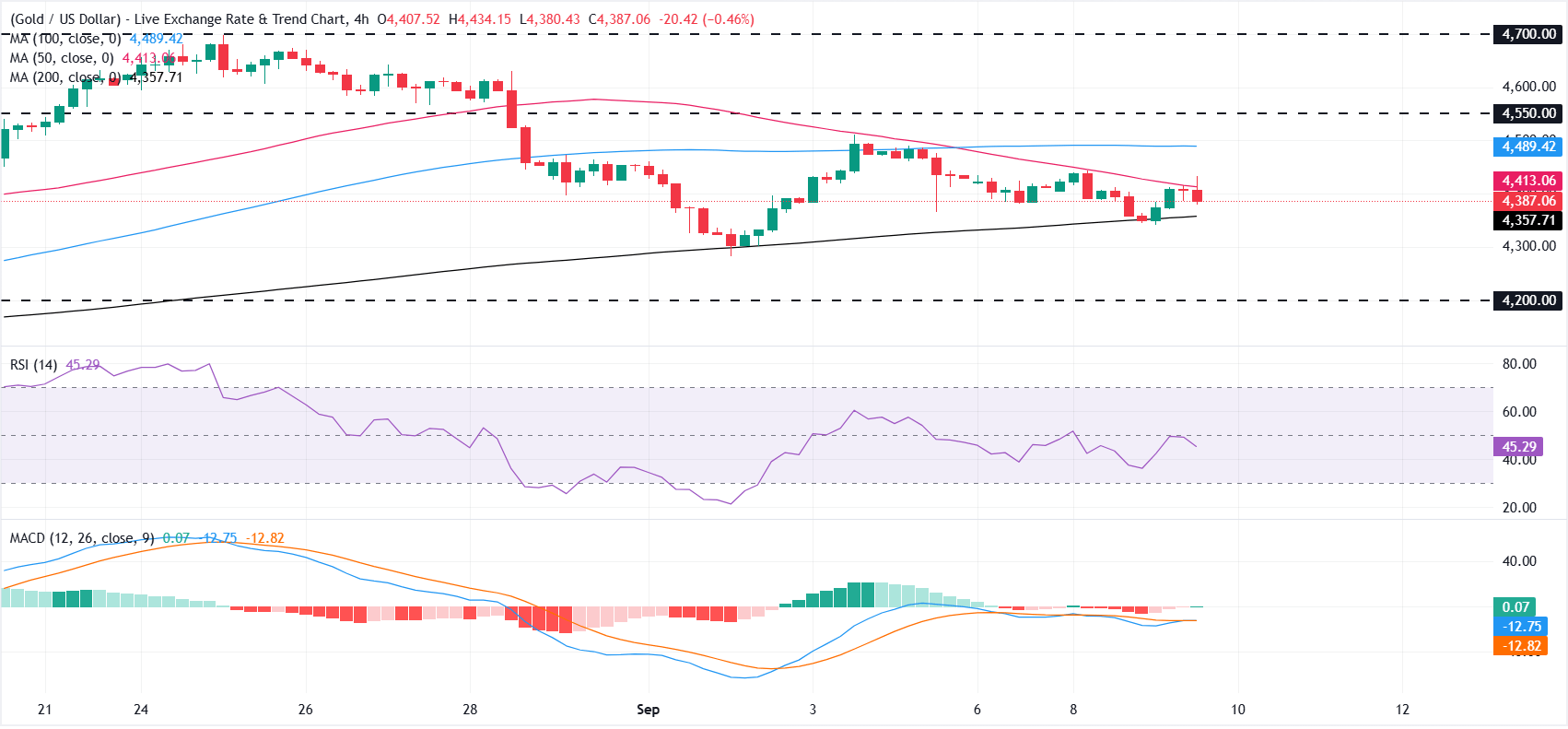
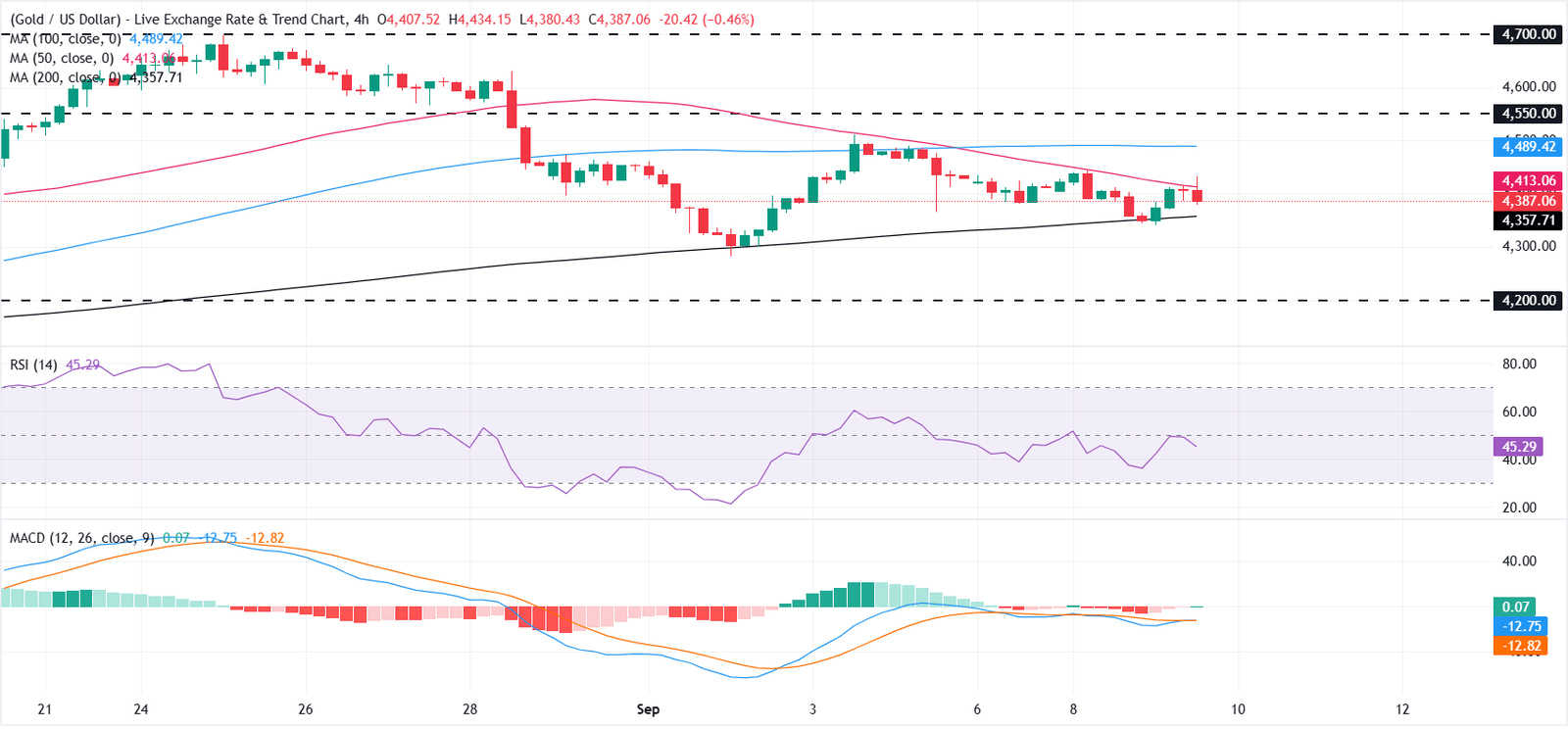
On the 4-hour chart, XAU/USD holds above the 200-period Simple Moving Average (SMA) at $4,356, suggesting buyers remain active on dips. However, the 50-period SMA at $4,415 caps the immediate upside. The Relative Strength Index (RSI) stands at 45, while the Moving Average Convergence Divergence (MACD) remains slightly negative, pointing to weak momentum and a broadly neutral near-term bias.
On the upside, the 50-period SMA at $4,415 acts as the first resistance, followed by the 100-period SMA around $4,489. A break above these levels could bring the $4,550 horizontal barrier into focus, followed by $4,700.
On the downside, initial support is seen at the 200-period SMA near $4,356. A clear break below this level could intensify selling pressure and open the door toward the $4,200 support zone.
(The technical analysis of this story was written with the help of an AI tool. Know more.)
Gold FAQs
Gold has played a key role in human’s history as it has been widely used as a store of value and medium of exchange. Currently, apart from its shine and usage for jewelry, the precious metal is widely seen as a safe-haven asset, meaning that it is considered a good investment during turbulent times. Gold is also widely seen as a hedge against inflation and against depreciating currencies as it doesn’t rely on any specific issuer or government.
Central banks are the biggest Gold holders. In their aim to support their currencies in turbulent times, central banks tend to diversify their reserves and buy Gold to improve the perceived strength of the economy and the currency. High Gold reserves can be a source of trust for a country’s solvency. Central banks added 1,136 tonnes of Gold worth around $70 billion to their reserves in 2022, according to data from the World Gold Council. This is the highest yearly purchase since records began. Central banks from emerging economies such as China, India and Turkey are quickly increasing their Gold reserves.
Gold has an inverse correlation with the US Dollar and US Treasuries, which are both major reserve and safe-haven assets. When the Dollar depreciates, Gold tends to rise, enabling investors and central banks to diversify their assets in turbulent times. Gold is also inversely correlated with risk assets. A rally in the stock market tends to weaken Gold price, while sell-offs in riskier markets tend to favor the precious metal.
The price can move due to a wide range of factors. Geopolitical instability or fears of a deep recession can quickly make Gold price escalate due to its safe-haven status. As a yield-less asset, Gold tends to rise with lower interest rates, while higher cost of money usually weighs down on the yellow metal. Still, most moves depend on how the US Dollar (USD) behaves as the asset is priced in dollars (XAU/USD). A strong Dollar tends to keep the price of Gold controlled, whereas a weaker Dollar is likely to push Gold prices up.
About The Author