- Gold price attracts some dip-buyers following a weaker close for the second day on Tuesday.
- Persistent trade-related uncertainties and a softer risk tone benefit the safe-haven commodity.
- Reduced Fed rate cut bets act as a tailwind for the USD and cap the non-yielding yellow metal.
Gold price (XAU/USD) regains positive traction during the Asian session on Wednesday and has now reversed a major part of the previous day’s slide to the $3,320 area. Investors remain on edge amid persistent uncertainty surrounding US President Donald Trump’s trade tariffs. Adding to this, bets that the Federal Reserve (Fed) will keep interest rates elevated trigger a fresh wave of the risk-aversion trade and drive safe-haven flows towards the commodity.
Meanwhile, the US Dollar (USD) stalls its recent move up to the highest level since June 23 touched on Tuesday, and turns out to be another factor underpinning demand for the Gold price. That said, the growing acceptance that the Fed would delay cutting interest rates amid a slight pickup in US inflation should limit any meaningful USD losses and act as a headwind for the non-yielding yellow metal. This, in turn, warrants some caution for the XAU/USD bulls.
Daily Digest Market Movers: Gold price draws support from weaker risk tone
- The US Bureau of Labor Statistics reported on Tuesday that the headline Consumer Price Index (CPI) increased the most in five months, by 0.3% in June, and the yearly rate accelerated to 2.7% from 2.4% in May. Meanwhile, the core gauge, which excludes fluctuating food and energy costs, rose 2.9% YoY from 2.8% in the previous month.
- The data sparked concerns over the inflationary effects of US President Donald Trump’s trade tariffs and reaffirmed bets that the Federal Reserve will keep rates higher for an extended period. This lifted the US Treasury bond yields higher and the US Dollar to its highest level since June 23, dragging the Gold price to a multi-day trough.
- Boston Fed President Susan Collins noted that it is challenging to set monetary policy right now amid uncertainty, and a solid economy gives the US central bank time to decide its next interest rate move. Tariffs could boost inflation over the second half of 2025 and push core inflation to around 3% by year’s end, Boston added further.
- Separately, Dallas Fed President Lorie Logan said the base case is that monetary policy needs to hold tight for a while longer to bring inflation down. Logan added that tariff increases appear likely to create additional inflationary pressure for some time, and an early rate cut by the Fed risks deeper economic scars on a longer road to price stability.
- Meanwhile, Trump said on Tuesday that 200% tariffs on pharmaceutical imports will come by the month-end. This comes on top of Trump’s tariff notices to more than 20 countries and a 50% tariff on copper imports last week, which keeps investors on edge and assists the safe-haven precious metal to attract some dip-buying on Wednesday.
- Traders now look forward to the release of the US Producer Price Index due later during the North American session. Apart from this, comments from influential FOMC members will drive the USD and provide a fresh impetus to the XAU/USD pair. The mixed fundamental backdrop, meanwhile, warrants caution for aggressive traders.
Gold price bulls have the upper hand while above 100-SMA on H4
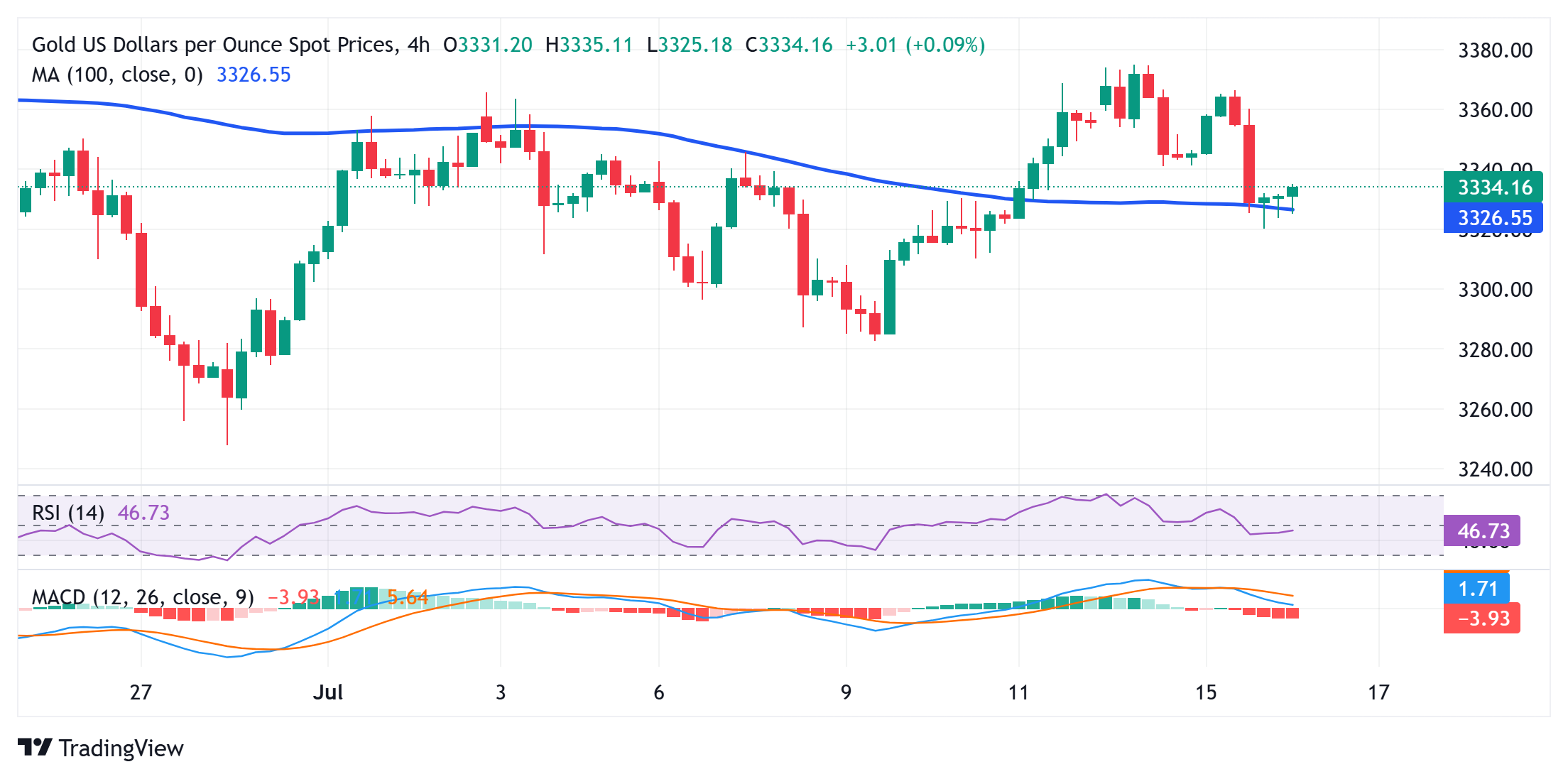
From a technical perspective, the commodity shows some resilience below the 100-period Simple Moving Average (SMA) on the 4-hour chart and, for now, seems to have stalled the retracement slide from a three-week top touched on Monday. That said, oscillators on the said chart are yet to confirm bullish bias and warrant some caution before positioning for further gains. Hence, any subsequent move up might confront an immediate hurdle near the $3,342-3,343 region, above which the Gold price could retest the $3,365-3,366 horizontal barrier. Some follow-through buying, however, would set the stage for a move towards reclaiming the $3,400 round figure.
On the flip side, weakness below the $3,320 area, or the weekly trough touched on Tuesday, is more likely to find decent support near the $3,300 round figure. This is followed by the $3,283-3,282 region, or over a one-week low touched last Tuesday, which, if broken, would make the Gold price vulnerable to accelerate the corrective fall towards the July swing low, around the $3,248-3,247 zone.
Gold FAQs
Gold has played a key role in human’s history as it has been widely used as a store of value and medium of exchange. Currently, apart from its shine and usage for jewelry, the precious metal is widely seen as a safe-haven asset, meaning that it is considered a good investment during turbulent times. Gold is also widely seen as a hedge against inflation and against depreciating currencies as it doesn’t rely on any specific issuer or government.
Central banks are the biggest Gold holders. In their aim to support their currencies in turbulent times, central banks tend to diversify their reserves and buy Gold to improve the perceived strength of the economy and the currency. High Gold reserves can be a source of trust for a country’s solvency. Central banks added 1,136 tonnes of Gold worth around $70 billion to their reserves in 2022, according to data from the World Gold Council. This is the highest yearly purchase since records began. Central banks from emerging economies such as China, India and Turkey are quickly increasing their Gold reserves.
Gold has an inverse correlation with the US Dollar and US Treasuries, which are both major reserve and safe-haven assets. When the Dollar depreciates, Gold tends to rise, enabling investors and central banks to diversify their assets in turbulent times. Gold is also inversely correlated with risk assets. A rally in the stock market tends to weaken Gold price, while sell-offs in riskier markets tend to favor the precious metal.
The price can move due to a wide range of factors. Geopolitical instability or fears of a deep recession can quickly make Gold price escalate due to its safe-haven status. As a yield-less asset, Gold tends to rise with lower interest rates, while higher cost of money usually weighs down on the yellow metal. Still, most moves depend on how the US Dollar (USD) behaves as the asset is priced in dollars (XAU/USD). A strong Dollar tends to keep the price of Gold controlled, whereas a weaker Dollar is likely to push Gold prices up.
About The Author