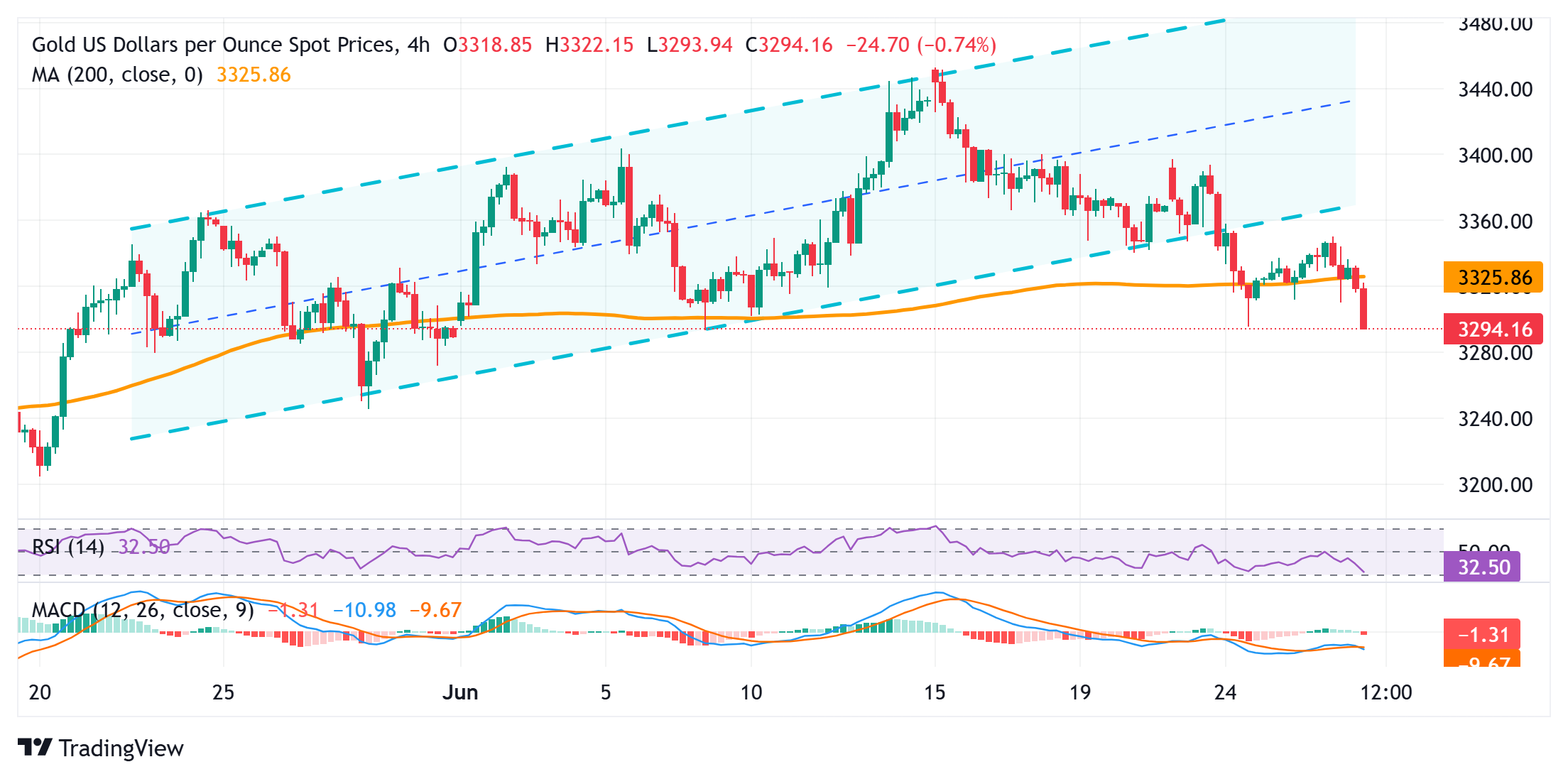
- Gold price weakens below $3,300 as a positive risk tone undermines safe-haven demand.
- Fed rate cut bets and a bearish USD could support the XAU/USD pair and limit losses.
- Traders now look to the release of the US PCE Price Index for a fresh directional impetus.
Gold price (XAU/USD) drops to a four-week low, around the $3,290 region during the Asian session on Friday as traders keenly await the release of the US Personal Consumption Expenditure (PCE) Price Index. The crucial US inflation data will be looked upon for cues about the Federal Reserve’s (Fed) policy outlook. This, in turn, will play a key role in influencing the near-term US Dollar (USD) price dynamics and provide some meaningful impetus to the non-yielding yellow metal.
Meanwhile, the US Dollar (USD) trades with a mild positive bias above a three-and-half-year low touched on Thursday amid some repositioning trade ahead of the key data risk. This, along with the upbeat market mood, turns out to be a key factors driving flows away from the safe-haven Gold price. However, concerns over the Fed’s independence and bets that the US central bank will lower rates again this year act as a headwind for the USD, which should limit losses for the XAU/USD.
Daily Digest Market Movers: Gold price struggles despite combination of supporting factors
- The Commerce Department’s third and final estimate released on Thursday showed that the US economy contracted more than previously estimated at the start of 2025 on the back of muted consumer spending and tariff-related disruptions. In fact, the US Gross Domestic Product (GDP) fell at an annualized rate of 0.5% during the January-March period, a steeper decline than the 0.2% reported in the second estimate.
- A separate report published by the US Labor Department showed that the number of Americans filing unemployment benefits for the first time dropped by 10,000 to a seasonally adjusted 236,000 for the week ended June 21. However, Continuing Claims rose by 37,000 to 1.974 million for the week ending June 14. That marked the highest level since November 2021 and suggested a sluggish hiring environment.
- The data fueled speculations that the US Unemployment Rate might tick up to at least 4.3% in June from 4.2% in May. This could force the Federal Reserve to resume its rate-cutting cycle in July and lower borrowing costs further by the end of this year. The outlook drags the US Dollar to its lowest level since March 2022 and might continue to lend some support to the non-yielding Gold price.
- Investors now await the release of the US Personal Consumption Expenditure (PCE) Price Index data, due later this Friday, for further cues about the Fed’s rate-cut path. Consensus estimates point to a 0.1% monthly increase in the core PCE Price Index and a 2.6% annual rise in May. A surprisingly stronger print would validate Fed Chair Jerome Powell’s wait-and-see approach to rate cuts and boost the USD.
- In fact, Powell reiterated this week that the Fed is well-positioned to wait to cut interest rates until they have a better handle on the impact of steep tariffs on consumer prices. The comments prompted fresh criticism from US President Donald Trump, who has been calling for lower interest rates. Moreover, reports suggest that Trump was considering naming Powell’s successor by September or October.
- The development fuels concerns about the potential erosion of the Fed’s independence, which should limit any immediate USD positive reaction to the crucial inflation data. This, in turn, suggests that the path of least resistance for the XAU/USD pair is to the upside and any further slide might still be seen as a buying opportunity.
Gold price bears have the upper hand a short-term ascending channel and the 200-SMA on H4
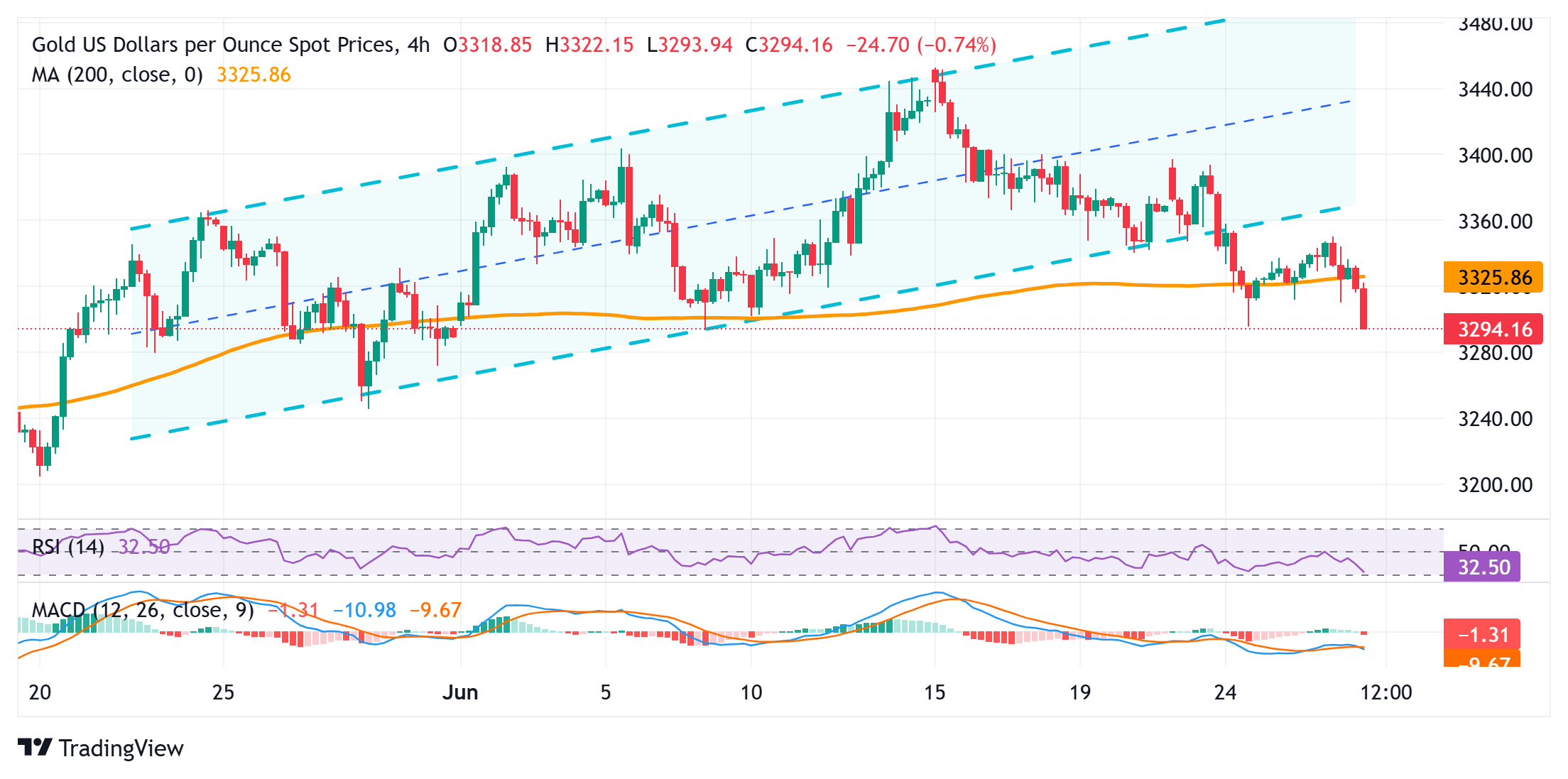
From a technical perspective, an intraday slide below the 200-period Simple Moving Average (SMA) on the 4-hour chart could be seen as a fresh trigger for the XAU/USD bears against the backdrop of this week’s breakdown through a short-term ascending channel. Given that oscillators on the daily chart have just started gaining negative traction, the Gold price might then accelerate the fall towards the $3,245 region before eventually dropping to the $3,210-$3,200 horizontal support and the $3,175 area.
On the flip side, the $3,324-3,325 area now seems to act as an immediate hurdle ahead of the overnight swing high, around the $3,350 region. This is followed by the trend-channel support breakpoint, around the $3,368-3,370 region, which should cap any further gains for the Gold price. A sustained strength beyond the latter, however, could allow the XAU/USD pair to reclaim the $3,400 mark. Some follow-through buying would negate the negative outlook and shift the bias in favor of bulls.
Risk sentiment FAQs
In the world of financial jargon the two widely used terms “risk-on” and “risk off” refer to the level of risk that investors are willing to stomach during the period referenced. In a “risk-on” market, investors are optimistic about the future and more willing to buy risky assets. In a “risk-off” market investors start to ‘play it safe’ because they are worried about the future, and therefore buy less risky assets that are more certain of bringing a return, even if it is relatively modest.
Typically, during periods of “risk-on”, stock markets will rise, most commodities – except Gold – will also gain in value, since they benefit from a positive growth outlook. The currencies of nations that are heavy commodity exporters strengthen because of increased demand, and Cryptocurrencies rise. In a “risk-off” market, Bonds go up – especially major government Bonds – Gold shines, and safe-haven currencies such as the Japanese Yen, Swiss Franc and US Dollar all benefit.
The Australian Dollar (AUD), the Canadian Dollar (CAD), the New Zealand Dollar (NZD) and minor FX like the Ruble (RUB) and the South African Rand (ZAR), all tend to rise in markets that are “risk-on”. This is because the economies of these currencies are heavily reliant on commodity exports for growth, and commodities tend to rise in price during risk-on periods. This is because investors foresee greater demand for raw materials in the future due to heightened economic activity.
The major currencies that tend to rise during periods of “risk-off” are the US Dollar (USD), the Japanese Yen (JPY) and the Swiss Franc (CHF). The US Dollar, because it is the world’s reserve currency, and because in times of crisis investors buy US government debt, which is seen as safe because the largest economy in the world is unlikely to default. The Yen, from increased demand for Japanese government bonds, because a high proportion are held by domestic investors who are unlikely to dump them – even in a crisis. The Swiss Franc, because strict Swiss banking laws offer investors enhanced capital protection.
About The Author