- Gold price remains depressed during the Asian session, though it lacks bearish conviction.
- Fed Governor Waller’s dovish remarks weigh on the USD and could support the commodity.
- Reduced Fed rate cut bets should limit USD losses and warrant caution for the XAU/USD bulls.
Gold price (XAU/USD) remains depressed through the Asian session on Friday, though it manages to hold comfortably above a one-week low, around the $3,309 area touched the previous day. Federal Reserve (Fed) Governor Christopher Waller’s dovish comments earlier today keep the US Dollar (USD) below its highest level since June 23 and act as a tailwind for the commodity. Apart from this, concerns about US President Donald Trump’s erratic trade policies and their impact on the global economy lend additional support to the precious metal.
However, the growing acceptance that the Fed would delay cutting interest rates, amid signs that the Trump administration’s increasing import taxes are passing through to consumer prices, helps limit deeper USD losses. Furthermore, the prevalent risk-on environment is seen as another factor undermining demand for the safe-haven Gold price. Nevertheless, the XAU/USD pair remains on track to register modest losses for the first time in three weeks. Traders now look to the US macro data for short-term impetus later during the North American session.
Daily Digest Market Movers: Gold price struggles to lure buyers amid reduced Fed rate cut bets
- Federal Reserve (Fed) Governor Christopher Waller said late Thursday that rising risks to the economy favour easing the policy rate. The central bank should cut its interest rate target in July amid evidence that the labour market is growing weaker, Waller added further. This, in turn, exerts some downward pressure on the US Dollar during the Asian session on Friday.
- Meanwhile, traders are pricing in the possibility of 50 basis points worth of policy easing by the Fed this year. Furthermore, growing worries about the potential economic fallout from US President Donald Trump’s erratic trade policies might continue to act as a tailwind for the safe-haven Gold price. Trump recently announced a 50% tariff on copper imports into the US.
- Adding to this, Trump notified leaders of 25 countries about new tariff rates that will kick in on August 1, and also plans to send letters to more than 150 countries notifying them their tariff rates could be 10% or 15%. This should keep investors on edge and warrants some caution before positioning for any meaningful depreciating move for the precious metal.
- On the economic data front, the US Commerce Department reported on Thursday that Retail Sales rose 0.6% in June, defying market expectations and signaling a modest rebound in consumer spending. This marked a significant improvement after a 0.9% fall in May and a 0.1% dip in April, providing a glimmer of optimism for an economy that has been struggling.
- Adding to this, US Initial Jobless Claims dropped for the fifth straight week, to 221,000 during the week ending July 12, or the lowest level in three months. This suggested that the US labor market remains resilient despite worries about the inflationary effect of higher US tariffs, reaffirming bets that the Fed could delay cutting interest rates and favoring the USD bulls.
- Fed governor Adriana Kugler said that the still-restrictive policy stance is important to keep longer-run inflation expectations anchored, and it will be appropriate to hold the policy rate at the current level for some time. Separately, Atlanta Fed President Raphael Bostic noted that the economic outlook remains highly uncertain and rate cuts might be difficult in the short run.
- The Fed is widely expected to keep its benchmark interest rate in the 4.25%-4.50% range at the upcoming policy meeting later this month. This, in turn, could act as a headwind for the non-yielding yellow metal. Traders now look forward to the release of the Preliminary Michigan US Consumer Sentiment and Inflation Expectations to grab short-term opportunities.
Gold price needs to breakout through monthly range before the next leg of a directional move
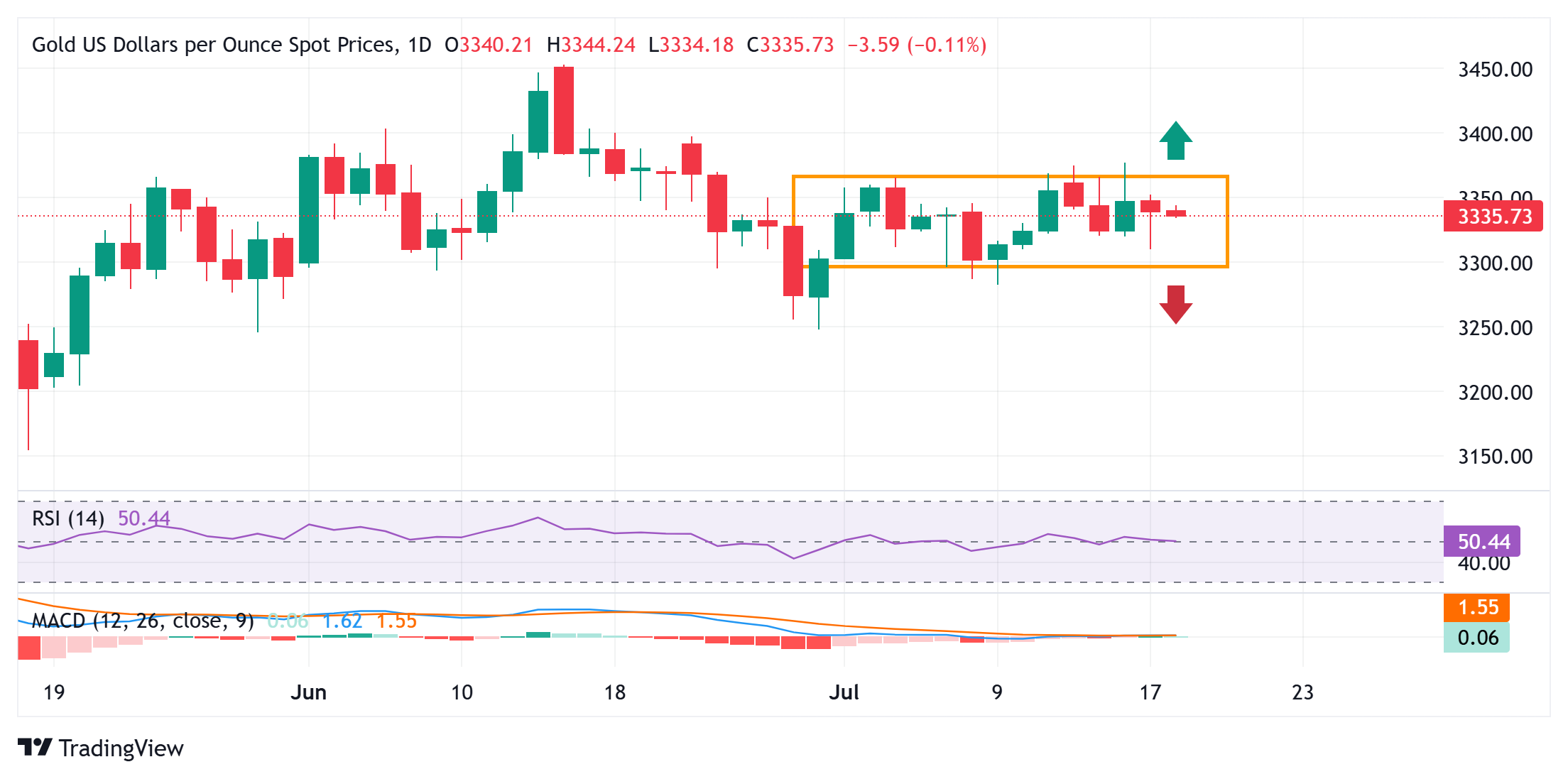
From a technical perspective, the recent range-bound price action witnessed since the beginning of this month constitutes the formation of a rectangle chart pattern and points to indecision among traders. Moreover, neutral oscillators on the daily chart warrant some caution before positioning for the next leg of a directional move. Hence, any further slide might continue to find decent support ahead of the $3,300 round figure. A convincing break below, however, could make the Gold price vulnerable to accelerate the fall towards the July swing low, around the $3,248-3,247 zone.
On the flip side, any positive move beyond the $3,352 immediate hurdle could attract fresh buyers and remain capped near the $3,365-3,366 region, or the top boundary of the short-term trading range. A subsequent move beyond the latter, however, could trigger a short-covering rally and allow the Gold price to reclaim the $3,400 round figure. The upward trajectory could extend further towards testing the next relevant hurdle near the $3,434-3,435 area.
Fed FAQs
Monetary policy in the US is shaped by the Federal Reserve (Fed). The Fed has two mandates: to achieve price stability and foster full employment. Its primary tool to achieve these goals is by adjusting interest rates.
When prices are rising too quickly and inflation is above the Fed’s 2% target, it raises interest rates, increasing borrowing costs throughout the economy. This results in a stronger US Dollar (USD) as it makes the US a more attractive place for international investors to park their money.
When inflation falls below 2% or the Unemployment Rate is too high, the Fed may lower interest rates to encourage borrowing, which weighs on the Greenback.
The Federal Reserve (Fed) holds eight policy meetings a year, where the Federal Open Market Committee (FOMC) assesses economic conditions and makes monetary policy decisions.
The FOMC is attended by twelve Fed officials – the seven members of the Board of Governors, the president of the Federal Reserve Bank of New York, and four of the remaining eleven regional Reserve Bank presidents, who serve one-year terms on a rotating basis.
In extreme situations, the Federal Reserve may resort to a policy named Quantitative Easing (QE). QE is the process by which the Fed substantially increases the flow of credit in a stuck financial system.
It is a non-standard policy measure used during crises or when inflation is extremely low. It was the Fed’s weapon of choice during the Great Financial Crisis in 2008. It involves the Fed printing more Dollars and using them to buy high grade bonds from financial institutions. QE usually weakens the US Dollar.
Quantitative tightening (QT) is the reverse process of QE, whereby the Federal Reserve stops buying bonds from financial institutions and does not reinvest the principal from the bonds it holds maturing, to purchase new bonds. It is usually positive for the value of the US Dollar.
About The Author