Gold (XAU/USD) maintains its offered tone below the $4,200 mark through the early European session on Friday, though it holds above the lowest level since November, touched the previous day. Mixed signals regarding a potential US-Iran peace deal revive demand for the safe-haven US Dollar (USD), which is seen as a key factor exerting pressure on the precious metal. Furthermore, hawkish US Federal Reserve (Fed) expectations contribute to driving flows away from the non-yielding bullion.
US President Donald Trump said on Thursday that a deal had been reached with Iran and the final document could be signed soon, perhaps even over the weekend. The optimism, however, fades rather quickly as Iran countered that it had not reached a final decision on an agreement. Furthermore, reports suggest that Iran’s new Supreme Leader, Mojtaba Khamenei, has not agreed to the proposed US peace deal. Adding to this, Iran’s Foreign Ministry reportedly said that key issues, including Hormuz access and frozen funds, remain unresolved, per Fars.
Meanwhile, Iranian forces blocked a tanker from transiting through the strategic waterway without coordination, underscoring uncertainty over Iran’s position. Adding to this, Fox News reported that US forces intercepted and shot down two Iranian one-way attack drones near the Strait of Hormuz. The latest developments keep geopolitical risk premiums in play and trigger a modest recovery in Crude Oil prices, fueling inflationary concerns. This comes amid signs of re-accelerating inflation in the US, backing the case for higher-for-longer interest rates.
The US Consumer Price Index (CPI) and Producer Price Index (PPI) released this week pointed to re-accelerating inflation, reaffirming bets that the US central bank will raise borrowing costs by the year-end. This further acts as a tailwind for the Greenback and weighs on the Gold. Traders, however, might refrain from placing aggressive bearish bets around the XAU/USD pair and opt to wait for further developments surrounding the Middle East crisis. Nevertheless, the commodity remains on track to register heavy losses for the second consecutive week.
XAU/USD daily chart
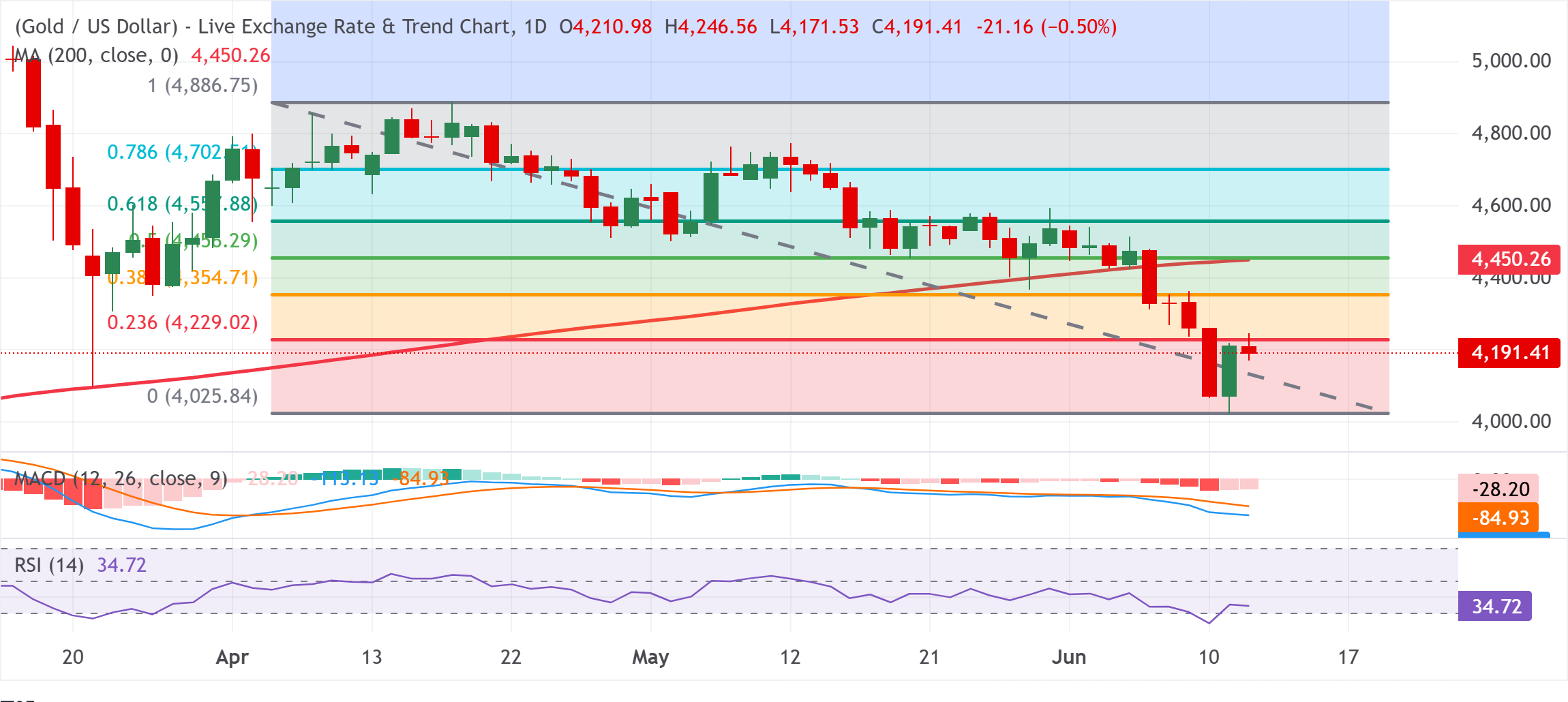
Gold bears retain intraday control below 23.6% Fibo. immediate hurdle
From a technical perspective, the precious metal retains a bearish near-term bias beneath the 200-day Simple Moving Average (SMA). Moreover, Friday’s failure near the 23.6% Fibonacci retracement level of downfall from the April monthly swing high suggests that the overnight recovery might still be categorized as a short-covering move.
Meanwhile, the Moving Average Convergence Divergence (MACD) remains in negative territory with the line below its signal and a still-negative histogram. Adding to this, the Relative Strength Index (RSI) hovers in the mid-30s, both of which hint that downside pressure persists despite a modest rebound from recent lows.
On the topside, initial resistance emerges at the 23.6% Fibo. around $4,229, followed by the 38.2% level near $4,355. Higher up, the 200-day SMA at about $4,450 and the adjacent 50% retracement at roughly $4,456 form a stronger cap, before the 61.8% level at $4,558 and the 78.6% retracement at $4,703 open the way toward the $4,887 cycle high. On the downside, the key support to watch is the recent swing low around $4,026, where a break would signal scope for a deeper corrective leg.
(The technical analysis of this story was written with the help of an AI tool.)
Fed FAQs
Monetary policy in the US is shaped by the Federal Reserve (Fed). The Fed has two mandates: to achieve price stability and foster full employment. Its primary tool to achieve these goals is by adjusting interest rates.
When prices are rising too quickly and inflation is above the Fed’s 2% target, it raises interest rates, increasing borrowing costs throughout the economy. This results in a stronger US Dollar (USD) as it makes the US a more attractive place for international investors to park their money.
When inflation falls below 2% or the Unemployment Rate is too high, the Fed may lower interest rates to encourage borrowing, which weighs on the Greenback.
The Federal Reserve (Fed) holds eight policy meetings a year, where the Federal Open Market Committee (FOMC) assesses economic conditions and makes monetary policy decisions.
The FOMC is attended by twelve Fed officials – the seven members of the Board of Governors, the president of the Federal Reserve Bank of New York, and four of the remaining eleven regional Reserve Bank presidents, who serve one-year terms on a rotating basis.
In extreme situations, the Federal Reserve may resort to a policy named Quantitative Easing (QE). QE is the process by which the Fed substantially increases the flow of credit in a stuck financial system.
It is a non-standard policy measure used during crises or when inflation is extremely low. It was the Fed’s weapon of choice during the Great Financial Crisis in 2008. It involves the Fed printing more Dollars and using them to buy high grade bonds from financial institutions. QE usually weakens the US Dollar.
Quantitative tightening (QT) is the reverse process of QE, whereby the Federal Reserve stops buying bonds from financial institutions and does not reinvest the principal from the bonds it holds maturing, to purchase new bonds. It is usually positive for the value of the US Dollar.
About The Author