Gold (XAU/USD) advances some 0.75% on Tuesday as Oil prices fall, along with US Treasury yields. Also, an improvement in risk appetite propelled the yellow metal to a two-day peak of $4,106.
XAU/USD advances as Hormuz reopening hopes weigh in Oil, ease inflation pressures
The US Dollar Index (DXY), which tracks the buck’s value against six other currencies, is down 0.05% amid growing speculation for a reopening of the Strait of Hormuz.
Recently, an Iranian Foreign Ministry spokesperson said that Iran and Oman continue talks on the Strait of Hormuz, as reported by IRIB. Tehran is reportedly weighing whether to allow Europe to clear mines in the Strait, while US President Donald Trump reposted an article from August 2, titled “Trump: Deal is imminent as Iran talks restart Monday on denuclearisation.”
In June, the US Job Openings and Labor Turnover Survey (JOLTS) declined from 7.537 million to 7.359 million, missing the forecast of 7.4 million. The low number of layoffs indicates minimal firing and hiring activity, with roughly one vacancy per unemployed person, signaling a balanced labor market.
The US Commerce Department reported that the trade deficit for June decreased from -$77.6 billion to -$73.3 billion, slightly higher than the estimate of -$73 billion.
Now eyes are on the ADP Employment Change for July, with private companies expected to have hired 70K people, down from the 98K jobs created in June. After this, the focus shifts to jobless claims on Thursday, followed by the release of Nonfarm Payrolls for July, with the US economy expected to add 80K workers to the workforce.
Worth noting, bullion prices are set to edge higher if crude prices continue to tumble. West Texas Intermediate (WTI), the US Oil benchmark, lost nearly 5% to $76.09 per barrel, pushing US yields lower, as markets expect lower inflationary prints. The US 10-year T-note collapses by 10 basis points to 4.687%,
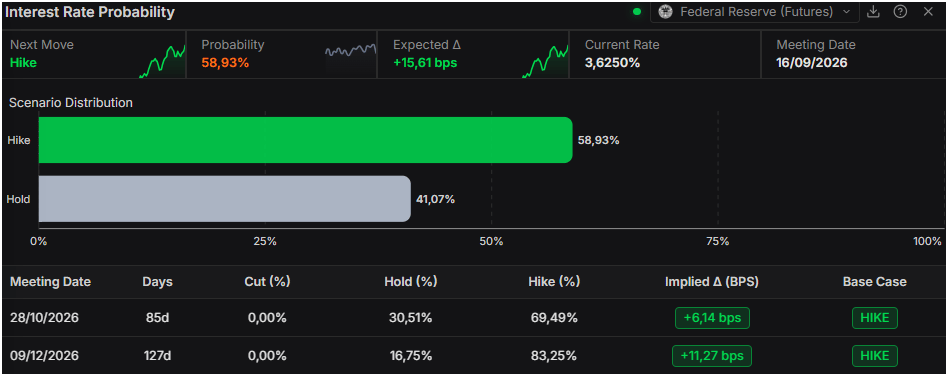
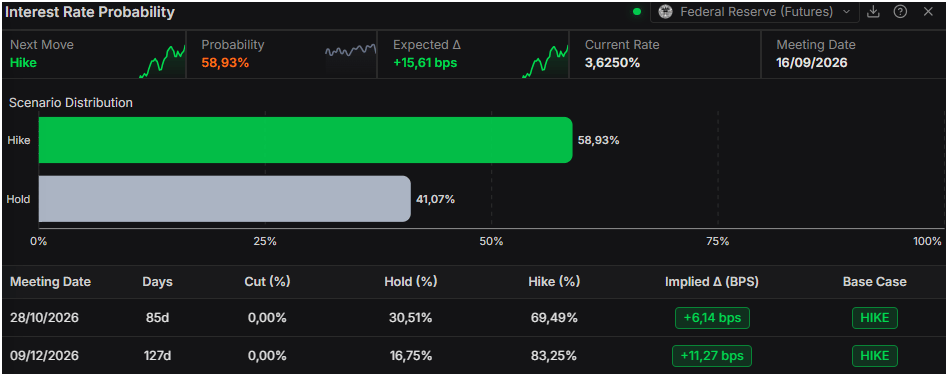
Money markets are pricing in a nearly 59% chance that the Federal Reserve (Fed) will raise rates at the September 16 meeting, according to Prime Terminal. For the December meeting, the odds for a rate hike are 83%.
Aside from this, on Monday, the New York Fed President John Williams expressed optimism that inflation pressures are expected to decrease gradually. However, he emphasised that if inflation does not subside as hoped, the US central bank is prepared to respond with rate hikes.
XAU/USD technical outlook: Gold threatens to clear $4,100, despite remaining bearish
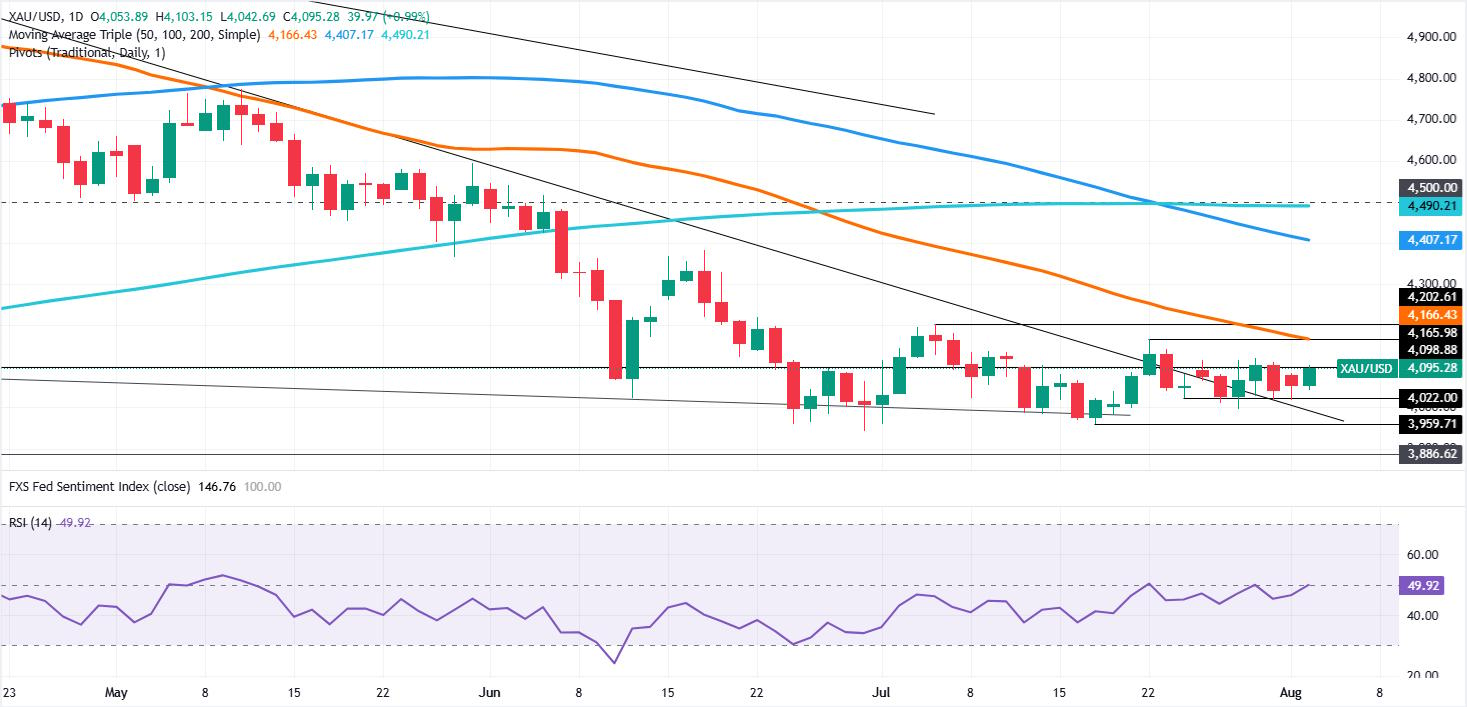
Gold price is consolidating but approaching $4,100 for the first time since last Friday. Momentum is turning bullish, as indicated by the Relative Strength Index (RSI), which is about to clear the 50-neutral level, a sign used by some traders to buy the yellow metal.
Despite this, the market structure is respecting the successive series of lower highs and lower lows, but if XAU/USD clears the 50-day Simple Moving Average (SMA) at $4,156, followed by the July 6 cycle high at $4,202, the yellow metal will shift to neutral-upward.
For a bearish continuation, Gold must extend its losses below the August 3 daily low of $4,019. A breach of the latter exposes $4,000, followed by the June 17 low of $3,959.
Gold FAQs
Gold has played a key role in human’s history as it has been widely used as a store of value and medium of exchange. Currently, apart from its shine and usage for jewelry, the precious metal is widely seen as a safe-haven asset, meaning that it is considered a good investment during turbulent times. Gold is also widely seen as a hedge against inflation and against depreciating currencies as it doesn’t rely on any specific issuer or government.
Central banks are the biggest Gold holders. In their aim to support their currencies in turbulent times, central banks tend to diversify their reserves and buy Gold to improve the perceived strength of the economy and the currency. High Gold reserves can be a source of trust for a country’s solvency. Central banks added 1,136 tonnes of Gold worth around $70 billion to their reserves in 2022, according to data from the World Gold Council. This is the highest yearly purchase since records began. Central banks from emerging economies such as China, India and Turkey are quickly increasing their Gold reserves.
Gold has an inverse correlation with the US Dollar and US Treasuries, which are both major reserve and safe-haven assets. When the Dollar depreciates, Gold tends to rise, enabling investors and central banks to diversify their assets in turbulent times. Gold is also inversely correlated with risk assets. A rally in the stock market tends to weaken Gold price, while sell-offs in riskier markets tend to favor the precious metal.
The price can move due to a wide range of factors. Geopolitical instability or fears of a deep recession can quickly make Gold price escalate due to its safe-haven status. As a yield-less asset, Gold tends to rise with lower interest rates, while higher cost of money usually weighs down on the yellow metal. Still, most moves depend on how the US Dollar (USD) behaves as the asset is priced in dollars (XAU/USD). A strong Dollar tends to keep the price of Gold controlled, whereas a weaker Dollar is likely to push Gold prices up.
About The Author