Gold (XAU/USD) trims a part of its modest intraday gains and slides back below the $4,300 mark during the first half of the European session on Thursday. The US Federal Reserve’s (Fed) hawkish tilt assists the US Dollar (USD) to attract fresh buyers following the US-Iran peace deal-led corrective pullback from the highest level since late March. This, in turn, is seen as a key factor that caps the upside for the non-yielding yellow metal.
As widely expected, the US central bank decided to keep its benchmark interest rate unchanged at a target range of 3.5% to 3.75% at the end of the first meeting under the new Fed Chair, Kevin Warsh. Adding to this, the Fed eliminated the language indicating a bias toward further easing, with the rate-setting committee sending a clear message that it supported higher rates. In fact, policymakers estimated the fed funds rate at 3.8% by the end of this year, up from 3.4% projected in March. Traders were quick to react and are now pricing in a nearly 85% chance of a 25-basis-point (bps) rate hike in December. The outlook led to a sharp rise in US Treasury bond yields on Wednesday and favors USD bulls. This, in turn, holds back traders from positioning for any further appreciation of the Gold price.
Meanwhile, US President Donald Trump and Iranian President Masoud Pezeshkian electronically signed a Memorandum of Understanding (MoU) aimed at ending hostilities between the two countries and reopening the Strait of Hormuz. Moreover, Trump said that the 60-day negotiation period to reach a final agreement on Iran’s nuclear program is not a hard deadline, boosting investors’ confidence. This might keep a lid on the safe-haven USD, warranting caution before placing fresh bearish bets on the Gold. Traders now look to the US economic docket, featuring the Philly Fed Manufacturing Index and the usual Weekly Initial Jobless Claims later during the North American session. Apart from this, comments from influential FOMC members might provide some impetus to the buck and the Gold.
The aforementioned fundamental backdrop, however, makes it prudent to wait for strong follow-through buying before positioning for the resumption of the XAU/USD pair’s recovery move from the $4,025-$4,020 region, or the year-to-date low, touched last Thursday.
XAU/USD daily chart
Gold seems vulnerable while below $4,350-$4,360 confluence hurdle
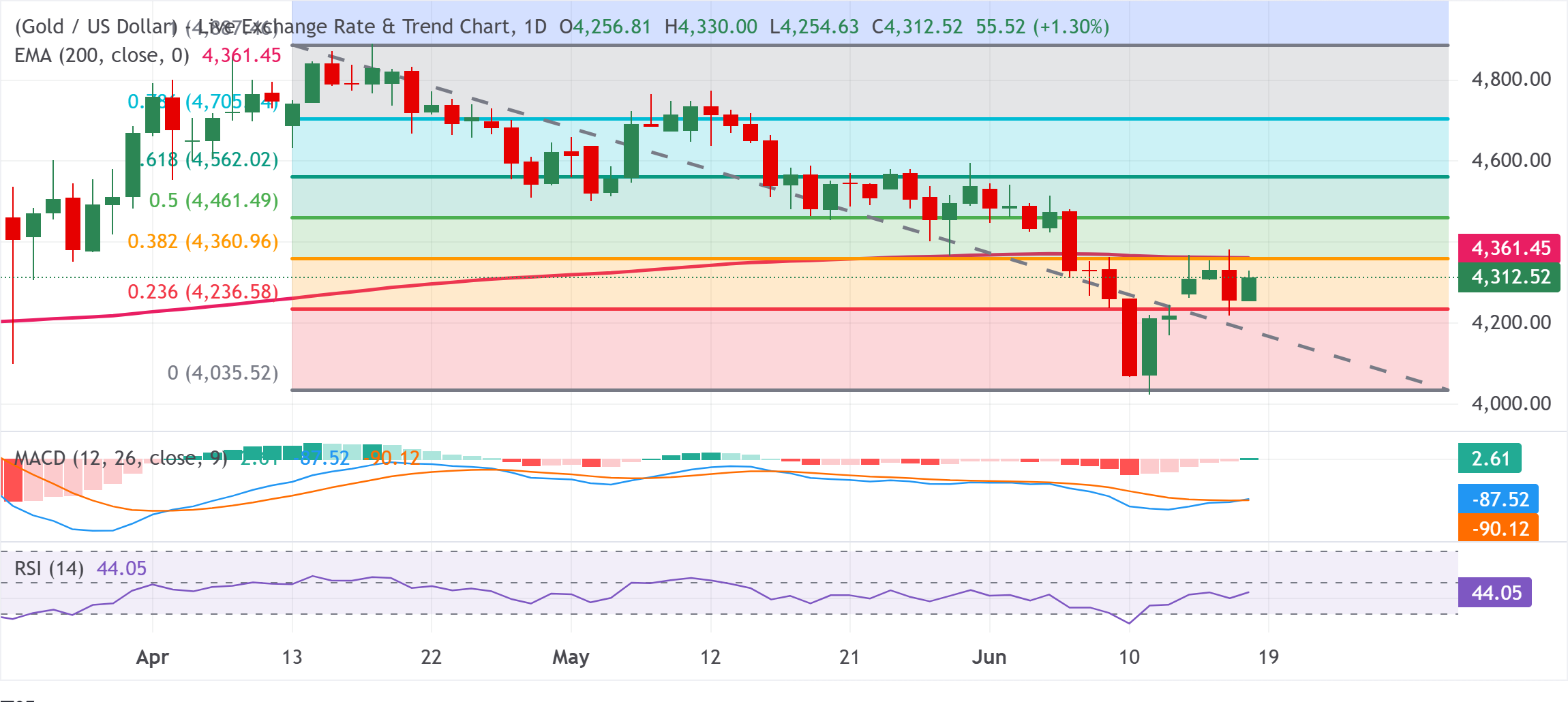
The overnight failed attempt to find acceptance above the $4,350-$4,360 confluence – comprising the 38.2% Fibonacci retracement level of the April-June fall and the 200-day Exponential Moving Average (EMA) – warrants caution for the XAU/USD bulls. The subsequent slide, however, stalled near the 23.6% Fibo. level, which should now act as a key pivotal point for short-term traders. Meanwhile, the Relative Strength Index (RSI) hovers near 44, signaling subdued momentum. In contrast, the Moving Average Convergence Divergence (MACD) histogram has turned marginally positive, hinting at a tentative loss of bearish pressure rather than a clear bullish reversal.
Hence, it will be prudent to wait for a sustained strength above the $4,350-$4,360 hurdle before positioning for further gains. The Gold might then climb to the 50.0% retracement near $4,461 and further towards higher barriers at $4,562, $4,705 and the recent peak around $4,887. On the downside, initial support is seen at the 23.6% Fibo. retracement near $4,237, with a deeper floor around the prior swing low close to $4,036, where buyers would be expected to defend the broader bullish cycle.
(The technical analysis of this story was written with the help of an AI tool.)
US Dollar Price Today
The table below shows the percentage change of US Dollar (USD) against listed major currencies today. US Dollar was the strongest against the Swiss Franc.
| USD | EUR | GBP | JPY | CAD | AUD | NZD | CHF | |
|---|---|---|---|---|---|---|---|---|
| USD | 0.08% | 0.23% | 0.02% | 0.10% | -0.07% | -0.03% | 0.32% | |
| EUR | -0.08% | 0.16% | -0.06% | 0.02% | -0.15% | -0.16% | 0.24% | |
| GBP | -0.23% | -0.16% | -0.23% | -0.14% | -0.31% | -0.30% | 0.07% | |
| JPY | -0.02% | 0.06% | 0.23% | 0.11% | -0.09% | -0.10% | 0.29% | |
| CAD | -0.10% | -0.02% | 0.14% | -0.11% | -0.20% | -0.20% | 0.20% | |
| AUD | 0.07% | 0.15% | 0.31% | 0.09% | 0.20% | -0.01% | 0.39% | |
| NZD | 0.03% | 0.16% | 0.30% | 0.10% | 0.20% | 0.00% | 0.40% | |
| CHF | -0.32% | -0.24% | -0.07% | -0.29% | -0.20% | -0.39% | -0.40% |
The heat map shows percentage changes of major currencies against each other. The base currency is picked from the left column, while the quote currency is picked from the top row. For example, if you pick the US Dollar from the left column and move along the horizontal line to the Japanese Yen, the percentage change displayed in the box will represent USD (base)/JPY (quote).
About The Author