Gold (XAU/USD) trades around the $4,100 mark during the first half of the European session and is looking to build on a modest intraday recovery from its lowest level since November 2025, touched earlier this Thursday. The US Dollar (USD) remains on the defensive as a softer Core US Consumer Price Index (CPI) eased concerns about a runaway inflation spiral, lending some support to the precious metal. That said, hawkish US Federal Reserve (Fed) expectations, along with renewed hostilities between the US and Iran, act as a tailwind for the Greenback and cap the upside for the bullion.
The US Labour Department reported on Wednesday that the core CPI, which excludes volatile food and energy prices, cooled off to 0.2% in May compared to the previous month’s 0.4%, while the yearly rate stood at 2.9%, matching expectations. The headline CPI, however, accelerated from the 3.8% YoY rate in April to 4.2% during the reported month, marking the highest level in three years due to a jump of 23.5% in energy costs. Furthermore, the risk of a further escalation of US-Iran tensions and the closure of the Strait of Hormuz acts as a tailwind for Crude Oil prices.
Iran announced the closure of the Strait of Hormuz after the US launched a fresh wave of strikes across the country under orders from US President Donald Trump. Iran’s joint military command said that its armed forces will give a “crushing and decisive” response to any “aggression” from the US in the region. This, in turn, helps Crude Oil prices to move away from a two-month low, touched on Tuesday, fueling inflationary concerns and bolstering prospects for more hawkish central banks. In fact, traders are currently pricing in a 70% chance of a Fed rate hike this year.
The outlook, in turn, remains supportive of elevated US Treasury bond yields and favors the USD bulls, suggesting that the path of least resistance for Gold remains to the downside. Market participants now look to the US Producer Price Index (PPI) data, due later in the day, which could shed more light on the Fed’s monetary policy stance. Furthermore, developments surrounding the Middle East crisis might continue to infuse volatility. This, in turn, should influence the USD price dynamics and produce some meaningful trading opportunities around the Gold price.
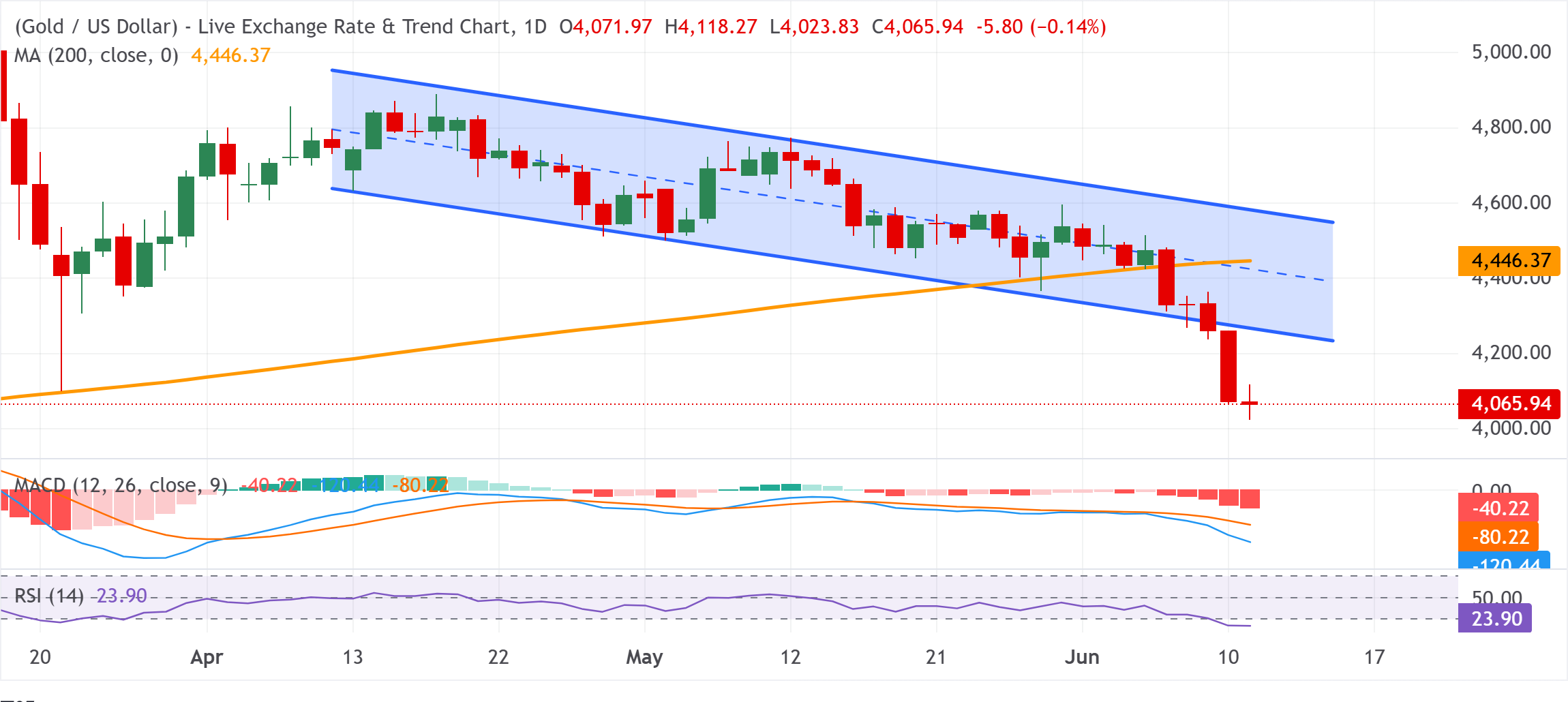
XAU/USD daily chart
Gold might struggle to capitalize on the recover amid a bearish setup
From a technical perspective, the recent breakdown through the very important 200-day Simple Moving Average (SMA) and a downward-sloping channel favors the XAU/USD bears. Moreover, the Moving Average Convergence Divergence (MACD) remains deeply negative, reinforcing the broader bearish tone. However, the Relative Strength Index (RSI) sits in oversold territory, hinting that while downside pressure dominates, the pace of the decline could start to moderate.
Meanwhile, the previous metal might now confront an initial barrier near the descending channel support breakpoint, around $4,257.39. This is followed by the 200-day SMA at $4,446.37 and the channel top near $4,572.06. As long as price holds below these stacked resistance levels, bears retain control, and any recovery is likely to be treated as a corrective move rather than a trend reversal.
(The technical analysis of this story was written with the help of an AI tool.)
Economic Indicator
Producer Price Index (YoY)
The Producer Price Index released by the Bureau of Labor statistics, Department of Labor measures the average changes in prices in primary markets of the US by producers of commodities in all states of processing. Changes in the PPI are widely followed as an indicator of commodity inflation. Generally speaking, a high reading is seen as positive (or bullish) for the USD, whereas a low reading is seen as negative (or bearish).
About The Author