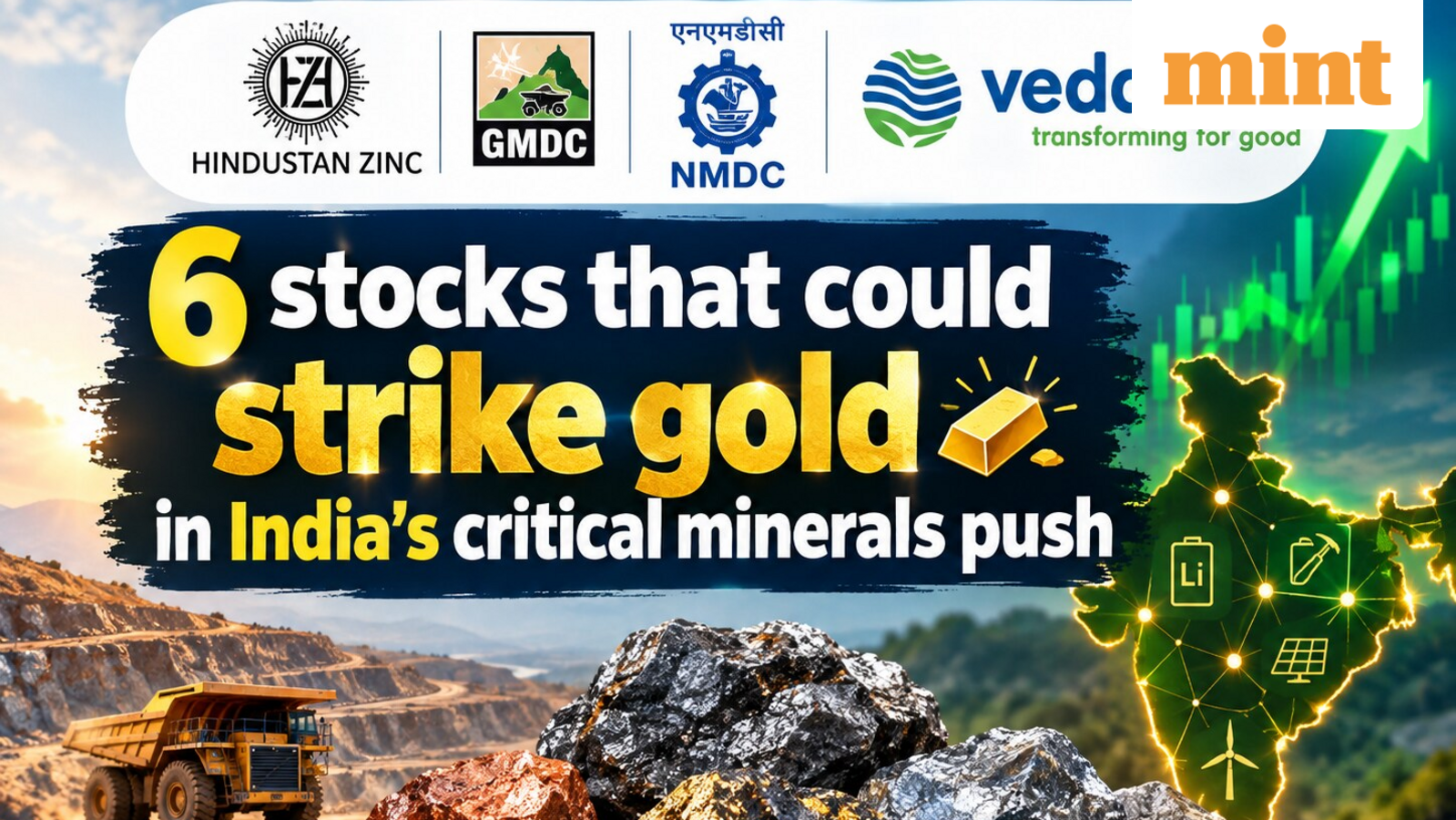
Hindustan Copper, Hindustan Zinc, Gujarat Mineral Development Corporation Limited, and Vedanta are among the top metal companies that may emerge as direct beneficiaries of India’s push for critical minerals. From cell phones to space technology to camera manufacturing, critical minerals have become an increasingly important part of India’s economic growth.
“India’s critical minerals strategy is no longer just policy; it is becoming a multi-decade industrial imperative. Budget 2026 dedicated Rare Earth Corridors across Odisha, Andhra Pradesh, Kerala, and Tamil Nadu, while KABIL is actively securing overseas lithium assets in Argentina,” explained Gaurav Bhandari, CEO, Monarch Networth Capital.
Which stocks are set to benefit from India’s critical minerals push?
“Hindustan Zinc, GMDC, Vedanta, NMDC and Hindustan Copper are among the listed Indian companies best positioned to gain from the government’s critical-minerals and rare-earth drive, including the National Critical Mineral Mission, the ₹7,280-crore rare-earth permanent magnet scheme and dedicated mineral corridors,” stated Santosh Meena, Head of Research at Swastika Investmart.
Vedanta
The Anil Agarwal-led Vedanta offers diversified exposure across zinc, aluminium, and copper but carries higher leverage. Vedanta has secured 10 of the 55 critical mineral blocks auctioned until October 2025. It covers critical minerals such as cobalt, rare earth elements (REEs), vanadium, graphite and potash. Vedanta stock closed 2.7% lower at ₹257.2 per share on BSE with a market capitalisation of ₹1,00,575.18 crore on Tuesday, September 15.
Hindustan Copper
“Among listed players, Hindustan Copper stands out as the strongest fundamental play. It is India’s only vertically integrated copper miner, sitting on a strategic monopoly as copper demand surges from EVs, renewables, 5G infrastructure, and AI data centres,” pointed out Gaurav Bhandari.
Hindustan Copper stock closed 4.34% lower at ₹492.05 per share on BSE with a market capitalisation of ₹47,582.42 crore on Tuesday.
NALCO
National Aluminium Company Limited (NALCO) is also a leading metal player that is likely to benefit from the expansion of India’s critical mineral industry. “NALCO is a close second; its MoUs with NML and BARC for extracting rare earth elements and gallium from red mud could unlock an entirely new revenue stream from what is currently industrial waste,” Gaurav Bhandari noted.
NALCO stock closed 2.79% lower at ₹351.3 per share on BSE with a market capitalisation of ₹64,520.87 crore on Tuesday, September 15.
Hindustan Zinc
“Hindustan Zinc has the strongest near-term case after securing monazite and other critical-mineral blocks and actively diversifying beyond zinc,” says Santosh Meena.
Earlier this year, Hindustan Zinc became one of India’s first private players to secure a rare earth (monazite) block, a land-based, non-radioactive deposit. The company scrip closed 2.61% lower at ₹561 per share on BSE with a market capitalisation of ₹2,37,040.40 crore on Tuesday.
GMDC
Gujarat Mineral Development Corporation (GMDC) will have the most direct rare-earth exposure among state miners and is likely to benefit from active exploration in Gujarat and a low debt balance sheet, according to Gaurav Bhandari.
GMDC stock closed 3.83% lower at ₹553.15 per share on BSE with a market capitalisation of ₹17,590.17 crore on Tuesday.
NMDC
NMDC, though primarily an iron ore company, is diversifying into critical minerals, making it a potential beneficiary of the critical minerals industry expansion. NMDC stock closed 2.13% lower at ₹80.69 per share on BSE with a market capitalisation of ₹70,941.18 crore on Tuesday.
About The Author