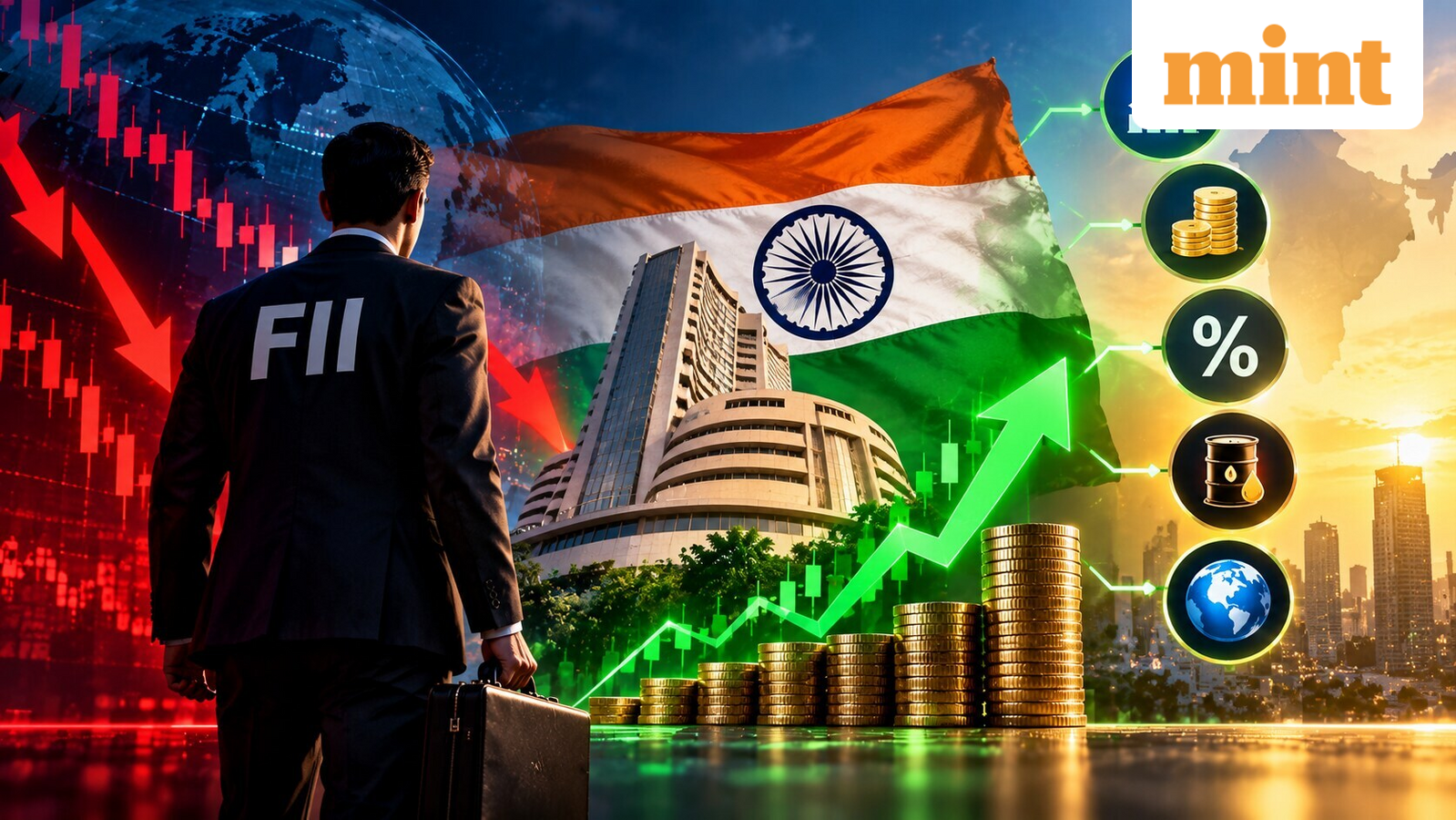
Amid a sharp rise in crude oil prices and elevated US bond yields, foreign institutional investors (FIIs) remained net sellers in Indian equities for the sixth consecutive week.
FIIs have offloaded a net ₹18,531 crore from Indian equities so far in September, while domestic institutional investors (DIIs) have invested ₹52,617 crore during the month. The data underscores the increasing role of domestic institutions in cushioning the impact of sustained foreign outflows.
This week too, the market saw a similar trend, with FIIs offloading over ₹11,490 crore in equities, during 21–25 September.
“If FII selling sustained while global headwinds are likely to keep markets volatile, though steady domestic institutional buying should continue to limit the downside. Market participants will closely monitor Brent crude oil prices, developments in US-Iran geopolitical tensions and US Q2 GDP data as key triggers for market direction in the coming week,” said Pabitro Mukherjee, Deputy Vice President-Research at Bajaj Broking.
Why FIIs choosing to remain net sellers?
Rising US Treasury yields and elevated crude oil prices have led the foreign fund flows. Ponmudi R, CEO of Enrich Money, said the US 10-year Treasury yield crossed 5.10% during the week, tightening global financial conditions and making emerging-market assets relatively less attractive.
Ponmudi added that the sharp increase in FII selling could make a sustained recovery in domestic equities challenging unless global risk sentiment improves and foreign inflows return.
“Oversold conditions and strong DII participation could support intermittent recovery attempts, but a durable improvement in sentiment will depend on stability in crude oil, global yields, geopolitical developments and a moderation in FII selling,” he added.
5 Factors that can bring FIIs back to India
According to market experts, FIIs evaluate global emerging markets through the prism of net post-tax alpha, ease of operational execution, and macro stability.
1] Tax predictability
Seema Srivastava, Senior Research Analyst at SMC Global Securities, believes that Tax predictability remains the primary lever for reversing FII outflows. The hike in capital gains taxes—short-term capital gains (STCG) to 20% and long-term capital gains (LTCG) to 12.5%—alongside applicable surcharges and the Securities Transaction Tax (STT), creates a friction drag that makes peer markets like South Korea or Taiwan relatively attractive.
“To bring institutional capital back, India needs policy stability: grandfathering commitments to eliminate retrospective surprises, rationalizing high surcharge slabs on non-corporate funds, and extending tax concessions for debt and G-Sec investments under the Fully Accessible Route (FAR). Streamlining withholding tax clearances and double taxation avoidance agreement (DTAA) processes would immediately compress frictional trading costs,”
2] Regulatory alignment
Srivastava further said that Regulatory alignment is equally pivotal. Frequent adjustments to beneficial ownership norms, strict look-through mandates for concentrated portfolios, and fragmented reporting across SEBI, RBI, and custodian banks raise compliance overhead.
“A unified digital onboarding window, standardized cross-border KYC, and uniform reporting timelines would lower operational resistance. Harmonizing derivative rules without penalizing offshore hedging structures like participatory notes (P-notes) or IFSC GIFT City setups gives foreign asset managers the flexibility they require to hedge currency and market volatility efficiently,” she added.
3] Market infrastructure and currency dynamics
Srivastava also highlighted market infrastructure and currency dynamics dictate fund flows. Active FIIs seek broader availability of rupee-hedging instruments, higher single-investor stock limits, and deeper corporate bond liquidity.
Meanwhile, Sugandha Sachdeva, Founder of SS WealthStreet, highlighted that a moderation in US yields, greater rupee stability and more attractive Indian equity valuations would improve India’s appeal.
4] Global competitiveness
India is also competing for global capital with markets such as Taiwan and South Korea, which have benefited from the AI and semiconductor investment cycle. If that trade becomes less concentrated, some capital could diversify towards India.
“To retain it over the longer term, Indian companies will need to build greater global competitiveness in semiconductors, batteries, energy storage and deep technology, alongside their existing strengths,” Sachdeva said
5] Global factors
Sachdeva further said that India’s growth story is intact, but growth alone may not bring FPIs back immediately. Sustained earnings momentum, more reasonable valuations, a stable rupee and a decline in the oil and US yield backdrop would make a durable return of foreign flows more likely.
Disclaimer: This story is for educational purposes only. The views and recommendations above are those of individual analysts or broking companies, not Mint. We advise investors to check with certified experts before making any investment decisions.
About The Author