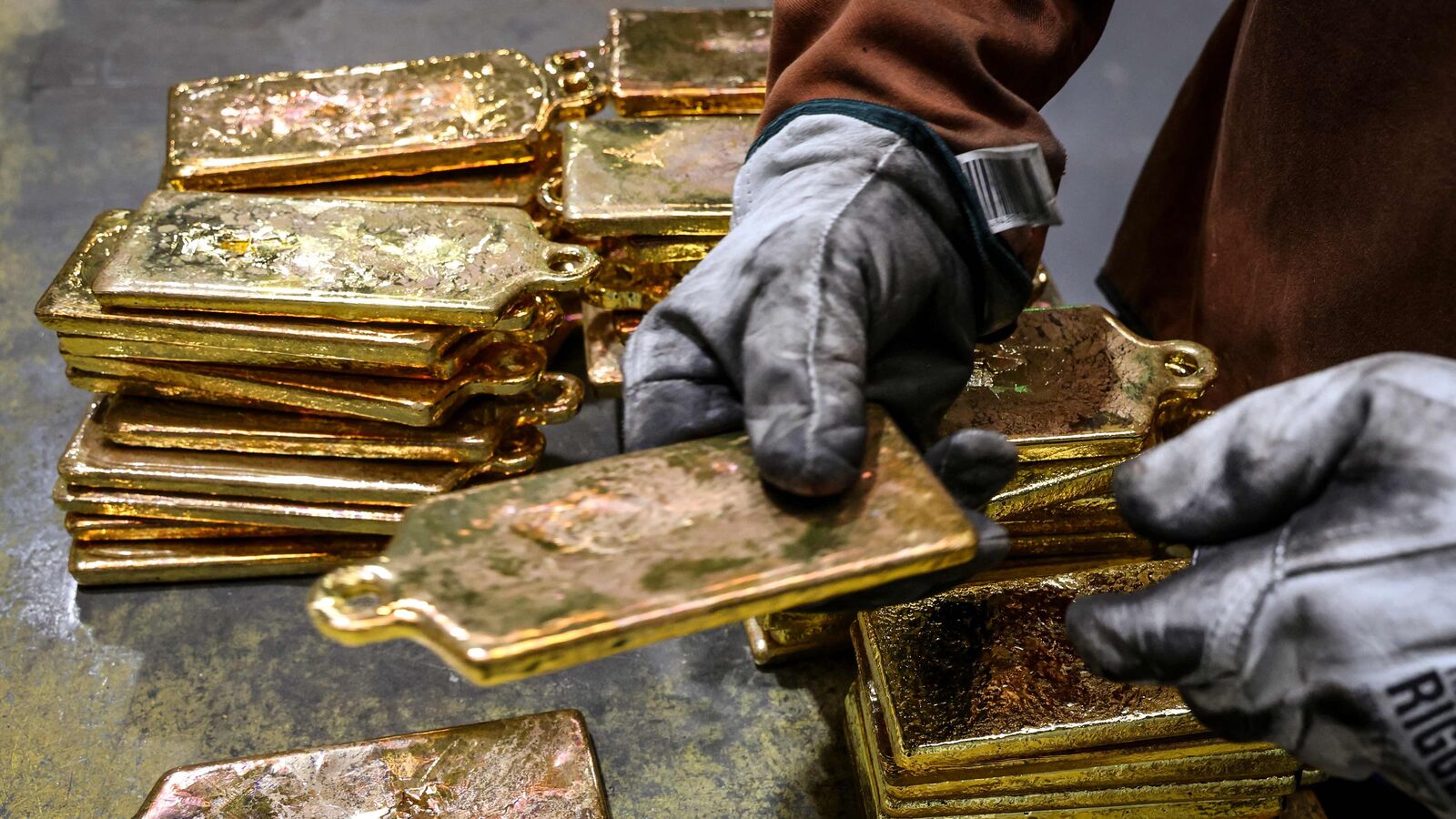
The pace of accretion is higher than that of most other nations facing US tariffs, according to a Mint analysis of data by the World Gold Council (WGC). As of June, 13.1% of India’s total reserves worth $711 billion were in gold, compared with 9.6% a year earlier.
Only the Philippines, which is facing a 19% tariff, comes close with 12.9% gold in total reserves as of June, up from 9.4% in the same month last year. The US has imposed 50% tariffs on India, including a penalty for buying Russian oil.
For China, with a 30% US duty, gold accounts for 6.7% of its reserves. However, India’s aggregate 880-tonne bullion reserves valued at $93 billion are much smaller than China’s 2,298.5 tonnes of gold worth $242.9 trillion, according to the WGC.
Reserve Bank of India (RBI) was the third-largest buyer of the yellow metal in 2024 at 72.6 tonnes, behind Poland’s 89.5 tonnes and Turkey’s 77.4 tonnes. Global central banks increased their gold buying as Russia’s invasion of Ukraine triggered geopolitical tensions. The pace picked up as Donald Trump unveiled his protectionist agenda during his campaign to be reelected as US president after a four-year gap.
Gold buying at three-year high
India’s purchases of the yellow metal last year were the highest since 77.5 tonnes in 2021. The biggest yearly accretion happened in 2009 when the country bought 200 tonnes from the IMF.
“This diversification has ended up being the smartest move by the central banks with gold hitting a record high again on 9 September,” said Shekhar Bhandari, president, Kotak Mahindra Bank. Bhandari expects gold prices to be almost topping out at current levels of $3,600 an ounce and sees the metal consolidating for the rest of this year.
However, according to the World Gold Council, the country’s gold buying fell to 3.8 tonnes in the first six months of 2025 compared to 37.1 tonnes a year earlier. This can be attributed to record-high prices, with the average cost surging 40% year-on-year to $3,073.39 per ounce (roughly 31.1 gms). That compares with the average purchase price of $2,205.86 an ounce in the first half of 2024.
Gold scaled another all-time high of $3,674.267 an ounce on Tuesday.
China, Turkey, Poland, and India have emerged as the leading gold buyers since 2022, said Soni Kumari, commodity strategist at ANZ, adding that China alone bought 352 tonnes of gold since November 2022 and has continued building its reserves for the last ten straight months.
“While the backdrop for central banks’ gold stockpiling remains strong amid intensifying geopolitical tensions, waning trust in US assets, and rising sanction risks, total central bank purchases moderated to 415 tonnes in H1, 21% lower year-on-year,” said Soni Kumari, commodity strategist at ANZ.
Kumari said that the moderation may be tied to several countries reaching their targeted gold-to-reserves ratios, as higher gold prices have sharply increased the gold’s reserve share.
Russia’s experience
Others pointed to Western sanctions on Russia following its invasion of Ukraine as the trigger for the diversification of dollar assets. Reuters reported in December 2023 that about $300 billion of sovereign Russian assets were frozen and Russian banks were prohibited from accessing Swift, a secure global wire transfer messaging platform.
The removal of Russia from the international payments system has resulted in global central banks de-risking themselves by diversifying their assets, one of the means being through gold,” said Sujan Hajra, chief economist at Anand Rathi group. “While the diversification through gold might slow because of the steep jump in prices this year, the quantum of buying could hinge on how the geopolitical situation evolves from here.”
The Indian official holding of US treasuries as a percentage of global central bank holdings has remained at around 6% and is likely to be around that level as other global central banks reduce purchases of them, Hajra said.
Meanwhile, finance minister Nirmala Sitharaman told CNBC TV18 last week that the Reserve Bank of India (RBI) has already started diversifying from US Treasuries to some extent.
As of June, India held $227.4 billion in US Treasury notes, a 6% dip from the previous year, according to data from the US Department of Treasury. China cut back its Treasury holding by 3.1% to $756.4 billion. Brazil, which faces 50% tariffs like India, too, has reduced these holdings by 5.2% to $215.3 billion.
Diversifying away from the dollar
Experts said the US dollar’s status is being challenged by a volatile administration, a rating downgrade, and fiscal concerns in the US.
“Since the start of the year, there has been a discussion around policy flip-flops in the U.S., impact of tariff hikes on the economy, and of course, the start of another round of Fed rate cut cycle driving weakness in the dollar,” said Kanika Pasricha, chief economic advisor, Union Bank of India. The weakness led to questions on cracking of the dollar hegemony crown, although “dollar is the only game in town”, she said.
The dollar, commanding a 47.9% share in global payments in July, has seen a slight increase in usage over the past year, according to data from Swift. However, the usage of the Chinese Yuan slipped 186 basis points (bps) to 2.88%.
About The Author